

Between the 1960s and the 1990s, during the meteoric rise in wealth and living standards of the post-World War II era, America became obese. Rates of obesity doubled in adults, and quadrupled in children. And severe obesity, where a person’s body weight exceeds their ideal weight by 100 pounds or more, increased by a factor of three. So much was changing so rapidly in those years that determining a single primary culprit for the trend is difficult. Was it the emergence of various new additives and ultra-processed foods? The flight of women from the household kitchen to the professional workforce? The decline of more physically demanding forms of employment? Perhaps it was also an unintended consequence of the rapid decline of the country’s favorite appetite suppressant: cigarettes. Regardless of its origins, the scourge of obesity has shortened lives and overwhelmed the healthcare system.
In Off the Scales: The Inside Story of Ozempic and the Race to Cure Obesity, author Aimee Donnellan explores how obesity has now encountered its first major headwinds. She reveals the opportunities and dangers inherent to the widespread use of Ozempic and other weight-loss drugs, and how the future of this breakthrough is far from certain.
The story of Ozempic goes back many decades. Glucagon, a peptide hormone that regulates blood sugar in the body, was first discovered in the 1920s. In the 1970s, Svetlana Mojsov, a young immigrant from Yugoslavia conducting research at Rockefeller University, wondered if GLP-1, a related hormone derived from the gut, might be used to treat diabetes. Mojsov was able to create GLP-1 synthetically in a lab and spent the better part of the 1980s racing toward proof of concept as other researchers, including the University of Copenhagen’s Jens Juul Holst, were vying for the same lucrative prize. In 1992, the Danish pharmaceutical giant Novo Nordisk bought the patent rights to GLP-1 from Mass General’s Joel Habener, a colleague and co-author of Mojsov’s, instigating a legal battle to claim her share of the patent royalties.
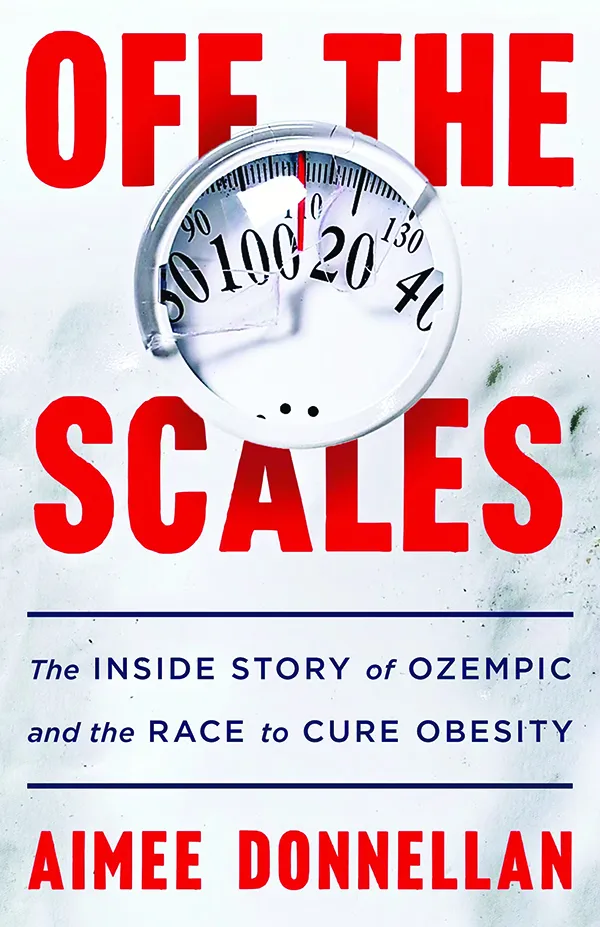
The intrigue and scientific rivalry that consumes the first part of Off the Scales flows smoothly into a broader exposé on the inner workings of the pharmaceutical industry and the broader social implications of GLP-1 drugs such as Ozempic. In illuminating the long and arduous pipeline for new drugs, from research and development, regulatory trials, marketing, and the post-approval minefield of unforeseen side effects and massive torts, Donnellan captures the brutal toll the process can take on even the largest and most sophisticated firms. One can almost feel a flicker of sympathy for Big Pharma. The stakes are ruinous, but payoffs can be spectacular, and Novo Nordisk’s windfall on Ozempic was large enough to distort the Danish housing market.
Ozempic is the brand name for semaglutide, which was developed when Novo Nordisk attached the GLP-1 molecule to a fatty acid to prevent its breakdown in the body. The result was a weekly jab to treat type 2 diabetes, unanimously approved by the FDA in late 2017. There were two notable side effects: nausea and weight loss. Novo Nordisk also developed an obesity-focused GLP-1 drug, Wegovy, “essentially a higher dosage of Ozempic,” which revealed a remarkable average weight loss between 17% and 18% of total body weight during a trial among 3,000 volunteers.
After the adman Jeremy Shepler adapted Pilot’s 1974 hit “Magic” for an Ozempic commercial in 2018, the diabetes drug reached $1 billion in U.S. sales within 18 months, overtaking Viagra to become the fastest drug to ever reach that milestone. But it wasn’t until February 2021, when the New York Times wrote about its weight loss effects and Dr. Mehmet Oz issued an “Oz Alert” about the drug, that Ozempic really took off in popular culture. That summer, the public took notice, creating an Ozempic and Wegovy shortage and putting “the body positivity movement into a coma.”
Off the Scales takes a determinedly personal approach to the subject matter, featuring a wide range of case studies and attestations that emphasize the incredible upside offered by Ozempic and competing products, and the sometimes-horrifying consequences of the weekly jab. We learn about Sarah, an overweight employee at a marketing firm in Michigan whose encounter with Wegovy set off a chain of good fortune, leading to promotions, multiple pay raises, 100 pounds of weight loss, and a new hobby in the form of marathon running. On the opposite end of the spectrum, there is Emily, a Canadian schoolteacher pushing 300 pounds, who found Ozempic in 2018 after a doctor diagnosed her with type 2 diabetes. This led to dramatic weight loss, but with a formidable chaser: Emily developed a condition that led to years of extreme vomiting, eventual gastric paralysis, and ultimately forced her to stop working entirely.
PETER MATTHIESSEN, MYSTICAL RENAISSANCE MAN
As a work of reportage, Off the Scales does a wonderful job of explaining the origins of Ozempic and other GLP-1 drugs and their dramatic impact on society. But one cannot help but feel that the saga has only just begun. At upwards of $1,300 a month (though often less with rebates, and with prices reportedly set to fall due to President Donald Trump’s recent deal with the manufacturers), prescriptions are tricky to insure and “well beyond the reach of many obese patients, who tend to be lower income.” There are now a number of improved GLP-1 drugs in the works, including in pill form. When the U.S. patent on semaglutide runs out in 2031, cheaper generic alternatives will certainly democratize the playing field.
In 1950, fewer than 10% of Americans were clinically obese. By 2016, the Milken Institute estimated that obesity was costing the American taxpayers $1.4 trillion each year. David Ricks, the CEO of the pharmaceutical company Eli Lilly, which makes Zepbound and Mounjaro, believes that in time, more than 20% of Americans will eventually use these drugs. There’s growing speculation that the GLP-1 family of drugs could treat other conditions such as alcoholism, drug addiction, and even criminal violence. So what do Ozempic, Wegovy, and their kin mean for society? Today, a “cure” has arrived, and Off the Scales captures the enormity of that moment. The question now is whether these drugs can actually make the country healthier and not just thinner.
Carson Becker is an American writer.
