

Attendees of the 48th annual Kennedy Center Honors ceremony were treated to the increasingly uncommon experience of witnessing President Donald Trump in his natural habitat: show business.
Dressed in a tuxedo with first lady Melania Trump alongside him on the red carpet, the former TV star and media mogul seemed genuinely mirthful and relaxed as he spent 20 minutes taking questions before going backstage.
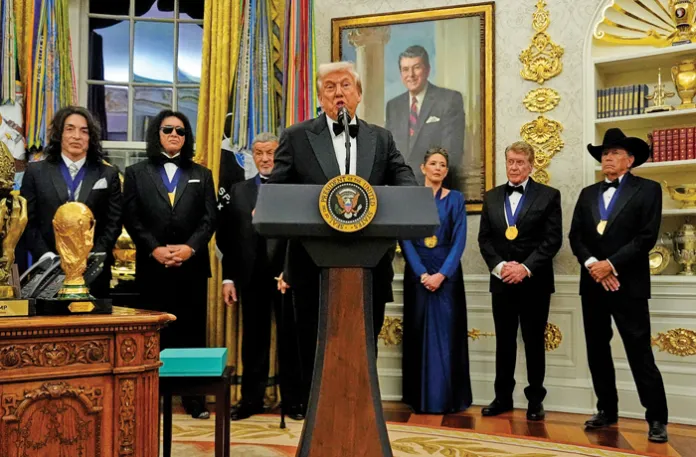
Trump was the first president in history to host the ceremony, having reaffirmed the event’s exclusive broadcast deal with CBS. The mantle of “host” was not a token gesture — the president offered a multipart stand-up routine somewhere between Johnny Carson and Don Rickles, whom he shouted out as inspirations.
“If there is one thread that connects all of these amazing artists together, it is the word ‘persistence,'” the president told the crowd, which consisted of entertainers, political operatives, and members of the media. “I can say that with a lot of the members of our audience — I know so many of you, and you are persistent. Many of you are miserable, horrible people. But you are persistent, you never give up. Sometimes I wish you’d give up. But you don’t.”
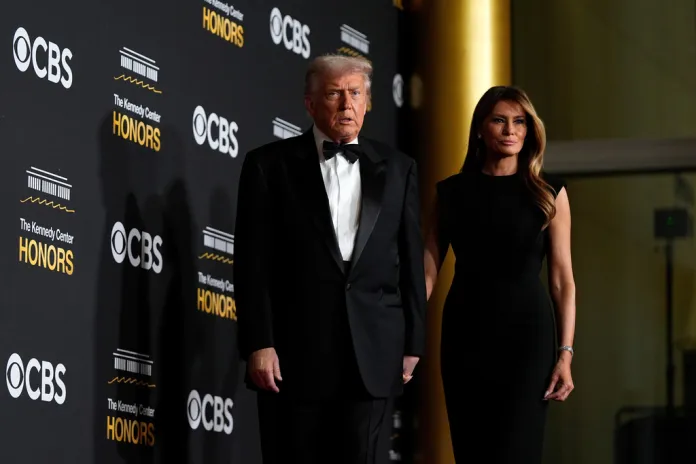
Five artists were honored at the event: Country music star George Strait, disco queen Gloria Gaynor, Broadway legend Michael Crawford, filmmaker Sylvester Stallone, and seminal rock group Kiss.
But supporters and detractors agree. At the Kennedy Center, Trump was the star of his own show.
“I guarantee the fake news is going to give me horrible [reviews],” Trump said. “‘He was horrible as an emcee. Don’t ever let that happen again. Don’t ever let it happen.’ But I guarantee you one thing, we get big ratings tonight.”
Despite the jabs at Washington’s elite, Trump took several shots at himself, encouraging those who might not be fans of his administration to focus instead on the honorees, who he boasted were “among the greatest artists and actors, performers, musicians, singers and songwriters ever to walk the face of the Earth.”
Attendees curious to study the art of Trump’s improvisation in public speaking needed only to look behind them at the massive teleprompter, which paused and accelerated to keep up with a script the president seemed to treat as more of a suggestion.
Reflecting on the death of Kiss lead guitarist Ace Frehley, Trump recalled seeing the musician’s daughter cry in mourning. He praised her tears as proof of love for her father before abruptly riffing, “I usually see people who don’t cry — they couldn’t care less!”
Trump is not shy about his outsize role running the Kennedy Center, having launched a takeover earlier this year by terminating the board and installing himself as chairman. He had direct input whittling the dozens of candidates, some of whom he found too “woke,” down to the five honorees.
Roma Daravi, vice president for public relations for the Kennedy Center, boasted of the institution’s efforts to offer “something for everyone” at a time when “American culture is under attack.” She told the Washington Examiner that she wanted a bigger emphasis on family-friendly programming so parents didn’t have to “worry about covering their children’s eyes” at shows.
Trump has expressed disgust at various performances hosted at the Kennedy Center in recent years, such as & Juliet, an LGBT-inspired retelling of Romeo and Juliet that the president dismissed as “all-lesbian Shakespeare.”
In March, a contract worker with the Kennedy Center made headlines with a video of himself reading a protest poem about Trump having “taken over” the institution — delivered while nude on his bed. Daravi said at the time that the video was “extremely disturbing, considering this individual worked with minors.”
In this spirit, the word “commonsense” was invoked frequently on the red carpet to describe the tone for the Kennedy Center moving forward.
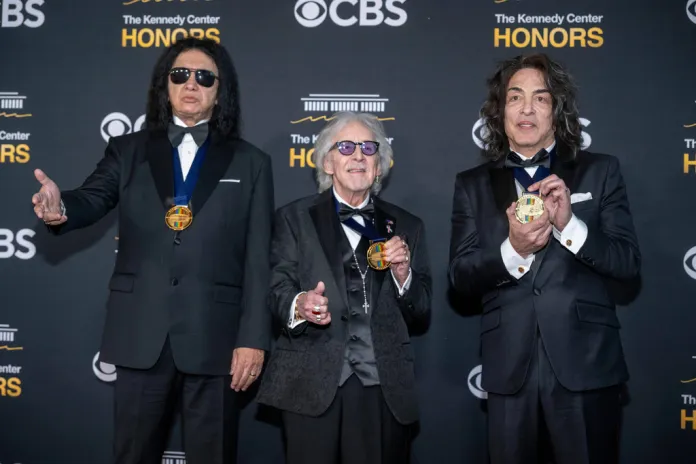
Kiss bandmates Gene Simmons, Paul Stanley, and Peter Criss were treated as the honorees’ first among equals.
Stanley, who previously called Jan. 6, 2021, Capitol rioters “terrorists” and accused Trump of being “incendiary and abhorrent” in his first term, took an apolitical yet patriotic tone about the evening, calling himself proof of the American dream.
He praised the Kennedy Center’s approach of honoring artists with broad popular appeal across the country, saying that “sometimes the East and West Coast forget that there is a middle ground to America and that the country is made up of diversity.”
“Looking down your nose at one performer because they don’t reach your criteria is contradictory to what the arts are supposed to be,” Stanley told the Washington Examiner. “It’s important for people to open their ears, open their eyes, and shut their mouths.”
Criss, remarking that he is about to be 80 years old but felt 25 again, seemed entirely uninterested in politics as he gushed about the “greatest honor of our career” and his treatment since arriving in Washington.
“I met a curator from the Smithsonian — I’m a big history kid — so I’m donating my cross that I wore for 50 years, and they’re over the moon about it,” the former drummer told the Washington Examiner. “I’m a big [Abraham] Lincoln guy, so I said ‘Can you put it near Lincoln’s [belongings]?'”
Simmons had the sharpest tongue. When a reporter attempted to quote the singer’s past criticisms of Trump, he rebuked her for trying to “put words in [his] mouth.”
“You’re doing clickbait there,” he told the reporter. Asking if she had a romantic partner, he added, “Do you agree with everything they say? Are you critical sometimes? So, why don’t I start the questions by saying ‘Oh, you criticized your husband, why are you staying together?'”
Simmons’s sparring session with the press, which lasted so long that his wife, Shannon Tweed, eventually walked away from the encounter in exasperation, culminated with a lecture against “yellow journalism, which is bulls*** journalism, which is leading the witness.”
Asked by the Washington Examiner to comment on the Kennedy Center’s efforts to choose honorees that resonate with the broadest majority of people, Simmons said it “doesn’t suck” to be included in such a group.
“When my mother and I came to America as legal immigrants, just stepping onto the grounds here where nobody … was trying to kill us just because we spoke with an accent or weren’t from here or didn’t look like anyone else — you win,” he told the Washington Examiner. “Because if I would have gotten off the plane in North Korea or Africa, that wouldn’t be the case, would it?”
Even if the ceremony was intended to put the spotlight on the arts, red carpet appearances by officials such as White House deputy chief of staff for policy Stephen Miller and War Secretary Pete Hegseth made it difficult not to think of politics.
Television star and magician Criss Angel, who joked that he was “definitely not one you would think of at the Kennedy Center Honors,” voiced his nostalgia for a less politically charged era.
“I remember the days of President Reagan and Tip O’Neill,” he said. “They would disagree all day long, but they would go hang out. They were good buddies. They would have a drink together. That was the wonderful thing at that time about our country is that you could have a difference of opinion and still respect and love each other.”
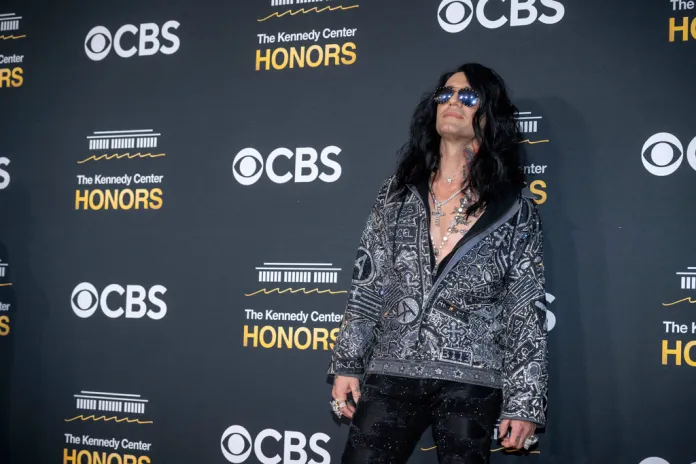
“I don’t care if you’re right-wing, left-wing, I don’t care what you are,” he continued. “I have my beliefs, but I won’t put it on people — unless we’re having a conversation. I always want to leave there hugging and respecting each other and loving each other.”
TRUMP DINES WITH SMITHSONIAN DIRECTOR AMID PUSH TO REMOVE ‘DIVISIVE’ NARRATIVES FROM INSTITUTION
Photography was strictly prohibited during the event itself, with the Washington Examiner observing one attendee threatened with removal by security if caught a second time.
Production was impeccable, boasting special effect lighting that pulsed with the disco anthems, swelled with melancholic ballads, and exploded with electric guitar.
As the Kennedy Center promised, the lineup offered something for everyone. A slew of guest artists performed covers of honorees’ classic songs, including Garth Brooks, Vince Gill, Miranda Lambert, Brooks & Dunn, Elle King, and more.
Action movie legend Kurt Russell regaled the audience with memories of breaking his body to star alongside Stallone, while actor Kelsey Grammer expressed his admiration for Crawford with a short show tune.
Trump watched it all from his box seats in the mezzanine, joined by the first lady, House Speaker Mike Johnson (R-LA), the honorees, and other VIPs. Beneath his section, a presidential seal was hung like a royal coat of arms.
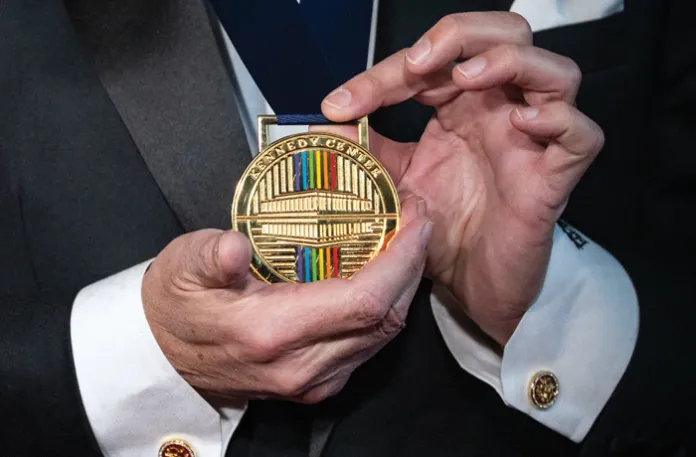
media in Washington, D.C., Dec. 7, 2025. (Bonnie Cash/UPI/Newscom)
In a moment of levity during one of his monologues, the president acknowledged that many of the performers and presenters “probably don’t like me very much.”
“But all I know is they’re big, right? We want bigness” he said. “We don’t care if they like Trump — we want bigness, right?”
It was a telling joke.
While much has been made of a “vibe shift” in popular culture that makes associating with conservatism almost safe for celebrities, the inner sanctums of the music and film industries still see Trump and his crowd as a toxic association for their talent.
Just last week, Sabrina Carpenter called the administration “evil and disgusting” for using her song “Juno” in a video about deporting illegal immigrants.
“Do not ever involve me or my music to benefit your inhumane agenda,” the bestselling pop star wrote on X.
Any established entertainer’s presence in the same room as Trump carries an air of rebellion — as if you’re catching them somewhere they are not allowed to be.
The Kennedy Center Honors did not feel like a glamorous Hollywood gala with the current crop of top stars, such as Taylor Swift, Chris Pratt, or Sydney Sweeney. But when you’re honoring artists for their longevity and consistent quality, you don’t need to be cutting-edge.
MAGAZINE: THE COMMONSENSE REVOLUTION AT THE KENNEDY CENTER
As the night wrapped up with a performance of the Kiss anthem “Rock and Roll All Nite” by guest stars Cheap Trick and the audience jumped to its feet, the normally stoic Melania Trump could be seen dancing alongside honorees on the mezzanine.
It’s impossible to tell whether the energy will translate to the small screen when the taping airs on Dec. 23, but for one night only, guests were treated to an absurd, electric spectacle that only Trump could arrange.
Timothy Nerozzi is the foreign affairs reporter for the Washington Examiner.
