

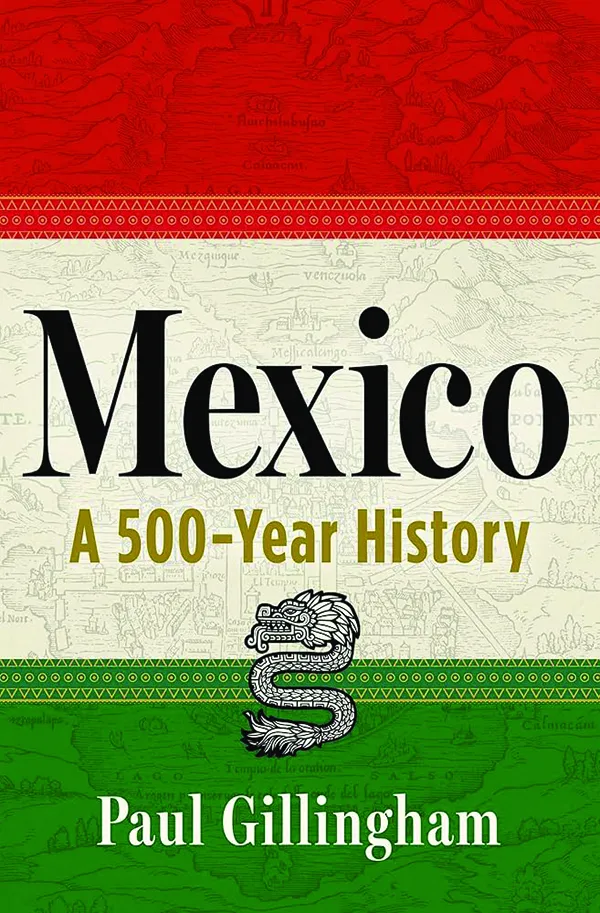
“Poor Mexico. So far from God, so close to the United States.” The famous words attributed to eight-term Mexican President Porfirio Díaz have often been repeated to describe the country he ruled as a de facto dictator for 30 years. They are also a fair summary of the story told in Paul Gillingham’s sprawling new work, Mexico: A 500-Year History.
To the average American reader, our southern neighbor is something of a mystery. In yellow-tinted film scenes and wistful country music lyrics, Mexico is a place apart, something distinctly different from the U.S. Except when some crisis bubbles up into the international news, or when Mexico’s problems leak across our all-too-porous 2,000-mile border, Americans tend to forget about it, just as we forget about Canada and the rest of the world.
But for those curious about Mexico, Gillingham’s 700-plus-page book provides a quick-paced and readable introduction to the nation’s history, beginning with the first contact between Spaniards and natives in the early 16th century.
Gillingham tells the story of a nation that developed from the start as a hybrid culture. Unlike the more sparsely populated parts of the New World to the north and the far south, the land that became Mexico was home to a dense, partly urbanized population of natives. Moreover, unlike the English settlers who would settle in New England a century later, the expeditions to New Spain were almost entirely male. The inevitable result, of course, was intermarriage and interrelations with the people they conquered and the rise of a mestizo population that would come to occupy places in every stratum of the developing Mexican society.
Which is not to say that natives were especially well-treated, any more than the black slaves who soon joined them in Mexico’s labor force. But the weight of their numbers, combined with the fact that some groups oppressed by the dominant Aztecs — most notably the Tlaxcalan people — joined the conquistador Hernán Cortés in conquering Tenochtitlan, meant that they shared in the victory that established Spanish hegemony there. The favoritism the Spanish crown would come to show for Spanish-born whites — peninsulares — in colonial government meant also that whites born in Mexico — criollos — began to have more in common with non-whites in Mexico than they did with their relatives back in the old country.
While Mexico may be “far from God” in Díaz’s formulation, it has never been far from the church. The initial impetus for the Spanish conquest included the usual colonial quests, second sons of minor nobility seeking fame and fortune in the New World because the Old World’s opportunities were too few. But they also included a genuine belief among many clergy and laity that spreading the Gospel was desirable — even necessary.
The clash of religions, Spanish Catholicism versus the human sacrifice of the Aztecs, was a major conflict in early Mexico — one which was not amenable to compromise or half-measures. The religion of Christ could not exist side-by-side with that of Huītzilōpōchtli, and the Spanish cast down the Great Pyramid and built their cathedral among its ruins. The conversion of the natives was surprisingly quick, led in part by the 1531 vision of the Virgin of Guadalupe.

Gillingham suggests that the apparition may have been a form of syncretism, perhaps a repurposing of the native mother goddess, Tonantzin, but acknowledges the popular appeal of this new “form of indigenous sainthood.” Appeals to the Virgin of Guadalupe continue through Mexican history — some of the earliest rebels for independence displayed banners of her, perhaps in contrast to the atheistic French Revolution that was sweeping Europe. Battles between the church and secular liberals continued throughout Mexican history, culminating in an uneasy truce following the Cristero War of the 1920s, during which the Mexican Constitution severely proscribed the Catholic Church’s role in public life, but the state learned not to push that too far in rural areas.
The second half of Díaz’s epigram, “so close to the United States,” is also a theme in Gillingham’s telling. In contrast with the fairly balanced explanation of Mexico’s colonial period, the author singles out Americans for harsh criticism throughout. Calling the America of the 1840s a grouping of “slave societies marked by Manichean racism and endemic vigilantism,” full of “genocidal” rhetoric and “messianic nationalism,” he leaves no doubt of his opinion of the U.S., applying historical judgment far harsher than even that leveled at the Aztecs — a society literally built on human sacrifice.
It is easy to paint such opinions as “woke” 21st-century revisionism. But it is not all just trendy, academic anti-Americanism. Even at the time of the Mexican-American War, many in the U.S. believed their own nation to be acting unjustly. Abraham Lincoln, then a Whig congressman, cast doubt on the reasons for the war. Ulysses S. Grant, who fought in Mexico under General Winfield Scott, later called the war “one of the most unjust ever waged by a stronger nation against a weaker nation.”
MAGAZINE: HOW TYRANNICAL GOVERNMENTS’ MONEY MADE AMERICAN CAMPUSES AUTHORITARIAN
The criticism is just, but later interactions between Mexico and the U.S. are not so one-sided, nor are all of Mexico’s problems attributable to its northern neighbor. American wealth and power did extend into Mexico, for both good and ill, but foreign investment (and the political power that comes with it) is a factor in all developing nations. If the power and money of the U.S. had been absent — as it was during the American Civil War — that vacuum would have been filled by European power and money, as it was when the French imposed a Habsburg princeling on the Mexican people as their emperor.
America played a larger role in Mexican history than Mexico played in American history, and one that is viewed by many Mexicans as a negative one. But while American readers will focus on those points and might quail at the disparagement of their own people, this book remains, for the most part, a useful guide to the history of that still-mysterious land of 130 million people just across the Rio Grande.
Kyle Sammin is the managing editor of Broad + Liberty.
