

When President Donald Trump roared to victory in 2024, conservatives told themselves a number of just-so stories. Biden-era profligacy had driven the Democratic Party into its grave, leaving MAGA Republicans to plot America’s future alone. Former President Barack Obama’s “coalition of the ascendant” had permanently splintered. Most importantly, wokeness was spent as a cultural force. From now on, surely no one would insist that men could become women, that racism lurked behind every rock and tree, or that right-leaning speech ought to be muzzled.
Alas, someone forgot to tell the country’s undergraduates. In October 2025, the Foundation for Individual Rights and Expression conducted a nationwide survey of 2,028 college students, including an oversampling of students at Utah Valley University, the site of the Charlie Kirk killing a month prior. The findings, released in early December, make for a harrowing read and duly rocketed through the news cycle. According to FIRE’s widely shared summary of its data, 9 out of 10 undergraduates believe the self-evidently absurd claim that “words can be violence.” Tallied in a particular way, the figures also seem to reveal that 79% think “silence is violence.” Such irrational attitudes, it would appear, give the lie to assertions of wokeness’s demise.
What are we to make of these terrible numbers? For starters, and with respect for FIRE’s deservedly good reputation, we might push back against them a little. The “9 out of 10” figure, for instance, adds up only if one includes those respondents who “somewhat,” 28%, or “slightly,” 15%, agree with the “words can be violence” claim. Nevertheless, journalists from Reason to UnHerd to Minding the Campus uncritically quoted FIRE’s math. Nor is the 79% “silence is violence” mark quite as bad as it initially looks. As FIRE’s own executive summary makes clear, only 29% of students “mostly” or “completely” assent to that lie.
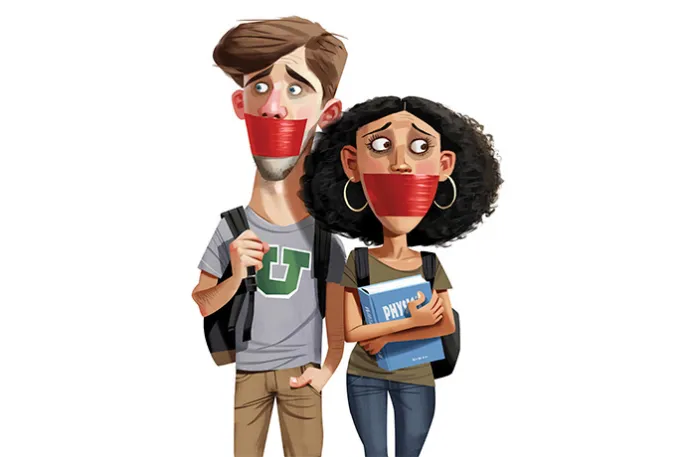
It is also the case that college campuses are where social science goes to die. As every pollster knows, social desirability bias is the specter haunting all survey attempts, provoking respondents to choose the answers they think others will applaud. Callow undergraduates have some of the least developed defenses against that peer pressure and know perfectly well which slogans they’re meant to parrot. Moreover, having been around college students for more than a quarter-century, I can attest that they are fans of the outrageous, to quote one of my own university pals. For every respondent meekly bowing to the perceived majority, another may well be trying to irk the adults in charge.
We might ask, too, the question that ought to attend every survey finding: And so what? At the extreme end, conflations of speech and deed can lead to “countermeasures” that shock the conscience. Kirk’s alleged killer presumably thought his victim’s “violence” warranted violence in return. Yet few would argue that 90% of college students are potential murderers or have anything like the courage of that depraved conviction. A safer bet is that, believing what they claim to think about speech, they are overwhelmingly going to vote for Democrats. But that is likely going to happen in any case, at least until adult realities shake many of them out of it.
It is possible, in other words, to overread FIRE’s data. However, that doesn’t mean that we can safely ignore the illiberalism of the American campus. In the aftermath of the Kirk shooting, the percentage of students confusing speech and violence ought to have been zero. A broad daylight assassination should, if nothing else, illustrate the limits of political abstraction. To put it another way, the “speech is violence” canard is exactly the sort of fuzzy, lecture hall daydream that turns to mist in the presence of an actual bullet. If students can be so wrong mere weeks after an incontrovertible demonstration of the truth, then they are lost indeed.
Worse, they may not be recoverable. Among FIRE’s discoveries is the fact that students learned precisely the wrong lesson from the September tragedy. “Because of what happened to Charlie Kirk,” significant percentages of undergraduates are now “a great deal,” 19%, or “slightly,” 26%, less comfortable “expressing [their] views on a controversial political topic during an in-class discussion.” Only 11% are now “slightly” or “a great deal” more comfortable. The numbers are similar when the “discussion” is moved to the quad, dining hall, or onto social media. Rather than redoubling, or inventing afresh, a commitment to civil discourse in the wake of political murder, college students are retreating further into their shells. And perhaps for good reason. Of the 28% of respondents who think it “always,” “sometimes,” or “rarely” acceptable to use violence “to stop a campus speech,” 7% are in favor of employing murder. That figure theoretically represents almost 300,000 undergraduates nationwide.
As previously stated, I have very strong doubts that any meaningful percentage of degree-seekers will one day take the lives of their political opponents. Yet the implication that they might like to do so is chilling. In the long run, it is impossible to maintain a civil society if ideological disagreements carry the threat of death. To name just one historical example of many, Japan’s prewar culture of assassination was a significant driver of that nation’s slide into militarism. We are not there yet. Pray God we never will be. However, the warning lights are flashing red. A country riven by intractable disagreements can muddle through. A country in which each side fears for its literal safety is doomed.
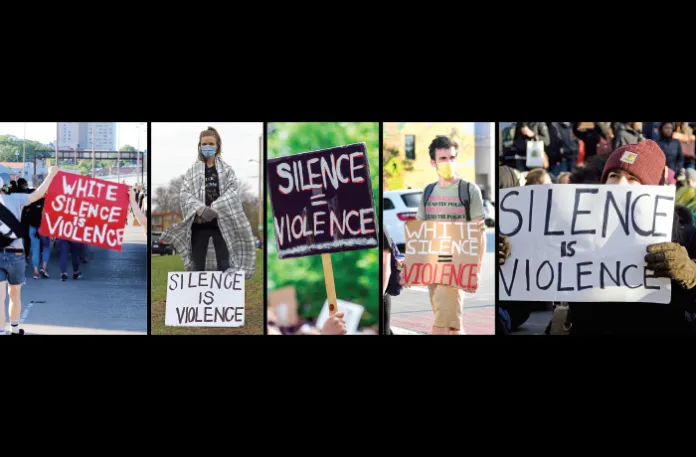
There is a final reason, too, that FIRE’s statistics are so appalling. If political speech counts as violence, then those with provocative views can simply grimace and hold their tongues. Such a dispensation would be a disastrous betrayal of American values, but we could, as a people, limp along. If, on the other hand, a refusal to echo leftist talking points is itself beyond the pale — “silence is violence” — then we are no better than Maoist China. We are Stalin’s Russia, and the first man to stop clapping is condemned. To keep me from saying what I believe is an abomination, but one that groups me with many, if not most, of the human beings who have ever lived. To require a lie is a special kind of evil. That even a few college students would do so represents a vast institutional failure.
How might we begin to correct it? Let me say from the start that a full cure will require spiritual and psychological renewal across the nation. Political remedies will be half measures at best. Nevertheless, it is possible to exert the right pressures and take the right actions — and in so doing to ameliorate the very worst of what FIRE has found.
To begin with, we should recommit to the slow, hard work of higher-education reform, school by school and state by state. Although splashy one-offs such as the Trump higher education “compact” can usefully focus attention, they are no substitute for the workaday business of educating voters, legislators, and boards. Among the major triumphs of the reform movement in recent years has been a renewed sense, at both the state and federal levels, that American universities are beholden to the public. Happy progress has been made, too, on curricular reform; institutional neutrality; freedom of speech, if not the willingness of students to use it; and admissions fairness.
These are not unrelated bites at the apple. Rather, they substitute, in their fullness, one vision of higher education for another. The university of the reformers’ hopes is curious, open, meritocratic, and responsive to the nation it serves. The status quo college, meanwhile, is esoteric, exclusionary, and radical. Instead of challenging received orthodoxies, it jealously guards them.
It is not difficult to imagine the kind of student that each institution might produce. Matriculants at status quo colleges read narrowly, chant sanctioned refrains, and find disagreement sinister and daft. Students at reformed universities speak civilly, search far and wide for truth, and have a foot in both the future and the past. To be sure, what college students believe is a function of what sort of people we bring to college. It is also a consequence of how we teach them once they arrive.
Yet even if reformers achieve no other victories ever, it will still be possible to curb the worst excesses of the “speech is violence” crowd. The answer, though difficult enough to put into practice, requires nothing more than wisdom and courage. Speak up. Say peacefully what you believe and why. Don’t give your acquiescence to a system of thought that makes an insufficient distinction between a microphone and a gun.
A HALF-CENTURY OF UPSTAIRS, DOWNSTAIRS
In sum, don’t play along. If the nation’s transgender adventurism has taught us anything, it is that even widely shared delusions lose their power if nonparticipants refuse to cooperate. The more college students muzzle themselves, the more those who don’t will seem like crazy provocateurs, undeserving of toleration and warranting whatever it takes to shut them up. If speech is widespread, however, then those who oppose it are the villains. To make words no longer “violence,” we’ll have to say a lot more of them.
One is tempted, reading the latest campus data, to anger and despair. Let clearheaded action carry the day instead.
Graham Hillard is editor at the James G. Martin Center for Academic Renewal and a Washington Examiner magazine contributing writer.
