

“Santa Claus is delivering mid-season acquisitions,” back-to-back NCAA basketball champion Dan Hurley posted on Christmas. “This s*** is crazy,” the University of Connecticut coach added.
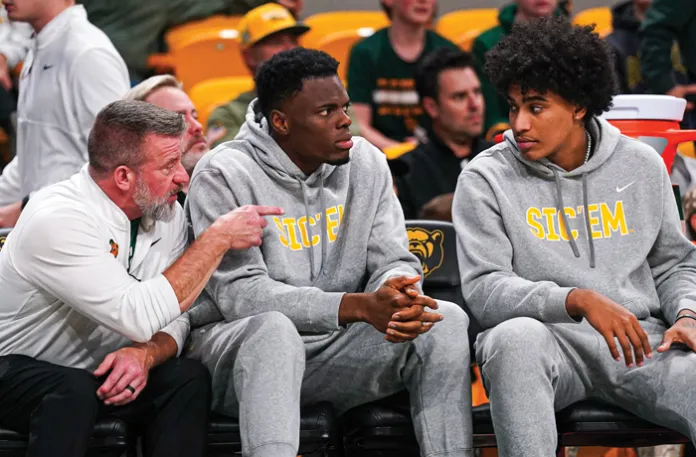
Hurley was reacting to Baylor University coach Scott Drew signing a 7-foot center named James Nnaji to the Bears roster almost two months after the season started. Schools adding players to their roster midseason is rare enough. But Nnaji’s circumstances make his signing even more noteworthy.
A native of Nigeria, Nnaji never played high school, let alone college, basketball in the United States. He began his professional basketball career in Hungary before being signed by FC Barcelona, the basketball arm of the famous European soccer brand, in 2020. Nnaji enjoyed enough success in Spain that he was drafted by the Detroit Pistons in 2023. Nnaji never signed with Detroit, but his rights have since been traded first to the Charlotte Hornets and then to the New York Knicks.
Not long ago, Nnaji’s only option for playing basketball in America would have been to sign with the Knicks. Professional athletes were simply not allowed to compete in college sports. That changed after the Supreme Court’s decision in NCAA v. Alston, which struck down restrictions on athlete compensation under federal antitrust law. Since then, lower courts have treated virtually all NCAA eligibility rules as legally suspect, plunging college athletics into disorder.
“It’s wild out there right now,” Gonzaga University coach Mark Few told reporters. “We really don’t have any organizational or any real rules right now. Until there’s a rule that says you can’t do it, it’s hard to blame anybody for doing what they’re doing.”
Drew was also quick to point out that because there are no rules, he can’t be accused of breaking them. “Early on, when it first came out with G League players, I wasn’t in favor of that either,” Drew said in reference to the fact that two current NCAA players once played for the NBA’s developmental G League. “But again, we don’t make the rules, and as we find out about things, we’re always going to adapt to put our program in the best position to be successful, because that’s what we get paid to do.”
“From my knowledge,” Drew continued, “until we get to collective bargaining, I don’t think we can come up with rules that are agreeable or enforceable. Until that, I think all of us have got to be ready to adjust and adapt to what’s out there.”
Unfortunately for college sports fans, collective bargaining is not a viable solution for college basketball or football. For starters, the National Labor Relations Act, which governs collective bargaining, doesn’t apply to either state employers or religiously affiliated institutions — and almost all colleges fit into one of those two categories. Furthermore, who would be in this union? All college athletes? Just those from so-called revenue sports, basketball and football? Just basketball? Just football?
What would student-athletes be allowed to bargain over? Wages, sure. But what about academic requirements? Grades? Could a college football player union bargain for better grades or more time on tests?
HOW THE SUPREME COURT BROKE COLLEGE FOOTBALL
And then, of course, there are the inevitable strikes that come with unions. It has been a while since football or baseball had a strike, but both sports have had them. And they have crippled seasons, including ending the 1994 baseball season entirely. Are labor stoppages really what college sports need?
The real solution is an antitrust exemption, modeled on the one Congress granted the United States Olympic Committee. With such protection, a new governing body composed of former student-athletes and administrators could write and enforce a coherent national rulebook, restoring order to a system that is unraveling.
