

A year ago, when President Donald Trump was sworn in for his second term, the chattering class was rife with predictions of his foreign policy priorities. The usual suspects, China, Russia, Iran, and North Korea, were high on the list. Few, however, predicted the outsize role that Venezuela would play. And fewer still expected that the White House would seize the Venezuelan dictator, Nicolás Maduro, in a daring raid.
If unwittingly, Maduro provided the Trump administration with the opportunity to usher in a new era of American power, reestablishing and reinventing an old doctrine at a crucial moment on the international stage. At first glance, Venezuela is an unlikely setting.
After all, Venezuela doesn’t have nuclear weapons. Nor was it actively trying to obtain them. Caracas is not Beijing. It is not an industrial titan seeking to supplant the United States as the world’s sole superpower. Nor is it Moscow. Venezuela hasn’t sent columns of tanks across borders to conquer its neighbors.
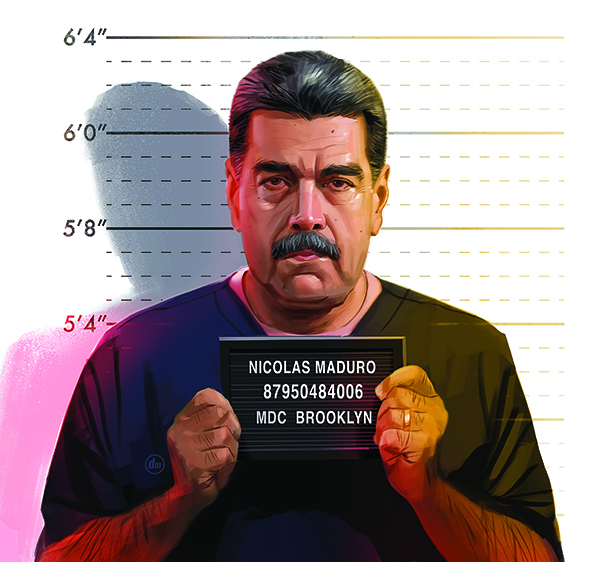
Maduro, a party flunky, is a far cry from Xi Jinping, Vladimir Putin, or Ayatollah Ali Khamenei. By any metric, he isn’t a man of destiny or God’s agent on Earth. But he is a despot all the same, and his regime was a problem for the U.S. and its national interests in real and substantial ways.
Those problems came to an end in the early hours of Jan. 3. The U.S. military seized Maduro in a daring strike codenamed Absolute Resolve. The U.S. Army Special Forces, including elite Delta Force commandos, took the dictator away for trial in the U.S. after a brief but bloody firefight. In a subsequent press conference, the chairman of the Joint Chiefs of Staff, Gen. Dan Caine, said 150 aircraft were involved and that preparation and planning took several months.
On X, the White House proudly shared pictures of the disheveled dictator, blindfolded and in sweatpants, aboard the USS Iwo Jima being spirited back to the U.S. Maduro faces a litany of charges and will confront “the full wrath of American justice on American soil in American courts,” Attorney General Pam Bondi said in a statement.
The buildup to Absolute Resolve was a steady march.
On Dec. 16, 2025, Trump announced that he was designating the Venezuelan government as a foreign terrorist organization. Furthermore, he ordered a blockade of all sanctioned oil tankers coming in and out of the country. Trump warned that the nation was “completely surrounded by the largest Armada ever assembled in the History of South America,” and demanded that Maduro “return to the United States of America all of the Oil, Land, and other Assets that they previously stole from us.” That warning was not heeded.
On Dec. 29, CNN revealed that the CIA had carried out a drone strike on a port facility in Venezuela the previous week. The U.S. reportedly targeted a remote dock on the Venezuelan coast used by Tren de Aragua to store and traffic narcotics. Born in Venezuela’s prisons, Tren de Aragua is a transnational crime organization, designated as an FTO in February 2025. As part of Operation Southern Spear, the U.S. military has continued to carry out airstrikes on maritime narcotics trafficking vessels operating in the Caribbean. No fewer than 30 such strikes have been carried out, prompting outcry from Sen. Adam Schiff (D-CA) and others, as well as demands for congressional briefings and hearings.
Some members of Congress have expressed concern about the War Powers Act, others about the legality of the killings, and some are just seeking to score political points. Others are nonplussed that Maduro has been brought to justice.
Former Vice President Kamala Harris, for example, called his capture “unwise and unlawful.” Notably, the Biden-Harris administration had a $25,000,000 reward for information leading to Maduro’s arrest. Harris didn’t explain what changed, or what she would’ve done differently.
There have even been questions as to whether the strike violates international law. Yet, there is precedent for America’s actions, including the 1989 U.S. military operation to seize Panama’s leader, Manuel Noriega, another major narcotics trafficker.
Indeed, Maduro’s very legitimacy as Venezuela’s president was debatable. As Secretary of State Marco Rubio said on July 27, 2025: “Maduro is NOT the President of Venezuela and his regime is not the legitimate government. Maduro is the head of the Cartel de Los Soles, a narco-terror organization which has taken possession of a country. And he is under indictment for pushing drugs into the United States.”
Maduro can be known by the company that he keeps. The roster of those critical of his seizure reads like a “who’s who” of the worst sort, from Xi’s China and Putin’s Russia to Hamas, a genocidal terrorist group. All are unhappy at Maduro’s ouster. One can hardly ask for a better endorsement.
While some critics have assailed Maduro’s capture as an example of “imperialism,” Venezuela’s Nobel Peace Prize-winning opposition leader, María Corina Machado, hailed Maduro’s removal, declaring that “the hour of freedom has arrived.” Venezuelans, abroad and at home, overwhelmingly celebrated the news.
But the campaign against the Maduro regime is about more than removing a tyrant. And it is about far more than just drugs and oil. In fact, his removal had become a strategic imperative.
Maduro was a menace to the U.S. and its national security. Like his predecessor, Hugo Chavez, he subverted Venezuelan democracy, turning a country that was once a U.S. ally into a base of operations for our enemies. The threat had been metastasizing for years.
Chavez, a former military officer who unsuccessfully attempted a coup in 1992, became president in 1998. He set about destroying Venezuela and welcoming autocrats into the Western Hemisphere. Chavez viewed Cuba’s Fidel Castro as a model to emulate. Like Castro, Chavez was an authoritarian who proved adept at wooing the Western Left. And similar to the Cuban dictator, Chavez struck deals with Moscow, allowing the bear into America’s backyard.
In the mid-2000s, Chavez purchased military equipment from Russia. Soon, the two countries engaged in joint military exercises. Additional agreements were inked over energy, arms, and other means of power projection. Other nations soon followed.
Venezuela welcomed Iranian leaders with open arms, providing them with economic relief and diplomatic cover at a time when Washington was increasingly concerned about Tehran’s nuclear weapons program and its support for terrorists.
China wasn’t far behind. In exchange for loans and political support, Caracas gave Beijing oil. Chavez, an admirer of Chinese communist leader Mao Zedong, visited China no fewer than half a dozen times. Chinese investments propped up Chavez, whose systems of internal repression were enabled by patrons in Moscow and Tehran. In return, they received a foothold in a part of the world that the U.S. has long considered essential to its security. Venezuela played a key role in Russia and Iran’s ability to evade sanctions, underwriting a black market that fills their war machines.
Chavez died from cancer in 2013. He was succeeded by Maduro, a former trade union leader who had served as Chavez’s envoy to autocracies abroad. Unsurprisingly, the new Venezuelan leader began expanding ties with them. For years, they’ve been digging in, wrecking the South American nation’s democracy while transforming it into a forward operating base against the U.S.
Under Maduro, Venezuela provided our enemies with the ability to both destabilize and distract, while murdering Americans. Maduro and his cronies flooded American streets with deadly drugs and facilitated the traffic of criminals and weapons. Venezuela, Rubio previously observed, “openly cooperates with narco-terrorists and others who openly threaten the national security of the United States.” Accordingly, “our interest in Venezuela and in the region is the national interest,” Rubio told reporters at a Dec. 22, 2025, press conference.
The Maduro regime was a chaos agent, exporting crime and drugs into the U.S. Days before he was captured, White House spokeswoman Anna Kelly said the administration was working “to deliver on the president’s agenda to keep this poison out of our communities.”
America’s foes were conscious of Maduro’s benefits. Indeed, his allies worked fervently, if ultimately unsuccessfully, to secure their investment.
Maduro was protected by Cuban agents. Havana sent thousands of counterintelligence operatives to buttress the dictator’s security. He was reportedly surrounded by bodyguards around the clock, and no one around him was allowed to carry cellphones or other electronic devices. Shortly before he was seized, Thomas Shannon Jr., a former high-ranking diplomat, told the Wall Street Journal that the Cubans were “taking very good care of Nicolás Maduro and his immediate successors. … The Cubans are not going to go quietly into the night.”
Yet, Maduro had long occupied unsteady ground. Unlike Chavez, he did not come from the army, and he couldn’t count on the loyalty of Venezuela’s armed forces. Nor was he popular with the people who suffered under his rule.
As Jorge Castañeda, Mexico’s former secretary of foreign affairs, observed in 2024, Maduro presided “over an economic collapse. … Oil production has plummeted, basic goods are scarce, and nearly eight million Venezuelans—more than one-quarter of the country’s population—has fled.” Unsurprisingly, the primary job of the Cuban agents in Venezuela was “coup-proofing” Maduro by “monitoring the army from top to bottom.”
But Havana’s efforts were for naught. A CIA source in Maduro’s inner circle helped U.S. forces track his movements. The dictator’s capture was also enabled by his own unpopularity, with one source telling Reuters that his removal was an “inside job” aided by his own military. Indeed, “members of the Venezuelan military cooperated with the United States” to secure his arrest, the news agency reported. According to Caine, the U.S. was able not only to find Maduro, but to understand “how he moved, where he lived, where he traveled, what he ate, what he wore” — even what his pets were. Now it is Maduro who is cornered and collared. The White House even shared video of him being perp-walked in custody like a common criminal.
Maduro’s policies were a sharp break from the country’s traditions. Venezuela was a thriving democracy in recent memory. Indeed, for decades, it was a wealthy, well-functioning state whose citizens enjoyed a comparatively high standard of living and freedom. Under Chavez and Maduro, they had neither.
Venezuela’s unique history and Maduro’s inherent weakness made the nation an ideal pressure point for American policymakers to grab. After all, Venezuela isn’t the only looming problem in the Western Hemisphere. By focusing on Caracas, the Trump administration sends an unmistakable signal to Cuba, Mexico, Colombia, and Nicaragua, all of which present challenges to American sovereignty and security of their own.
As Josh Treviño of the Texas Public Policy Foundation pointed out in October 2025, Maduro’s ouster could have a ripple effect. It sends a message that threats in America’s near abroad, be it from hostile nation states or drug cartels, will no longer be tolerated. This reckoning is past due.
A superpower that tolerates growing hazards in its own backyard isn’t destined to be a superpower for long. For too many years, the U.S. has been complacent while dangers gathered on our doorstep. This hurt American credibility and power, both with nations and with our own citizens who rightfully expect sovereignty to be defended and order to be kept. Narco-terrorists and their enablers are a threat to both.
America’s enemies had a lot riding on Maduro. In exchange for supporting China’s objectives, Maduro received important military and surveillance tech from Beijing and others. Maduro adopted China’s “Homeland Card” system, enhancing his control over average citizens. In 2023, Beijing upgraded ties with Caracas to an “all-weather strategic partnership.”
China’s interests in the regime were manifold. Venezuela gave China a reach into our hemisphere and gave it oil. By some estimates, China was purchasing a majority of Venezuelan crude. Now, the U.S. controls the taps, and Washington has leverage over its opponents that it previously lacked. This might throw a wrench into some of China’s plans. It certainly will be a complicating factor if China decides to invade Taiwan.
Importantly, Maduro was seized shortly after Chinese officials arrived in Venezuela for talks with the dictator. China reportedly sent an envoy to meet Maduro mere hours before his capture. Rush Doshi, a former member of the U.S. National Security Council, pointed out that just a few weeks prior, China had issued a “new White Paper insisting on its role in Latin America.” Now, Doshi observed, “both have collided with the reality of U.S. power projection in its hemisphere.” In remanding Maduro into custody, Washington sent Beijing a not-so-subtle communique: not in our backyard.
China condemned Maduro’s seizure, saying it “is deeply shocked by and strongly condemns the U.S.’s blatant use of force against a sovereign state and actions against its president.” China’s foreign ministry prattled on about how “such hegemonic acts of the U.S. seriously violate international law … and China firmly opposes” them.
But the Trump administration has called China’s bluff. Ultimately, the Middle Kingdom is largely powerless to intervene so far from its shores — a fact that will not go unnoticed. As Rep. John Moolenaar (R-MI), the chairman of the House Select Committee on China, pointed out: “Those who choose to work with Xi Jinping should note that he could not save Maduro from defeat.” Indeed, Chinese-supplied anti-stealth radars were no match for the U.S.
With Absolute Resolve, the Trump administration showed that the U.S. will bring its vast military and intelligence capabilities to bear. The operation sends another message: The U.S. can act with a surgical precision and reach that China simply does not possess.
No other nation could carry out such a complicated combined operation so successfully. No one else has the capability. This was a meticulously planned mission, carried out with great skill by America’s fighting men and women. The U.S. went into the homeland of an opponent and removed its nominal ruler, and not a single U.S. servicemember was lost, no equipment left behind. That is noteworthy, and there should be no doubt that America’s enemies, from Moscow to Beijing, are taking notes.
This isn’t the first time that Venezuela has found itself central to U.S. grand strategy and great power politics. American leaders have long understood that security in the Western Hemisphere is a necessity.
In 1902-03, Imperial Germany, Great Britain, and Italy threatened action against Venezuela over its mounting debts. President Theodore Roosevelt responded by issuing the so-called Roosevelt Corollary to the Monroe Doctrine. Roosevelt said the U.S. reserved the right to use military force in Latin America. And then, as now, more was at play.
As Roosevelt’s biographer Edmund Morris noted, Alfred von Tirpitz, Kaiser Wilhelm’s secretary of state for naval affairs, “made no secret of his desire to establish naval bases in Brazil.” The kaiser’s strategists were even working on a far-fetched “plan for the possible invasion of the United States” in which Tirpitz would “dispatch his fleet” at the first sign of hostilities, eventually seizing “Puerteriko” then launching surprise attacks along the American seaboard. The Roosevelt Corollary coincided with America’s emergence as a world power, signaling to rivals that the U.S. wasn’t to be trifled with.
More than 100 years later, America has sent our current adversaries a similar message. This is Trump’s addition to the Monroe Doctrine that was first articulated two centuries ago. Trump himself made this clear. After Maduro’s capture, the president told reporters, “Under our new National Security Strategy, American dominance in the Western Hemisphere will never be questioned again.” He added that “the future will be determined by the ability to protect commerce and territory and resources that are core to national security.”
There is another historical parallel, too, and it is more recent. During the 1980s, the Reagan and H.W. Bush administrations carried out operations in Grenada and Panama, both of which restored the morale of a U.S. wounded by the morass of Vietnam. After years of flops and failures, the U.S. is once again regaining its self-confidence. This is no small thing.
Venezuela makes sense politically, as well. The other related issues at stake, crime, immigration, and citizenship, are tangible to citizens who are increasingly skeptical of foreign intervention abroad. The U.S. is conducting foreign policy at a time of severe constraints. The defense industrial base has been hollowed out, and defense budgets aren’t what they used to be. Meanwhile, Washington is facing the very real possibility of conflict with China, a peer adversary, in the near future. Absolute Resolve gives America a boost, strategically and otherwise.
As with the summer 2025 strike against Iran’s nuclear program, the Trump administration has again demonstrated that it is both able and willing to use American hard power judiciously and with great skill. Beijing is now on notice. The U.S. will no longer be complacent, content with sitting back and watching its strategic position deteriorate. This is not an administration that simply reacts to events. Rather, it seeks to shape them. The era of “foreign policy by autopen” is over.
YEAR ZERO FOR THE MODERN MIDDLE EAST
Harris’s charge that Absolute Resolve does not “make America safer, stronger, or more affordable” is wrong on all counts.
Venezuela provided an opportunity to assert national interests at a time of steep limitations and growing dangers. The status quo was neither tenable nor tolerable. And thankfully, now the U.S. has a president who isn’t content to preside over a period of managed decline. America is back, and with a vengeance.
Sean Durns is a Washington-based foreign affairs analyst. His views are his own.
