

President Donald Trump surprised the world by ordering airstrikes in Venezuela and extracting strongman Nicolas Maduro from the country to stand trial in the United States. But beyond the geopolitical shock, the operation’s economic ramifications are just beginning to unfold, across the Western Hemisphere and globally.
Maduro, 63, was arrested in the early morning hours of Jan. 3. While the U.S. has accused him of funneling narcotics into the U.S., the South American nation has the largest oil reserves in the world. And questions about what will come of that oil now that he has been deposed are swirling.
OIL INDUSTRY WINNERS FROM MADURO CAPTURE
In the short term, there will likely be little effect on global oil supply and oil markets, industry analysts say. Although the Trump administration has said it wants to build out infrastructure there and make use of the oil resources that could be opened up by Maduro’s departure.
Additionally, Venezuela was a major ally of other U.S. adversaries such as Iran and China, so the changes could affect trade with those countries.
Venezuela isn’t just rich in oil resources; it also has big deposits of different minerals and even some critical minerals and rare earth elements, which have been increasingly sought after amid the growth of artificial intelligence and global competition with China in the tech space.
And while the economic opportunities are ripe for the taking, most of the economic benefits for the U.S. won’t happen overnight.
“I think, in general, it’s going to take time for this to actually come to fruition because Venezuela has been a dysfunctional political environment for over 20 years — so you don’t rebuild those institutions overnight. But they are rebuildable, and the economic incentives are pretty good,” Rockford Weitz, director of the Fletcher Maritime Studies Program at Tufts University, said in an interview.
Short-term implications
In the short term, the economic fallout from the Venezuela operation, which the U.S. dubbed Absolute Resolve, won’t be too profound, analysts say.
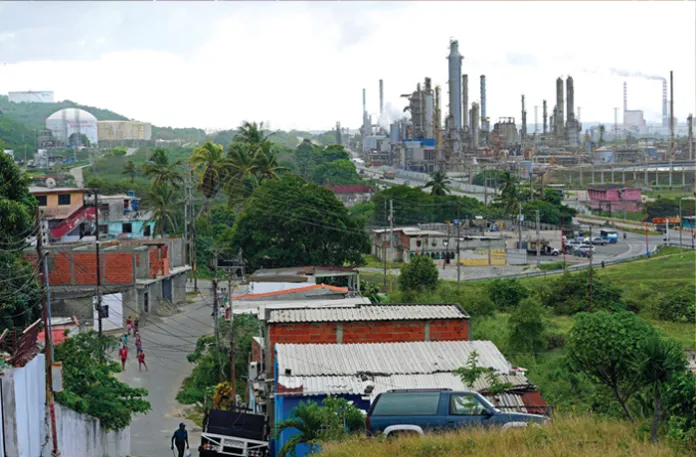
Washington or Caracas can’t just turn on the spigot after years of dwindling oil output. At its peak in 1970, Venezuela was a top global oil producer, churning out 3.7 million barrels per day. That output fell under the regime of socialist Hugo Chavez and later Maduro and is now fewer than a million barrels per day.
“Beyond some repairs to infrastructure that might give a small boost in 2026, I think the change in the supply dynamics coming from Venezuela — it’s going to take several years and significant investment to have a material impact,” said Eric Teal, chief investment officer for Comerica Wealth Management, in an interview.
Skeptics of the Trump administration’s Venezuela operation paint it as an oil-lust move in line with the U.S.-led invasion of Iraq in 2003. Yet Trump has pushed back on comparisons that the Venezuela situation is similar to Iraq as it relates to oil. In a phone call with MS Now’s Joe Scarborough, Trump reiterated the administration’s desire to make use of the new source of crude.
“The difference between Iraq and this is that [former President George W. Bush] didn’t keep the oil. We’re going to keep the oil,” Trump said, according to the host.
Trump said this week that oil companies could help bolster the now Maduro-less country’s infrastructure and predicted it could take under 18 months.
“I think we can do it in less time than that, but it’ll be a lot of money,” Trump told NBC News. “A tremendous amount of money will have to be spent, and the oil companies will spend it, and then they’ll get reimbursed by us or through revenue.”
Still, the development of Venezuela’s infrastructure by oil companies and increased foreign investment will be largely contingent upon what comes next in Caracas politically.
Notably, the Trump administration made the call to recognize Maduro’s second-in-command, acting President Delcy Rodriguez, rather than Edmundo Gonzalez — who outside observers say won the 2024 Venezuelan election — or fellow opposition leader Maria Corina Machado.
There are many unanswered questions about what Rodriguez’s leadership might look like and about whether there will be another election soon. Sen. Rick Scott (R-FL), who represents the state with the biggest Venezuelan diaspora, thinks oil companies will shy away from development there until there is democracy and a semblance of stability.
“I used to live in Texas, I got a lot of relationships with people in the oil industry, and you’re not going to put your money into a place they can confiscate your money again,” Scott said in an interview on Capitol Hill. “So the money is not going in until we get democracy.”
Still, in the short term, some stocks saw a boost.
Chevron, which is currently the only U.S. oil firm allowed to ship oil out of Venezuela under U.S. sanctions, added some $15 billion in market capitalization on Monday, with its stock rising by more than 5%. Exxon Mobil and ConocoPhillips both also saw a mild boost.
Domestic refiners also saw a post-Maduro pop. Valero, which handles a large share of Venezuelan crude, rose more than 9% on Monday, while Phillips 66 was up more than 7%.
On the critical minerals front, rare-earth producer MP Materials’ stock increased 6.6% on Monday and rose another 2% on Tuesday.
Longer-term implications
The bigger economic effects will come in the longer term, a timetable likely measured in years rather than weeks or months.
Ehab Shaheen is a professor of construction management at Florida Gulf Coast University who previously spent years working in many aspects of the oil and gas industry. He said the major reason oil development in Venezuela will take so long is just how bad the infrastructure there has become.
Shaheen said that Venezuela has suffered from years of mismanagement, and it will take years for the country’s oil infrastructure to improve.
“Also, the sanctions that we put on them marginalized their impact on the market; it took them out,” he said.
Oil comes out of the ground in different formulations and viscosities depending on where it is extracted. One positive for the U.S. is that it has a lot of refining capacity already online for the specific type of oil extracted from Venezuela, according to Weitz, the Tufts professor.
He said that a major buildout of Venezuela’s oil infrastructure in the coming years could lower global oil prices once production is up and running, and because the U.S. can refine Venezuelan oil, it could have a positive effect on U.S. gas prices down the line.
While the most profound commodity tied to Venezuela is oil, in the long term, precious metals and critical minerals could be of interest to the U.S. as well.
“They have a lot of critical minerals, they have the largest cobalt deposits in the Americas, they have lithium, they have all kinds of stuff,” Weitz said.
China has dominated the rare earth market for years and accounts for about 80% of U.S. imports of rare earth metals and compounds. Demand for the metals is only growing as clean energy products, such as wind turbines and electric cars, which use the metals, become more popular.
The Trump administration has been working to move away from reliance on Chinese supply chains, so rare earth investments in Venezuela could be another longer-term goal following Maduro’s ouster.
