

There is a thin line between being admirably ambitious and being intolerably mercenary, but in the leading awards-season contender Marty Supreme, Timothée Chalamet shows himself determined to dance atop that tightrope.
This constitutes an act of substantial actorly bravery on the part of Chalamet, who, along with the acting chops he demonstrated in Call Me by Your Name and A Complete Unknown, seems to have been born with a genetic predisposition for obnoxious self-promotion that is unique even for his attention-grabbing profession. This makes his performance in the new movie, on which he also served as a producer, revealing if not outright autobiographical.
That Chalamet has been richly honored for his performance — he just won a Golden Globe — will do nothing for his humility. But if he continues to give performances as rich as this one, and to shepherd to the screen movies as fine as this one, who cares?
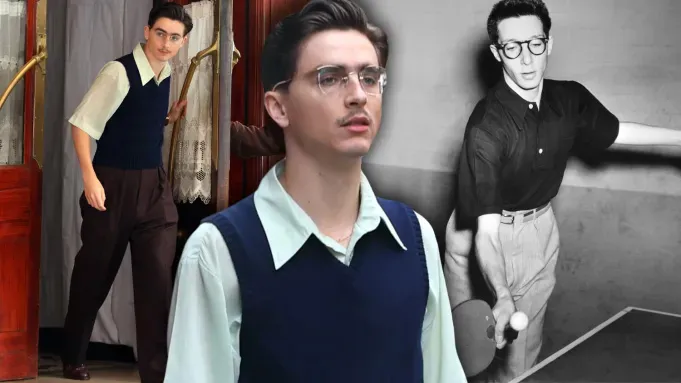
In Marty Supreme, Chalamet stars as Marty Mauser, whose life, in some broad strokes, resembles that of Marty Reisman, a table tennis impresario in the 1950s and 1960s. In the movie, set in New York in 1952, Marty is given the whirling zeal and the same unlikely athletic pursuit, but it is a testament to the tenacious intensity of Chalamet, and the skill of director-co-writer Josh Safdie, that it renders hypnotic a game that is, for the unconverted, frustrating in its smallness and in the hollow bounce of its little ball. Yet, Marty not only plays the game in dramatic fashion, but has invested considerable mental energy in ways to improve its popularity in America. For example, Marty notes that the whiteness of the ball necessitates that players dress in black, but would it not be better, even classier, if the players wore white and the ball was painted orange?
In fact, one of the pleasures of the movie is that it has the imagination to present a striver whose idea of success is rooted in something tangible: in contrast with the tech bros of the 21st century who invest their dreams in such amorphous concepts as artificial intelligence or cryptocurrency, Marty hitches his wagon to a game that requires nothing more than a table, two paddles, and that annoying ball. This luxuriously conceived movie is alert to the tactile pleasures of the predigital world it painstakingly recreates, including rotary phones, sensible shoes, and paper currency.
Of course, the success of Marty Supreme does not depend on the audience sharing the object of its hero’s obsession, but merely finding his obsession alternately credible, frightening, and finally comprehensible. In the opening scene, we are offered a first glimpse of Marty’s drive and his ruthlessness: To support himself and stow away money for future table tennis tournaments, Marty draws a paycheck as a clerk at his uncle’s shoe store. He serves the little old ladies who seem to be his main clientele obligingly, and he plucks shoe boxes from the tall shelves with gusto. Yet he declines an offer to become manager, and when a promised sum is not forthcoming — to be used to finance a trip to London to compete — he does not hesitate in extracting the money from a surly coworker at gunpoint. Marty is goal-oriented to the exclusion of all other values; he evinces no concern about the questionable health of his mother, played by Fran Drescher (one of numerous actors cast with imagination).
Until the film’s authentically stirring climax, the London tournament is one of the few extended scenes showing actual table tennis. But even here, Safdie’s concern is not athletics but anthropology. Despite, or because of, his penurious background, Marty has a keen appreciation for the finer things and an almost feral capacity to detect when he is in proximity to them. He finagles better lodging in London in spite of the supercilious head table tennis official (writer Pico Iyer, revealing a hilariously unshakable sense of superiority). And, seated at his new hotel’s fancy restaurant, he orders beef Wellington simply because it is among the most expensive dishes on the menu.
At the hotel, Marty finds himself in the company of beautiful, icy Kay Stone (Gwyneth Paltrow), a one-time movie star spending her days out of the limelight and in the glum company of her husband, a pen company mogul named Milton Rockwell (Shark Tank personality Kevin O’Leary). In one of the touches that lend this slightly tall-tale-ish movie its believability, Marty stands upright on his hotel bed as he cold-calls Kay in her room. Someone with his level of energy and sheer ballsiness would never initiate such contact while meekly sitting down. For her part, Kay reacts to Marty not as an aggrieved star but as someone stimulated by his undomesticated brashness. Throughout the film, Marty and Kay pass like ships in the night, but all the while, he maintains the relationship and its promise of wealth, access, and glamour, despite his longtime relationship with a girl back home, the unhappily married Rachel (Odessa A’zion).
We meet Rachel in the first scene in the shoe store, which she enters in the guise of a customer with a complaint, but whose actual purpose is to have an assignation with Marty in the basement. The subsequent opening credit sequence (showing the fertilization of an ovum, in the manner of the 1989 romcom Look Who’s Talking) confirms that Marty makes Rachel pregnant. But he only becomes aware of the fact when he returns to New York, eight months into the pregnancy. Predictably, he does not admit his paternity, but she cannot get enough of his gamesmanship and brio. In the film’s most breathless, shaggy dog-like passage, Rachel proves herself every bit Marty’s equal in trying to negotiate an obscenely high reward ($2,000) for the return of the dog of a Mafioso-type whom Marty met in a fleabag motel. Not only does Rachel accompany Marty in trying to locate the actual dog — itself a near-lethal mission to New Jersey — but she concocts a recklessly bold scheme to get the money, sans canine. It’s all strictly for Marty’s benefit, but through A’zion’s sassy, sexy performance, we sense that Rachel shares a portion of his shamelessness.
This makes it all the more dispiriting that Marty is unable to fix his mind on anything other than table tennis and his future earning potential as a presumed master of the sport. He intersects again with Kay, who is trying to resurrect her career on Broadway. (The play’s director is amusingly played by David Mamet, happily reincorporated into mainstream cinema despite his conservative views.) Kay attempts to help Marty, who is trying to piece together the money to go to the table tennis world championships in Japan, but he is reduced to a beggar before Milton, whose previous offer of help he had cockily declined. Milton is perhaps the film’s least effective character, the latest in a line of implausibly cruel midcentury tycoons in recent movies (e.g., Guy Pearce in The Brutalist). Marty manages all of this without the assistance of his seemingly ideal helpmate, Rachel, to whom he says coldly at one point: “I have purpose. You don’t.”
But what is Marty’s actual purpose? Is table tennis glory and its attendant riches its own reward, or will his insane doggedness win him something more? As it turns out, Marty’s energy and motion have not been aimless. In the end, Marty improbably makes the journey from Japan to New York to see Rachel and their newborn. Here, Marty sees what he has been scrapping, fighting, and brawling for all along. But how long will that last?
Peter Tonguette is a contributing writer to the Washington Examiner magazine.
