

When Maine voters head to the polls this year to pick a new governor, they will run into a growing problem in American politics: a lack of fresh, new candidates. While six of the 16 declared candidates have served in public office, three are direct descendants of familiar Maine or Maine-adjacent politicians.
Hannah Pingree, daughter of Rep. Chellie Pingree (D-ME), is running as a Democrat. So is Angus King III, son of Sen. Angus King (I-ME). The Democratic candidate field also includes Dr. Nirav Shah, a former director of the Maine Center for Disease Control & Prevention, Secretary of State Shenna Bellows, and former state Senate President Troy Jackson.
In the Republican gubernatorial candidate field, there’s Jonathan S. Bush, nephew of the late President George H.W. Bush, and a first cousin of former President George W. Bush and his brother, former Florida Gov. Jeb Bush. While members of the Bush clan have held office in other states (and, of course, nationally), they are deeply connected to Maine. Their Kennebunkport estate was a summer White House in both administrations and has been in the family since the early 1900s.
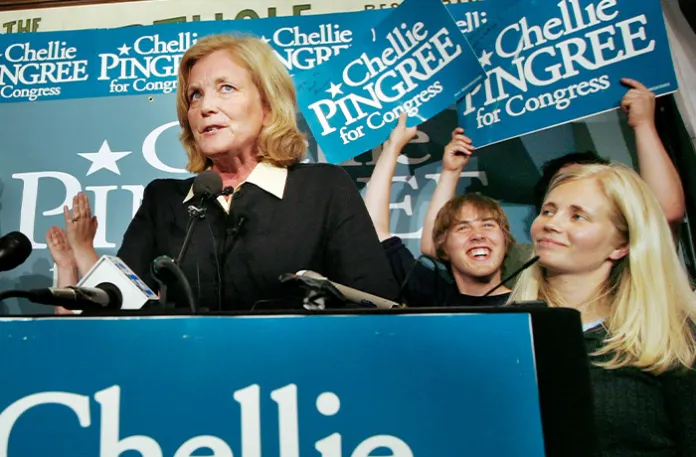
Rep. Chellie Pingree (D-ME) talks to supporters in Portland, Maine, on June 10, 2008, during her first House bid. To the future congresswoman’s right is her daughter, Hannah Pingress, who is a 2026 Democratic gubernatorial candidate in Maine. (Derek Davis/Portland Press Herald via Getty Images)
Other Republican gubernatorial candidates include Bobby Charles, a former State Department official and congressional aide, as well as state Sen. Jim Libby and former state Senate Majority Leader Garrett Mason, among others.
Gov. Janet Mills (D-ME) is being forced from office by term limits and is seeking to challenge Sen. Susan Collins (R-ME) in November. The primaries are on June 9.
The gubernatorial aspirations of so many political kin and close relatives are not necessarily surprising because they understand the benefits of elected office, according to Betsy Sweet, a Democratic strategist with Moose Ridge Associates in Augusta, Maine’s capital.
“Sometimes we have to say, ‘Who the hell would want to do this, right?’ So, and I think we’re seeing some of that,” she said in an interview.
A famous name can boost a candidate in the polls, regardless of whether it’s tied to legacy, Sweet said.
Maine is Democratic-leaning in presidential politics, as 2024 Democratic nominee Kamala Harris won three of the state’s electoral votes and beat President Donald Trump, 52% to 45%. Yet, gubernatorial races in the nation’s northeast corner are quirky affairs. Over the 40 years leading up to the end of this gubernatorial term, ending in early January 2027, Republicans and Democrats will each have held the governorship for 16 years, while Angus King, the senator, was an independent governor from 1995 to 2003.
It makes for a wide-open 2026 midterm election field. Maine voters have to decide whether a political scion or a last name new to their ballots is the way to go.
Political scions battle part of crowded Democratic field
Hannah Pingree, 49, may have an edge in the Democratic primary due to her familial name and hands-on experience.
She was a state representative from 2002 to 2010 and Maine House speaker for her last two years in office. When she retired from the state House, she was called one of the top “40 under 40” by Time magazine.
Although she flirted with a congressional run in 2012, Hannah Pingree remained out of state politics, instead spending time on a local school board. This means her political arc diverges from that of her mother. The elder Pingree was a former state senator who was first elected to the House in 2008, in the 1st Congressional District, covering the Portland area and mid and southern coasts.
The groundwork for Hannah Pingree’s return to public office was laid in 2019 when Mills appointed her to the Office of Policy Innovation and the Future. Hannah Pingree’s time in the Mills administration allowed her to direct a $60 million storm relief package and direct housing and climate policy.
Hannah Pingree resigned from the position last May to launch her run for governor. She has received endorsements from more than 100 current and former state officials, including the current state House speaker and majority leader.
The broad Democratic establishment support is not surprising to Maine political observers.
“She’s been Mills’ heir apparent for years, being given uncontentious, higher-profile roles,” observed Lisa Keim, a former GOP state senator. “As the chosen one, Mills has often shared the spotlight with her, and she’s got money and connections.”
While Hannah Pingree combines legacy and government experience, Angus King III is looking to leverage his family name with private-sector experience. He has never held public office before. However, he has been active in politics for decades.
Angus King III volunteered for Michael Dukakis’s failed 1988 Democratic presidential campaign as an 18-year-old Dartmouth College freshman. He later worked for two years in the Clinton White House as an assistant to the director of communications and to the chief of staff. The Harvard MBA later worked in management consulting at Bain & Company.
He entered the energy sector in 2002, working as an executive at various renewable energy firms. Now running for governor, he has suggested that his lack of a political resume could help him attract voters. He has portrayed his private-sector work as proof that he understands how to tackle real problems, such as affordability and job creation.
He is also banking on his father’s reputation to help lure in voters. The elder King was named the 17th most bipartisan senator by the Lugar Center in 2023.
“If you know my dad, you know my values,” Angus King III said in his campaign announcement last spring. In interviews, he has subsequently called himself a centrist.
He received 33% support from voters surveyed in a poll released by Pan Atlantic Research last summer, ahead of Hannah Pingree’s 20%.
“He seems the most cognizant of the need for businesses to be able to survive in Maine,” said Keim, praising Angus King III for being outside the bubble of Maine politics.
There remains an appetite for nonpolitical candidates in the 2026 Democratic landscape. Both Angus King III and Hannah Pingree saw support dwindle when Shah announced his gubernatorial run.
Shah, who led the state’s response to the COVID-19 pandemic, drew 24% support in Pan Atlantic Research’s December poll. Angus King III and Hannah Pingree were at 19% and 18%, respectively.
Sweet portrayed Shah’s popularity as a recency bias from the pandemic. But, as with all campaigns, the Democratic gubernatorial primary will be decided by voter turnout, Sweet added.
A Bush family political comeback?
On the Republican side, legacy politics plays out more as a liability. Name recognition matters, but GOP voters seem less willing to accept it as more than an entry point.
While the Bush name is well-known among older Maine generations, the family’s influence has waned.
Jonathan S. Bush is the son and namesake of Jonathan Bush, a younger brother of the late president. At 56 years old, he is nearly a generation younger than his most famous first cousin. Jonathan S. Bush graduated from Wesleyan University and Harvard Business School and co-founded Athenahealth, a healthcare technology company, in 1997.
He entered the 2026 gubernatorial race after years on the periphery of Maine politics, primarily as a donor. He contributed to Nikki Haley’s losing bid for the 2024 Republican presidential nomination, according to federal campaign donation records. He also supported Collins and began building relationships within the state GOP ahead of his gubernatorial bid.
But his famous name could be a strike against him, Keim said, noting that some voters are staunchly anti-Bush. Maine GOP voters will end up evaluating Jonathan S. Bush based on his stances, not on his family’s past, she said.
“They want a no-nonsense, strong, capable leader who has the chutzpah to fix our state, with zero interest in a legacy name or wealth,” Keim said.
So far, the Bush name has done well in fundraising but not necessarily in polling.
Jonathan S. Bush announced over $1.3 million in donations earlier this month, including $389,000 of his own money, putting him ahead of all other GOP candidates.
Yet, he received only 5% support in Pan Atlantic Research’s most recent gubernatorial poll. That was more than 10 points behind front-runner Bobby Charles, ironically, a former member of the George H.W. and George W. Bush administrations.
The GOP race could also change with the entry of Mason, who has made his legislative experience an important factor in the race.
It will be months before either party selects a nominee. Maine has gone to a ranked choice primary system, where voters list their choices in order of preference. A candidate wins if they garner more than 50% of the vote in the first round.
If no candidate has more than 50%, the candidate with the fewest votes is eliminated, and their votes are redistributed to other candidates. Voting continues until a candidate gets a majority.
For Bush, the recent extended family campaign history can’t be encouraging. By the time former President George W. Bush was leaving office, he was deeply unpopular, his political support drained by a worsening financial crisis, a yearslong unpopular war in Iraq, and a range of other challenges. His Gallup Poll approval rating in early November 2008, just as Democratic nominee Barack Obama was elected to succeed him in the White House, was down to 25%, just a point above former President Richard Nixon on the eve of his Aug. 9, 1974, resignation over Watergate.
FOUR TAKEAWAYS FROM HOUSE OVERSIGHT’S HEATED MINNESOTA FRAUD HEARING
Since then, it’s been tough going politically for the Bush clan.
Jeb Bush, nearly a decade out of the Florida governorship, lost his bid for the 2016 Republican presidential nomination. His son, George P. Bush, was twice elected Texas land commissioner. But he lost a 2022 bid for Texas attorney general. And Pierce Bush, the grandson of the late President George H.W. Bush and the nephew of former President George W. Bush, lost a 2020 Republican primary bid for a Houston-area House seat to current Rep. Troy Nehls (R-TX).
Taylor Millard is a freelance journalist who lives in Virginia. Follow him on X @TaylorMillard.
