

A decade before he exercised force in Venezuela, sought the fall of Cuba, or fixed his eyes on Greenland, Donald Trump had his sights not on conquering nations but on toppling his rivals for the Republican nomination for president. Small stakes can have large ramifications.
To vanquish those seeking the 2016 GOP presidential nomination would not seem as lofty a goal as “running” a foreign country, as the president has said he intends to do with Venezuela, but in the fullness of time, we can see it as the first step toward a changed America: The boldness, or folly, of the second Trump administration’s current pursuit of hemispheric dominance would simply not have happened had the future president not first contended with Sen. Ted Cruz (R-TX) and Gov. John Kasich (R-OH) some 10 years ago.
Of course, with the benefit of hindsight, Trump’s ability to dispatch with that first slate of primary opponents seems both inevitable and somewhat comic in its very inevitability: a huge figure in modern times, for better and for worse, making quick work of candidates who would either be absorbed into his orbit, temporarily (former Texas Gov. Rick Perry) or more lastingly (Sen. Marco Rubio (R-FL)), or disappear from the scene entirely. But at the time, such conclusions were not at all obvious to the cognoscenti, who preferred to regard Trump less as a threat to democracy than an irritant to decency.
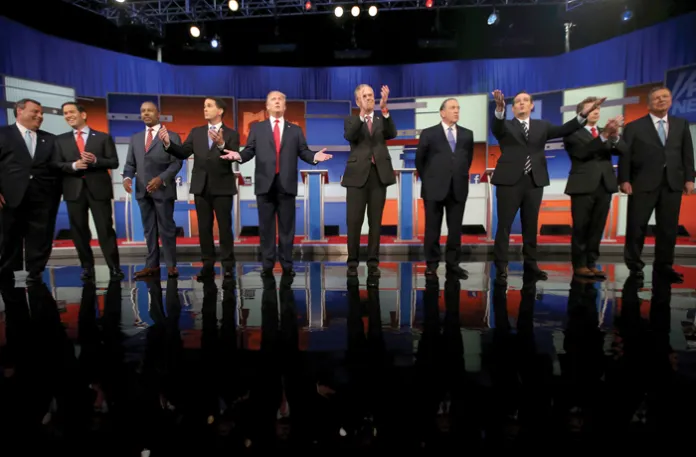
For many observers, Trump’s gobbling up of American life — for some, a welcome merger, and for others, the most hostile of hostile takeovers — can be traced to the August 2015 GOP debate on Fox News. There, on live television, Trump appeared to evolve in real time from an amusingly immoderate New York real-estate developer and media personality to a profoundly politically incorrect presidential aspirant. On that night, Trump won some fans, or, at least, some cheers, for his comical singling out of Rosie O’Donnell in reply to a pointed question from interlocutor Megyn Kelly, and accumulated untold, and, in this case, deserved, enemies for his inexcusably crass post-debate references to Kelly. Yet after this debate and many of the others that followed, a kind of Trump denialism nonetheless set in: The Trump campaign, built on so much flotsam and jetsam, would surely not prove actually damaging to such Republican stalwarts as Cruz, former Florida Gov. Jeb Bush, or physician Ben Carson. Maybe Trump was funny, perhaps he was a vessel to foreground thorny issues the party would rather have glossed over, such as illegal immigration or trade, but he was, in the end, a novelty candidate: an attention-getter not so very different from perennial presidential candidate Vermin Supreme of Massachusetts, albeit with better funding, name recognition, and mass appeal.
Yet Trump correctly comprehended that it was not he who was a flash in the pan but his opponents who were, to one degree or another, worn-out or outmoded. It was a spectacle, and one worth recalling in all its weirdness and consequence.
Among the GOP contenders were several who, pitifully, consented to appear on lower-level, Trump-less debates. This was an insult but an acknowledgment of the fact that nothing shines as fleetingly as a once-ascendant political star: Simply put, what GOP primary voter, in the run-up to 2016, would have been roused by an ex-New York governor who had not occupied the office since 2006 (George Pataki) or a former senator who had not been part of that body since 2007 (Rick Santorum)? Trump cannot be credited with vanquishing marginal figures against whom he never really went head-to-head, but he must have sensed that the presence of such candidates suggested that the field was, on the whole, weaker than advertised, or at least not immune to his tactics. By the same token, years later, seemingly a lifetime later, then-President Joe Biden can hardly be faulted for dismissing with a flick of the wrist the incredible political magnetism of Marianne Williamson, Dean Phillips, or Jason Palmer during the so-called 2024 Democratic primary process — that Biden was later forced from office is no testament to his low-wattage opponents.
By contrast, in the 2016 cycle, there were plenty of plausible-sounding GOP contenders who were given ample opportunity to parry with Trump but who found that, to adopt a term that came into usage at a later moment, the vibe had already shifted. In 2016, the values-oriented sermonizing of Carson, principled libertarianism of Sen. Rand Paul (R-KY), and I’m OK — You’re OK nice-guy-ism of Kasich came across to voters like cable TV in a streaming world, or a flip phone in an iPhone world: outdated, or at least not what a majority wanted to buy. This is not to cast aspersions on the candidates or their messages but merely to accept reality: despite the cumbersomeness of Washington, politics changes as quickly as any other fashion-based form. In 1960, Vice President Richard Nixon looked grim and clammy beside Massachusetts Sen. John F. Kennedy, but by 1968, the country had come around to regard Nixon as pragmatic and even indispensable.
Indeed, it is not so much that the public lost the appetite altogether for what Carson, Paul, or even Kasich were selling as much as they were more interested in buying something entirely new: Never before had mainstream politics tolerated a figure such as Trump, who made no attempt to rein in his rowdy, impulsive manner and aggressive, rhetorically bold, defiantly impractical views, such as building a border wall and making Mexico pay for it. True, Trump had made that persona known to the public through pizza commercials and a hit reality show, so GOP voters were primed for it. His opponents, however, most often reacted with unfathomable slowness. During the debates that cycle, Rubio vacillated between adopting Trump’s crassness as a means to combat it and, more earnestly but arguably even less successfully, deploring that same crassness.
And so it continued through the primary season: Among the various and many ways dreamt up to derail the nomination of Trump, Bush invoked the warm collective memory not of his brother, the Iraq War bungler, but of his father, the inarguable war hero and man of decency; Cruz made common cause with former Hewlett-Packard CEO Carly Fiorina, whom he anointed as his intended running mate were they to seize the nomination from Trump; and Kasich, that cycle’s Jon Huntsman, persisted in the not-unappealing but sadly naïve belief that what voters wanted was not a wall but more and better hugging. Some of these efforts bore fruit some of the time: Cruz won the Iowa caucuses, and Kasich lingered on the scene long enough to win the primary in Ohio, where he was the sitting governor. Yet Trump, for the first and certainly not for the last time, powered through his adversaries like a bulldozer ramming into a bounce house, or the East Wing: He won New Hampshire, then South Carolina, then a healthy smattering on Super Tuesday, and the rest was history.
In a certain sense, it is easy to see why Trump was successful a decade ago. Even his opponents’ branding appeared puny and stage-managed by comparison. The proliferation of first-name-only campaign logos for some of the candidates — “RAND,” “CARLY,” and, notoriously, “Jeb!” — was no match for the fat, emphatic “TRUMP” and its accompanying slogan, “Make America Great Again.” These candidates’ sluggish, cautious styles were indicative of their sapped, played-out messaging. When watched again today, the GOP debates leading up to 2016 reveal Trump’s opponents not dated in the sense that they were viable public figures 10 years ago — they seem more like public figures from 25 or more years ago. In terms of manner or image, Bush calls to mind the sweater-wearing Al Gore. Former Arkansas Gov. Mike Huckabee, now the U.S. ambassador to Israel, suggests Gary Bauer. Paul dutifully fills the economics-centric accent of, say, Steve Forbes.
Only Trump emerges with any constancy — like a glacier. It is striking how many of these presidential aspirants have receded entirely from the public scene: Cruz remains a force in the Senate, and Rubio is now secretary of state, but where in the conservative conversation today are, for example, Kasich or Fiorina? Trump’s confidence in bending the political world to his will faced its first test a decade ago, and he won.
To look back on those GOP primaries is to see the crumbling of a once commonly held notion: that candidates could come to attention strictly on the basis of their background or experience and win votes on the strength of their ideas and ideals. Trump proved that such assets cannot overcome an accusation of lameness or weakness, especially when he is the one doing the accusing. This is a questionable legacy, at best, but it must be reckoned with. Just as Kennedy’s defeat of Nixon in 1960 paved the way for the primacy of television in future presidential contests, Trump’s defeat of Cruz, Kasich, et al. demonstrated the attractiveness of raucousness. For those citizens who hope for a revival of past norms, though, all is not lost: As noted, Nixon, defeated by his sweat in 1960, was not in any way finished.
Peter Tonguette is a contributing writer to the Washington Examiner magazine.
