

In my imagination, the opera is the last bastion of a certain kind of sumptuous formality. White gloves, taffeta gowns, black tie, gem-encrusted lorgnettes: This is what I believe a night at the opera means, and no amount of contact with reality is sufficient to disabuse me. Yet, late last year, perusing Opera Philadelphia’s website to buy Christmas presents, I received another reminder of how often my deeply held beliefs are equally deeply incorrect. There is, in fact, no particular expectation of formality, let alone magnificence, at Opera Philadelphia. As its website assures:
“We don’t enforce a formal dress code at Opera Philadelphia. In fact, we encourage guests to come as they are! For some people, this means dressing up and being fancy. For others, it’s helpful to know that jeans are welcome.”
Not only will the company refrain from actually turning anyone away at the door based on dress, a reasonable demurral, but it also refuses to take any position at all on what guests should wear, nor lay out any suggested standard to which opera-goers can conform to the best of their ability. The only specific item of clothing mentioned is jeans: jeans are welcome. Thank God. I was worried that there might be one single place on God’s green Earth, up to and including the Vatican, where jeans might not be welcome.
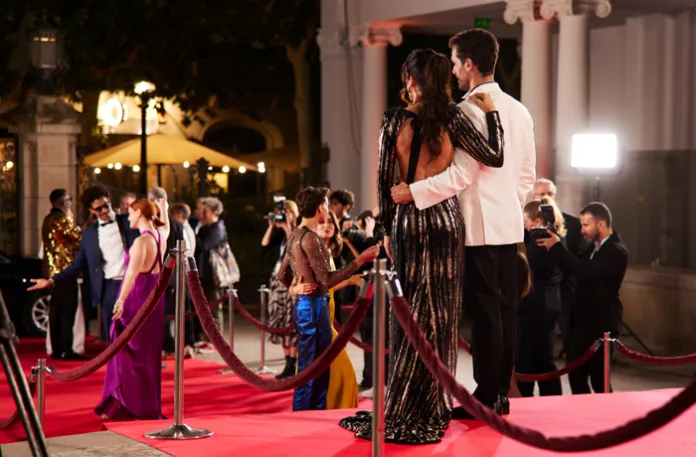
Opera Philadelphia is not alone. Among all but the most rarefied of American institutions, rather than a stuffy set of rules, you are more likely to encounter an eager chumminess assuring you that you don’t have to dress any which way. Not for church, for the theater, for the symphony, for the restaurant, as long as you please, please, please, just leave for your house for one to four hours and show up. Private parties are no different; people are extremely hesitant to venture anything that might border on a demand or even opinion about what other people wear.
This is understandable. People are sensitive about their clothes. Few components of the morning routine are as socially fraught as getting dressed. (People will notice if you fail to brush your teeth, but there’s very little chance that they will think you have brushed your teeth in the wrong way.) Clothes express the intricate and intimate convergences of taste, class, occupation, gender, habitus, budget, and both real and aspirational self-concepts. In covering your nakedness, you expose nearly everything else.
Because of this, formalized dress codes of any kind run the risk of bringing out a certain type of crazy in a given percentage of people. They dredge up seething resentments borne of high school humiliations deeply buried, but never exorcised. They trigger anxiety loops and incite massive, free-floating projections about a host’s intentions, attitudes, and self-appointed place in the social hierarchy. There is an unfortunate type of person who sees the words “Attire: semi-formal” and thinks, Oh? I’m not good enough for your party unless I wear your special little fancy boy outfit? You’ll throw me out the door like yesterday’s garbage if I haven’t ironed my pocket square? And the oldest and most ferocious of all social snarls, the classic invitation to brawl: You think you’re better than me?
This is all nonsense, of course. When people write, “RSVP by the 11th” at the bottom of an invitation, it is not because they are engaged in a subtle plot to separate the organized and conscientious of their acquaintance from the chaotic and lazy. When they say, “Please bring a drink or snack to share!” they have not sworn a private vow to turn away anyone who, for whatever reason, arrives empty-handed. And by the same token, when they write “Attire: semi-formal,” they are not rubbing their hands together with glee, imagining the grotesque humiliation ritual to be inflicted on anyone who shows up without a tie. They are simply trying to create a particular kind of experience for their guests and inviting their guests to assist them. They are communicating the parameters of a particular event. Parameters mean expectations, it is true. The pleasures of social intercourse, I am sorry to say, largely depend on our collective ability to bear the brute fact of other people’s expectations. But it does not follow that these expectations are therefore a trap, spring-loaded with rejection and condemnation for anyone hapless enough to set them off.
Precisely because clothes are such a driver of insecurity and potential source of humiliation, explicit expectations are, more often than not, a positive kindness. The two dreaded questions before any event are: What should I wear? What will everybody else be wearing? The second question is more important than the first. The lack of an explicit dress code does not mean that every single person will show up to the event dressed in a completely different sartorial register dreamed up ex nihilo by each individual guest. It means that, absent the assumption of authority by the host, authority will devolve on and dissipate into the group; the dominant trend will, rather than being codified, emerge as a “vibe,” communicated through group texts and outfit photos and other processes as mysterious as the murmuration of starlings. This is a situation that the confident, the stylish, and the socially plugged-in will find easy to navigate. But the more someone lies on the margins of all these qualities, the more vulnerable they will be to anxieties, confusions, and what turn out to be embarrassing misjudgments. To take the reins as a host — whether private or institutional — is to put everyone on a more or less equal playing field. It is to create a situation where good faith effort, not social capital, determines the success of your attempted conformity.
Of course, conformity is not something to which we are supposed to aspire. At the very least, it is not something we are supposed to admit chasing. After-school specials, young adult literature, and the long shadow of 1968 have trained us to register conformity as something approaching a dirty word. We are all supposed to find our voices, be ourselves, break free from the shackles of social expectations, and emerge from the cocoon of stifling sameness into the sun as gloriously eccentric butterflies. To maintain this ideal, we will all endure the ridiculous spectacle of various well-meaning actors blithely pretending, in defiance of every observed fact of human sociality, that to “come as you are,” to make their clothing choices in a total vacuum of personal caprice, without reference to any group dynamic or meaningful social script, is what most people want or can endure.
Of course, people want to conform. Conformity in dress is a kind of modesty, a disinclination to demand the attention of others or set ourselves apart from our fellows. It is also a pleasure: a capacity to understand, interpret, and apply clothes as a textual tradition with communicative power about the type of activity we are engaged in, and to participate in the creation of an aesthetic effect on the collective level. People respect and desire conformity in dress so much that they will reliably shy away from anything that smacks of its deliberate rejection, even at the expense of other pleasures. In a casual age, people have, if anything, more of a horror of over-dressing than of under-dressing.
This is what Opera Philadelphia misunderstands: By refusing to impose or even encourage any level of formality in dress, they are not making opera more accessible to a significant degree. People of all different classes have one good funeral suit, one good cocktail dress, that they can break out. If anything, it is the subtleties and variations of dressy casual and the expense required to do justice to its carefully balanced equilibria that instantly reveal the wearer’s social position. What they are doing is removing a permission structure that allows people to indulge in magnificence without violating the mandate to modest conformity.
CONFESSIONS OF A PASSENGER PRINCESS
Motivated people find ties on eBay and gowns in thrift and fabric stores. What is much less easy to come by, for ordinary people who do not live in a whirl of state dinners and charity galas, is an occasion to wear them. Part of the social service that formal occasions provide is an official mandate to break out grandmother’s pearls. People who do not have the theater kid’s comfort with donning a self-conscious costume or the fashionista’s willingness to be a lone trendsetter still want and enjoy the opportunity to glitter: to be one beautiful bird among many in a shining aviary; to feel that tonight is a special night, and I have made myself special accordingly.
This all, doubtless, reveals the impoverishment of my character. If I were a true aesthete, I would attend opera only for the music, not the clothes. If I were not a wretched little bourgeois, I would not be so starved for formal occasions, nor so timorous about creating my own private mandate. But this is my point: Not only the sophisticated and elite, but the provincials, the middle-brows, the rubes, and even the wretched bourgeoisie, are rightful possessors of the human capacity for magnificence. If there is a difference, it is only that they need more social support to properly enjoy it. It is a shame that, in an avoidance of responsible social authority posing as egalitarianism, we have created a barrier to its exercise as almost as high as any sumptuary law.
Clare Coffey is a writer from Pennsylvania. Her work appears in the New Atlantis, the Bulwark, Plough, and elsewhere.
