

Michael Reagan, the eldest son of President Ronald Reagan, never shied from a fight when it came to defending the principles that defined his father’s presidency. He carried the torch of conservatism with the same unapologetic vigor his father brought to the White House, turning a life marked by adoption, personal struggles, and family fame into a platform for unyielding advocacy.
Born John Charles Flaugher on March 18, 1945, in Los Angeles, he was the biological son of Essie Irene Flaugher, an unmarried woman from Kentucky who placed him for adoption immediately after birth. Hours later, he was welcomed into the home of actor Ronald Reagan and his then-wife, Academy Award-winning actress Jane Wyman. The couple embraced the infant as their own, giving him the name Michael Edward Reagan. He grew up in the glittering yet often chaotic world of Hollywood, navigating the aftermath of his parents’ 1948 divorce and the arrival of new siblings following Ronald Reagan’s 1952 marriage to Nancy Davis. These early experiences shaped a sense of being on the periphery of his own family story, a feeling he would later confront openly in his writings.
His schooling reflected a restless path. After expulsion from Loyola High School in LA, he attended the Judson School, a boarding institution near Scottsdale, Arizona, and graduated in 1964. College followed in fits and starts: a brief stint at Arizona State University, then a transfer to Los Angeles Valley College, where he did not earn a degree. Instead, he entered the workforce, selling men’s clothing, directing special events catering, and later selling circuit boards.
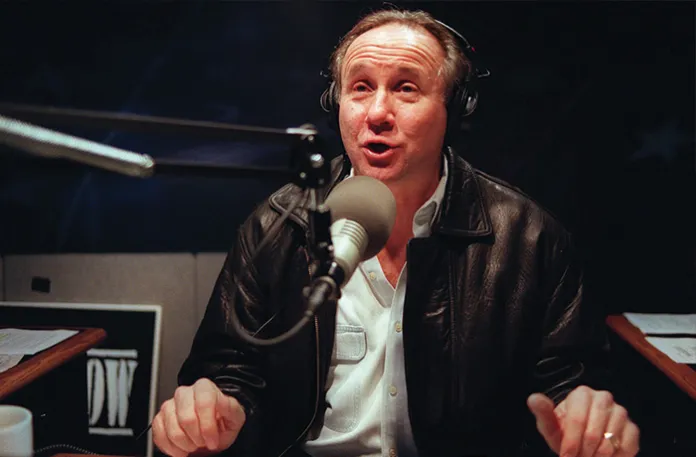
Entertainment beckoned briefly; he took small acting parts on television, including roles on Capitol and an episode of Falcon Crest alongside his adopted mother. In 1987, he hosted the inaugural season of the syndicated game show Lingo. These forays into show business offered glimpses of fame but never captured his full attention the way ideas and public debate would.
That shift arrived decisively in the late 1980s with talk radio. He began as a guest host filling in for Michael Jackson (no, not that Michael Jackson) on KABC in Los Angeles before securing his own daily program on KSDO in San Diego. By the early 1990s, The Michael Reagan Show had expanded nationally. For more than two decades, his broadcast reached millions of listeners each day, delivering incisive, often fiery commentary on national politics, cultural trends, and breaking news — all filtered through an unwavering conservative lens. He consistently promoted limited government, fiscal restraint, personal accountability, robust national defense, lower taxes, and traditional family values — principles that mirrored and extended the ideological framework his father had championed during his eight years in the Oval Office.
The microphone became his instrument for broader impact.
Informed by his own adoption, he spoke forcefully in support of reform efforts to ease bureaucratic hurdles for families. He channeled energy into philanthropy, organizing high-profile powerboat racing events that raised substantial funds for the Juvenile Diabetes Research Foundation, the Cystic Fibrosis Foundation, and the Statue of Liberty-Ellis Island Foundation during its restoration campaign. He joined the board of the John Douglas French Alzheimer’s Foundation, driven in part by his father’s decadelong struggle with the illness, and served as national spokesman for the My Stuff Bags Foundation, which provides comfort items to children entering foster care after removal from abusive environments. In 2005, he launched the Michael Reagan Center for Advocacy and Research in collaboration with Arrow Child & Family Ministries, focusing on faith-based approaches to child welfare policy.
His written work complemented his radio presence. The 1988 autobiography On the Outside Looking in, co-authored with Joe Hyams, explored the emotional scars of adoption, parental divorce, and a traumatic childhood experience of sexual abuse at summer camp. Twice Adopted (2004) traced his spiritual awakening and embrace of born-again Christianity as a source of healing and purpose. He edited The Common Sense of an Uncommon Man: The Wit, Wisdom, and Eternal Optimism of Ronald Reagan, gathering the former president’s memorable quotations, and in 2016 published Lessons My Father Taught Me: The Strength, Integrity, and Faith of Ronald Reagan, distilling enduring lessons in optimism, moral clarity, perseverance, and faith drawn from his father’s example.
Television regularly called on him as a commentator for CNN, Fox News, Good Morning America, and the Today show. In his later career, he aligned with Newsmax, penning columns and appearing on air to challenge what he saw as the Republican Party’s drift from core conservative tenets. Through the Reagan Legacy Foundation, which he founded in 1997 and led as president and chairman, he worked to safeguard and promote his father’s vision — emphasizing individual liberty, American exceptionalism, anti-communism, and civic engagement — while educating new generations about the 40th president’s achievements.
In an era when political discourse often tiptoes around conviction, Michael Reagan charged straight ahead, microphone in hand and principles intact. As he once put it while defending his father’s vision against party drift, “Today’s Republican Party is rudderless, leaderless and in full retreat from the conservative values and vision of Ronald Reagan.” He never retreated himself — and that’s no small legacy.
Daniel Ross Goodman is a Washington Examiner contributing writer and the Allen and Joan Bildner Visiting Scholar at Rutgers University. Find him on X @DanRossGoodman.
