

Good intentions tend to carry far more weight than they should in some spheres. Public housing is unquestionably one of them.
While the arguments in Howard Husock’s The Projects: A New History of Public Housing as to what’s gone wrong in this realm are sometimes familiar, they have never been assembled so cogently as here. Trying to make things better is no excuse for making them far worse.
Popular and expert opinion on how American experiments with public housing have played out has not been entirely inflexible. There is, happily, no real remaining constituency for demolishing urban neighborhoods to build Corbusian tower blocks. The flaws of blank-slate planning of public housing are broadly acknowledged, to a point.
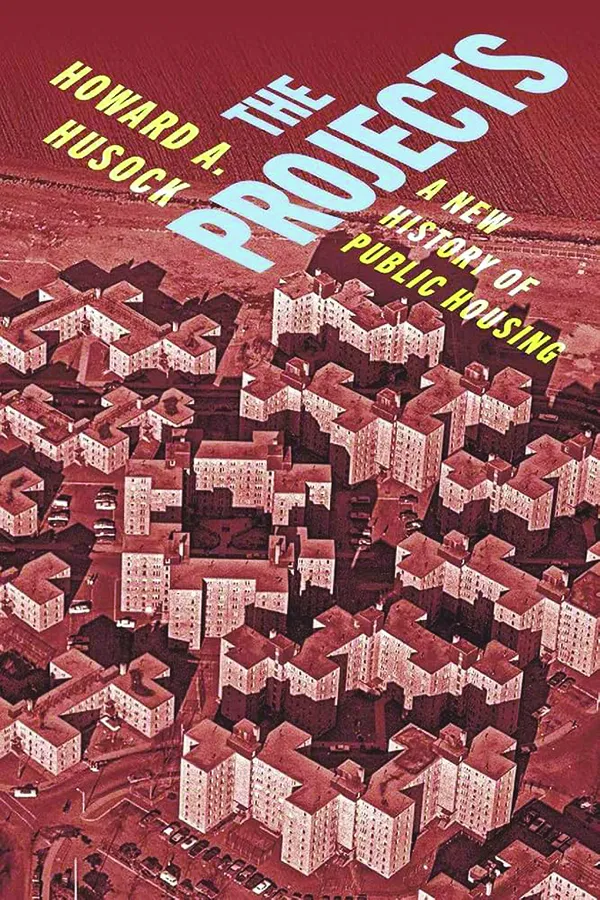
The rub is often in just how these failures are ranked in the ledger of urban missteps. Overzealous urban highway construction tends to be classed as pure evil, while sweeping obliteration of neighborhoods for public housing tends to end up reckoned as a good thought gone somewhat wrong. Husock undertakes the important task of clarifying this history.
Two ideas were combined in force at the aegis of the American public housing experiment during the Great Depression. One was that much of the American stock of housing was absolutely inadequate and had to go. The other was that many residents would never be able to afford suitable replacements on their own. The first idea has gone into abeyance. The second has unfortunately not, but we will return to that shortly.
A 1934 housing exhibit at the Museum of Modern Art was a crucial moment. It assembled vital grandees. Robert Moses and Philip Johnson were involved in its planning. Walker Evans captured the misery of slum life in photos. Abby Aldrich Rockefeller, Arthur Ochs Sulzberger, and Francis Perkins all provided support. There was even a model tenement, a sort of haunted house for museum-going reformers. Catherine Bauer, an academic and organizer of the exhibit (later author of the Federal Housing Act of 1937), observed that about two-thirds of Americans were relatively decently housed, but that “meanwhile the lowest economic third of the population occupy obsolete, inadequate, neglected shelter, damaging in varying degree to health and self-respect.”
This was a largely upper-class crusade, often promoted by people who simply were not paying much attention to the dynamics of the neighborhoods they regarded as horrific. There was little to no acknowledgement, Husock writes, of one such alarmist account, “that what he witnessed might just as well be described as a lively and dynamic city neighborhood whose residents [were] striving, saving, and planning.” They rallied all sorts of experts, but “notably absent were any residents of low-income neighborhoods themselves.”
The Federal Housing acts of 1937 and 1949 set the stage for a building boom in public housing construction. More than a million and a half units were built between the first act and the mid-1980s. This was an intensely destructive process, leveling whole neighborhoods in almost every American city.
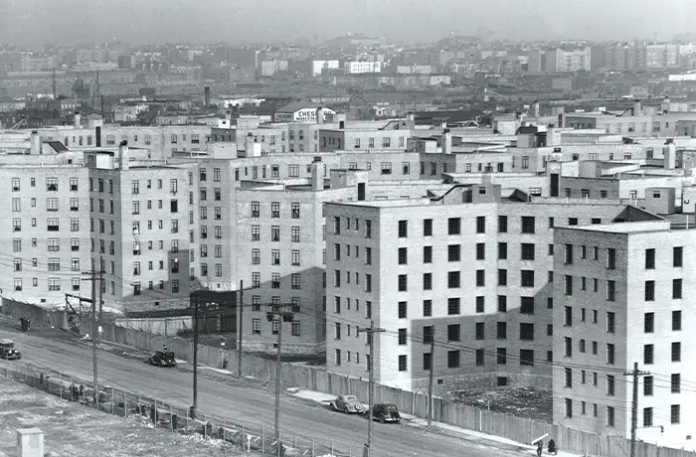
Husock is a reliably fair-minded observer. There were objectively bad conditions in many settings. “According to the 1940 census, less than half of all housing units had a private bath with a private flush toilet.” Eighteen percent of all residences had no indoor plumbing at all. Housing construction also stalled alarmingly during the Great Depression.
However, building public policy from extreme cases is rarely a good idea, especially with the solutions that emerged here, which focused so intensely on the fix of erecting more spacious and better-lit individual dwelling units while ignoring and often literally forbidding the activities that made “slum” communities a great deal more functional than their replacements. Many residences doubled as businesses of some sort; lodgers were a frequent means of income. Both of these routes were soon expressly forbidden. He quotes Jane Jacobs: “When we try to justify good shelter instead on the pretentious grounds that it will work social or family miracles, we fool ourselves.”
There was no regard for businesses, very little for any other community institutions, and frequently a rigid hostility to any use of new residences for any commercial purposes. Such clearances were not confined to African American neighborhoods but unquestionably focused most heavily upon them.
Husock quotes an op-ed in the Pittsburgh Courier, related to the near-obliteration of the city’s mainly African American Hill District: “What about the churches, schools, business neighborhood associations, civic groups? All these are part of the whole problem of uprooting the lives of many people, whose patterns of living have been labeled, ‘not desirable, not acceptable, not Endurable.’”
These processes were accentuated by a narrative, one that is still with us today, that minority tenants were an inevitably oppressed class in urban neighborhoods, overcharged for stygian hovels by greedy white landlords. Overlooked in this accounting was the substantial number of owners whose properties were seized for very meagre compensation. Twenty-eight percent of homes in the majority African American tracts in Detroit were occupied by their owners.
“The 1940 federal Census of Housing, the first of its kind, reported that there were 13,539 nonwhite tenants in Pittsburgh — but also 1,964 nonwhite owner-occupants of their own homes,” Husock writes.
The crucial point here is that the nest egg of urban real estate, which often became immensely valuable, was taken for a pittance from a large and disproportionately nonwhite population, not by avaricious developers but by the government. A compounding factor was that the model for new housing was always rent, never ownership.
Public housing was not targeted specifically at the destitute for its early decades. Most New Deal-era projects were workforce housing, and subsequent developments were generally mixed-income. Husock explains that “housing would be a sort of municipally owned public utility.”
There was an early era of relative success. Many housing projects got objectively better housing units. Federal subsidies were provided for construction, but these projects were intended to be supported by rents subsequently. Many had substantial working-class tenancies early on. Background checks were a regular feature, soon all but unthinkable in public housing.
This sort of broad income foundation, which persists in some places, soon crumbled in most cities due largely to a classic case of the government not quite paying attention to what its other hand was doing: namely, providing Federal Housing Administration long-term loans. Almost anyone who then found home ownership in reach decided to take off. This was not generally accessible. The Federal Fair Housing Act was not enacted until 1968, and while white residents could easily relocate, it was a far more difficult proposition for black tenants.
As projects shed paying residents, even the most routine maintenance became all the more difficult; this was a bind compounded in 1969 by the Brooke Amendment, which capped rent for public housing tenants at 25% of their income — if they had any. Public housing became the realm of the intensely poor, and crime rates skyrocketed. Things reached a crisis point during the Nixon administration, which declared a moratorium on the construction of publicly subsidized housing projects in 1973. The Pruitt-Igoe project in St Louis started coming down the prior year, an icon of things having gone horribly wrong.
Housing vouchers began during the Nixon administration and expanded thereafter. The idea that intense artificial concentrations of poverty (while even prior slums tended to combine poverty and productivity) were of use to no one became at last fairly generally accepted. The Clinton Administration’s HOPE VI program provided $4.5 billion to replace projects with mixed-income neighborhoods. This was all a step in the right direction after many steps in the wrong one. There has been progress, related or not, on other fronts. The black suburban population has increased from 24% in 1980 to over 35% more recently. The black population residing in public housing has also declined over these decades. There have been a variety of experiments in how public housing projects are run, some involving contracting management to private operators, which have yielded improvements from an absolute nadir.
Husock’s observations are not all that different from a range of other recent authors, from Nicholas Dagen Bloom to Suleiman Osman, if his emphases are different. Many, such as Matthew Desmond, continue to argue that the deficiency remains far too little government support for housing. This view’s resonance would seem confirmed by New York City’s last mayoral election. Catherine Bauer’s idea that the housing market will always fail a large segment of the population remains disquietingly widespread.
Husock poses with renewed force important questions about the perverse incentives of guaranteed support, capped rent, and income limits. This is not an argument against government support of housing at large, but rather an examination of the manner in which this is done, and the incentives it provides, or more importantly, does not provide to economic mobility.
There’s a strange taboo in much popular discussion; perverse incentives of the tax code for those of greater means are up for general debate, but those concerning the poor are often dismissed as wanton cruelty. Yet the fact remains that people are overwhelmingly rational economic actors. As Husock writes, “The households that had been formed in part in response to the availability of project apartments for low-income, single-parent households find … that they would be punished by a higher rent if they increased their earnings.” These households are behaving rationally; they are not at fault, policies are. There has been greater freedom granted to a number of housing agencies to link tenancy to work or other economic mobility programs, such as Moving to Work in Atlanta, which has yielded some early success.
REVIEW OF ‘THE PRICE OF VICTORY’
There is a prevailing image of public housing as a realm of fairness in the rapacious world of real estate. It is providing needed housing to the intensely poor and many elderly seniors. Husock visits and talks to a number of these, from the Bronx to New Bern. And yet, 78% of public housing residents in New York City have lived there for over 10 years, and 21% for over 40 years. The manner of allocating units, even for the elderly poor whose prospects in rental markets would certainly be grim, remains illogical. As Husock explains, “The New York City Housing Authority has a multiyear waiting list, but nearly a third of its tenants live in units with empty bedrooms.”
While acknowledging that public housing took a series of wrong turns is widespread, much commentary on the topic tends to blame austerity for nearly all its faults. Husock charts a different course, and an invaluable one.
Anthony Paletta is a writer living in Brooklyn.
