

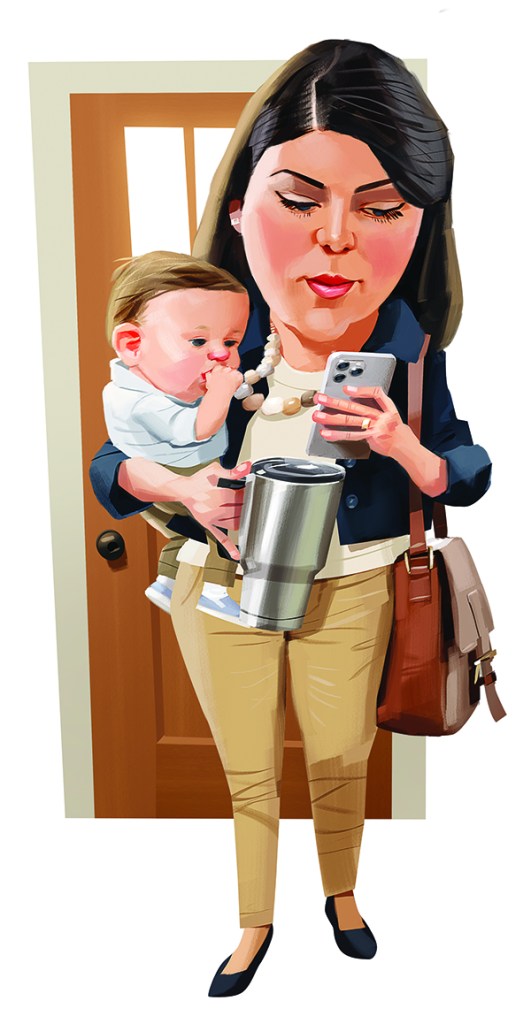
In recent years, the notion that motherhood is binary has gained significant traction. As a quick glance at social media will confirm, there are seemingly two competing forces at play: that of the “girlboss” and the “tradwife.” For those who fully subscribe to one, they find passionate allies to commiserate with. The sisterhood is strong among those who prize careers and corporate lives or those who prefer what is presented as domestic bliss. But lost alongside these rigid categories are the many women who fit neither mold. There are millions of mothers in America who choose to do both, or must do both, out of necessity. And for some reason, modern society can quickly view these “partial” commitments by another word: inadequacy.
The aforementioned scourge of social media has done much to introduce strict adherence to certain lifestyles as some sort of ultimate virtue. If you’re a girlboss whose goal is making money and advancing in your career, well, you’re really doing something with your life. If you’re a stay-at-home mother focused on making sourdough bread from scratch and raising children, well, you’re really doing something with your life. If you’re doing something other than that, including a combination of both, you’re not fully committed. And that in itself is unacceptable. Or so says the pressure-filled digital landscape.
But what if the “girlboss” and “tradwife” crowds are the minorities? What if those of us who blend the two are the real, silent majority? From all indications, this appears to be true.
In February 1963, Betty Friedan’s book, The Feminine Mystique, was published. Friedan’s book greatly affected the American populace and helped to usher in the second wave of feminism. Friedan introduced “the problem that has no name.” This so-called problem? That of the housewife. Namely, her existence.
Friedan wrote, “Can the problem that has no name be somehow related to the domestic routine of the housewife? Is she trapped simply by the enormous demands of her role as modern housewife: wife, mistress, mother, nurse, consumer, cook, chauffeur; expert on interior decoration, child care, appliance repair, furniture refinishing, nutrition, and education? … We can no longer ignore that voice within women that says: ‘I want something more than my husband and my children and my home.'”
There is nothing wrong with a wife and mother doing and achieving things outside the home. But Friedan, and countless others who sang her praises, acted as if being a housewife is not enough, not fulfilling, and painfully stifles women as a matter of course. This mindset, this about-face, did not bring about a positive change. The feminism of the 1960s and 1970s did much to permanently alter not just American life, but how we measure women and their worth. Unlike what we’ve been told repeatedly, these alterations were not improvements.
Fast-forward to the 2020s and the computerization of everything. Neither women nor men could have anticipated just how much the online world would impact our offline one. Among many other things, the internet is used to spread ideals, foster a sense of community, as well as mock and shame. The social and emotional contagion that is naturally part of the online world does much to influence women. There is a lot of content about being a girlboss in a male-dominated world. There seems to be just as much content about being a tradwife in a world that urges you to be a girlboss. The display of a false binary reinforces the idea that not fully giving yourself to one means you are falling short as a mother and woman. These two categories are culturally recognizable archetypes. But it begs the question, are they more internet subcultures than statistically dominant identities? Just how many mothers are able to exist as either a top-tier career woman or the ultimate of all supermoms? Believing we, as mothers, must pursue or excel at one of them is daunting, to say the least.
While there is plenty of internalized pressure on women, external pressure to perform exists, too. And sometimes, it is the outside pressure and comparisons that form the bulk of often unspoken inner dilemmas. In October 2023, the Journal of Medical Internet Research published a study titled “Understanding the Tensions of ‘Good Motherhood’ Through Women’s Digital Technology Use.” The technologies in question, both social media and parenting apps, can and do greatly impede some women as they attempt to meet societal standards.
Among the principal findings: “The discourse of good motherhood permeated participants’ responses as they described their experiences when encountering ‘perfect’ images of motherhood posted on social media. Although such instances were acknowledged by the participants in this study as performative, the bombardment of these idealized images appeared to impact their self-perception and led to moments of self-critique accompanied by espoused feelings of guilt or anxiety.”
Motherhood is enough on its own without seeing the so-called perfection others choose to present to the world. This digital onslaught does a lot to discourage mothers.
Emily C. Klear, Director of Adult Psychotherapy Services at The Family Institute of Northwestern University said of these burdens, “It puts us in a position of competition, as women. Or that there is … some sort of ‘right way’ or ‘wrong way’ to be a mother.”
In this world of online oversaturation, it’s easy to feel as though you don’t measure up. And that is especially true of women when they first become mothers. The universe of motherhood is completely unknown at the time one starts out on that journey. Seeking help and advice is only natural. But it seems that increasingly, looking for guidance can be a negative experience. Instead of support, one can quickly find ways you are mothering wrong. This colors the early days of motherhood and beyond.
The pressure only deepens when a mother has to decide if she’ll work while raising her children. It’s not an easy choice, whether she works because she wants to, needs to, or both. Either way, it becomes a defining moment in her life. Women in general are free to choose their paths, but biology ensures trade-offs that men will never face. That’s not a negative. It’s just a basic biological reality that must be accepted.
If you pay attention to the narratives from both camps, you’ll see unspoken calls to fit into a certain framework. The overarching reason for contention between the two versions of motherhood almost solely relates to employment. But the real-world data about both what women want and where they actually end up defy each side’s loud demands. Once again, these lifestyles include both those created by planned desire and those driven by financial or familial necessity.
An Employment Characteristics of Families Summary released by the United States Bureau of Labor Statistics in April 2025 shows a country with diverse family makeups. The data show that families are certainly not one-size-fits-all: “In 2024, 32.7 million families, or nearly two-fifths of all families, included children under age 18. At least one parent was employed in 91.4 percent of families with children, down from 91.9 percent in 2023. Among married-couple families with children, 97.5 percent had at least one employed parent in 2024, and in 66.5 percent of these families both parents were employed. Among families maintained by fathers, 84.8 percent of fathers were employed, down from 86.5 percent in 2023. This was a greater share than the 75.4 percent of mothers who were employed in families maintained by mothers, little changed from the prior year.” These figures reveal the black-and-white, but they don’t show what mothers want when it comes to employment.
A report by the Institute for Family Studies released in November 2025 reached this conclusion: “Despite recent fluctuations in women’s employment, the long-term trajectory shows that more married mothers of young children are working full time than ever before, even though full-time work is not the preferred option for most.” The breakdown is as follows: “Only 39% of married mothers with children under five say their ideal is full-time work. 40% prefer part-time work. 20% would prefer not to work for pay at all.”
The big flashing desire this data points to? A word called flexibility. There is nothing that says a majority of mothers want full-time work. At the same time, it’s clear what might be considered the “tradwife crowd” is not a majority, either. It’s almost as if mothers have a complicated relationship with employment and what it looks like for them personally. And there is nothing in these figures to suggest mothers who do work want to abandon their biological duties as bearers and carers of children. Painting mothers with a broad brushstroke is never a good idea. It is a much more complex situation than culture warriors on either side of the political aisle will admit.
The IFS report also found that mothers who work outside the home prioritize certain policies that would help them the most. The top three are paid family and parental leave, flexible work arrangements, and a strengthened child tax credit. While the report shows government-subsidized child care is on the list, it “does not rank among mothers’ top priorities—especially compared to policies that give families more time and financial stability.” Again, flexibility is key. The freedom to tailor work-life balance to each individual family naturally induces stability. Every couple with children is looking for ways to not only provide for them and their offspring, but to make it work as seamlessly as possible.
One trend likely to stick around is the so-called “side-hustle wife.” This is a mother whose main priority is raising her children. But because of financial needs and/or personal ambition, work is also part of her life. That work can involve a part-time position outside the home or a work-from-home situation. Either way, it’s a blending of traditional motherhood with children as the top focus alongside work to supplement the family income. This can come from a desire to make the family’s lifestyle more achievable or take some pressure off the husband/father as the breadwinner. These women don’t fit perfectly into either the girlboss or tradwife categories. They occupy both at different times during the day and week.
In 2025, the American Family Survey’s annual polling data on affordability revealed that 71% of respondents said raising children is unaffordable, compared to 14% who said it is affordable. The breakdown along party lines is wide but perhaps not as enormous as expected: “In 2025, about 82% of Democrats viewed raising children as unaffordable, compared to 64% of independents and Republicans — an 18 percentage-point gap.” Democrats see it as a bigger issue. But others, including Republicans, are concerned as well. And this is one area where Republicans can make up some major ground.
Far too often, the Republican Party is presented as anti-woman. This is, of course, not true, but is used as a powerful narrative by the legacy media and online provocateurs. One reason for this campaign is the traditional pro-life stance held by Republicans. Another is the promotion of marriage and the nuclear family. Women and men are naturally encouraged to have and raise children. Parental age is sharply on the rise, and fertility rates are on a downward trend. These are problems not just in the present but long-term sense. Republicans are right to address both. But as they do, it’s important to recognize a few key things: Many families struggle to make ends meet, some mothers work out of need or want, and working mothers are not failures. The Republican Party as a whole, and right-leaning voters individually, would do well not to castigate women for straddling both the mother and boss/employee lanes. Doing so dismisses real-world stresses and ignores our shared economic reality.
The majority of women still lean Democratic, even if the margin is somewhat slim. And according to the Pew Research Center, “at all age levels, parents are more Republican-oriented than non-parents.” If Republicans want to maintain the support of parents and draw more women in general to their side, they should take a softer approach. This doesn’t require abandoning honesty or forsaking responsibility, but it does require a greater understanding of the real-world situations mothers and families are in.
We live in a society that is desperate to throw people into categories. This is partly due to our preoccupation with politics. It also has much to do with our consumption of the online world and, however wrongly, what people think of us. The truth is, most mothers do not live in strict ideological categories either promoted by secular society or used as a response to those societal demands. Mothers live in kitchens and sometimes carpools, offices, nurseries, homeschool classrooms and public school drop-off lanes. Mothers, no matter their path, are often surrounded by half-finished to-do lists. Mothers make trade-offs daily. This is not because they are confused about their values, but it’s because life demands compromise. Too often, women are told we can “have it all.” This suggests we can achieve a perfect record in both motherhood and career at the same time. This is not possible. In reality, “having it all” looks like juggling a host of commitments and shifting priorities around the moment, and the most important people in our lives.
SURROGACY IS BOOMING, BUT ETHICAL QUESTIONS REMAIN
The call from outside observers for total, unbending commitment to career or to domesticity misunderstands the nature of motherhood altogether. For most of us, we are simply trying our best. This may not satisfy onlookers, but the only real test lies with the husbands who love and support us and the children who depend on us. What they think, and how their needs are met, is what matters.
The competing camps of motherhood may look at the majority in the middle and say we are not achieving. But most women are not failing to live up to an ideal. They are already living the real thing.
Kimberly Ross (@SouthernKeeks) is a contributor to the Washington Examiner’s Beltway Confidential blog and a contributing freelance columnist at the Freemen News-Letter. She is a mother of two and lives in the southern United States.
