

Canada and the United States have had an important political relationship for more than a century. These two nations went from fighting against each other in the War of 1812 to becoming great friends, allies, and trading partners. They haven’t always seen eye-to-eye on certain matters, including: free trade, softwood lumber, acid rain, relations with South Africa under apartheid, Vietnam, the Iraq War, and more. That’s not surprising: occasional disagreements between governments are unavoidable and inevitable. Canadian and American leaders, to their credit, have always been able to get past these short-lived disputes, identify an appropriate middle ground, and move forward in a strong, united front.
That’s not the case right now. Canada-U.S. relations are at their lowest point in modern history. This is largely due to President Donald Trump’s threats to annex Canada and turn it into the 51st U.S. state.
Two Liberal prime ministers, Justin Trudeau and Mark Carney, have been directly involved in this high-level dispute with Trump. It’s frustrated the Conservatives and left-wing NDP, and even brought a number of provincial premiers, including Alberta’s Danielle Smith and Ontario’s Doug Ford, into the fray. Last year’s federal election was largely fought on the issue of Trump and tariffs, with Canadian issues taking a backseat. There’s been an ongoing tariff and counter-tariff battle between our two countries, a noticeable reduction in Canadians traveling to the U.S., and a significant rise in nationalism and patriotism across Canada.
Poll after poll has shown that the majority of Canadians don’t wish to join the U.S. Although Trump correctly pointed out that Canada would gain certain political, economic, and military benefits as the 51st U.S. state, it’s not an option the country wishes to consider. Even if you don’t believe Trump ever seriously considered annexing Canada (and I’m in that camp), the president’s trial balloons and insinuations have clearly hurt the historic ties our two countries have long shared.
Can the Canada-U.S. relationship be repaired? Yes, but it’s going to be fraught with difficulty. Canada wanted to maintain its old, symbolic relationship with the U.S. and fundamentally rejected Trump’s vision of building a new political and economic relationship with the U.S. firmly in charge. Even when Trump leaves office, the political wounds will still be fairly fresh. It could take years, or even decades, to get things relatively back on track once more.
Interestingly, Trump isn’t the first prominent American political figure to have either threatened or mused about annexing the Great White North.
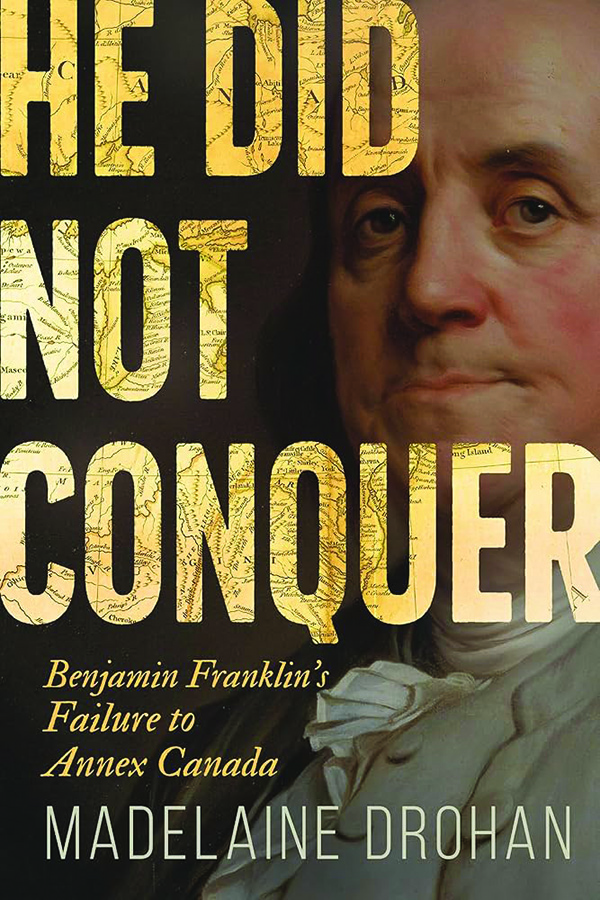
A fascinating historical example is Benjamin Franklin. This Founding Father devised several plans and strategies that, if successful, would have made Canada part of the U.S. colonies. While Franklin’s political and personal accomplishments are well known, his interest in America’s northern neighbor isn’t. Madelaine Drohan, a longtime Canadian journalist for the Globe and Mail and the Economist, examined his Canuck-ish obsession in He Did Not Conquer: Benjamin Franklin’s Failure to Annex Canada. “Had the British given in to Franklin’s entreaties in Paris,” she wrote, “the colonies that made up modern Canada would have been absorbed into the newly created United States.”
Franklin, like Trump, had a remarkably similar approach to Canada. Both men viewed the possibility of annexation as a means of expanding U.S. territory, power, and influence. While their initial attempts to bring Canada into the American fold were both unsuccessful, they similarly refused to give up on this idea.
Why was Franklin, described by Drohan as “the eighteenth-century equivalent of a rock star,” so keen on having Canada become part of the U.S. colonies? Several papers and historical documents are highlighted in her book that identify some reasons for his long-standing vested interest.
Observations Concerning the Increase of Mankind, Peopling of Countries, etc., a pamphlet written by Franklin in 1751, “dealt with the burgeoning population of the thirteen colonies and the need for more territory for the next generation of farmers.” There was also Franklin’s Albany Plan of Union and A Plan for Settling Two Western Colonies, both written in 1754, which suggested that “some of this expansion could be accomplished by buying land west of the Appalachians from the Indigenous peoples.” This land was considered by France “to be part of Canada, or New France,” and the American colonies “claimed belonged to them.” He wrote the Canada Pamphlet in 1760, also known as The Interest of Great Britain Considered with Regard to her Colonies, and the Acquisitions of Canada and Guadaloupe, which suggested that Britain retain Canada at the end of the Seven Years’ War. In Franklin’s view, “with Canada in British hands, the colonists’ security problems would disappear, and a huge new area would be open for expansion.”
Franklin was part of other attempts to bring Canada under American control, too.
He was appointed a commissioner in 1776, along with fellow Founding Fathers Samuel Chase and Charles Carroll of Carrollton, the only Catholic to sign the Declaration of Independence, and went to Montreal to “convince the Canadians to join the budding rebellion against the British ministry.” Franklin worked on his “British friends” in 1778 to support annexation. Drohan described that period thusly: Canada was a “mere pawn” that the Americans desired, the French wanted the British to keep it “but did not want the Americans to know,” and the British didn’t desire to possess it “but thought that might be better than any other outcome.” Franklin was a lead American negotiator during the 1782-1783 peace negotiations that ended the American Revolutionary War and tried to get Canada once more. Although Congress had specifically told him he couldn’t make the issue of annexation “a condition of any peace agreement,” he still suggested this idea would be “advisable rather than necessary.”
It’s also worth mentioning that Franklin’s autobiography nearly contained an eye-catching section about Canada. Drohan wrote that it was going to be labelled “Canada delenda est,” which is Latin for “Canada must be destroyed.” This section was never written, which was surely for the best. The Founding Father never conquered my country, and Canada “remained the prize that eluded him.”
Trump likes Canada far more than Franklin ever did, and obviously has no plans of destroying it. That being said, the prize of annexation is seemingly going to elude him, too. This is also a good thing. While it won’t immediately rebuild Canada-U.S. relations in the new political world that Trump has forcefully initiated, we’ll be able to give it the old college try.
Michael Taube, a columnist for the National Post, Troy Media, and Loonie Politics, was a speechwriter for former Canadian Prime Minister Stephen Harper.
