

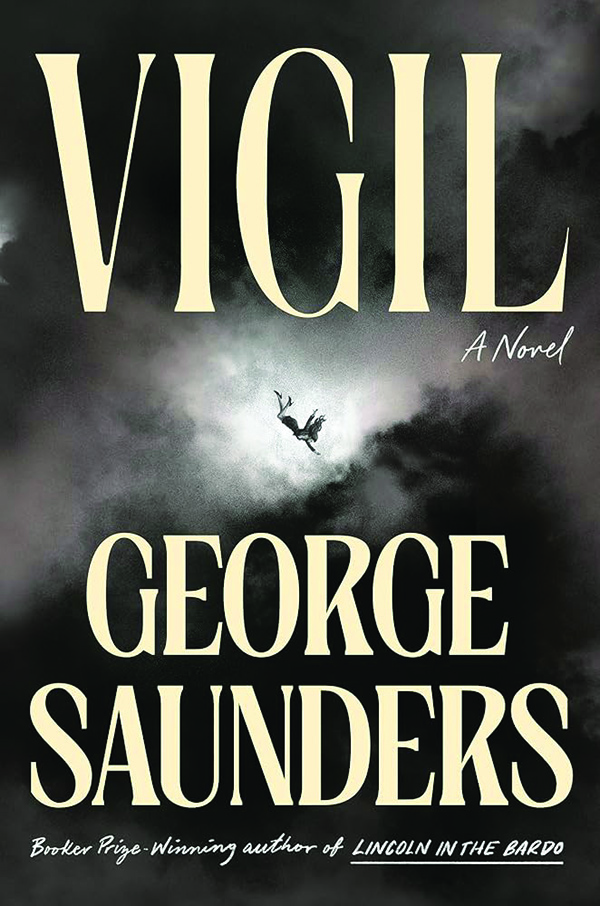
In his new novel Vigil, George Saunders puts us in the mind of an angel who crashes to earth for the purpose of comforting a dying sinner. Not just any sinner. Her “charge,” as she calls him throughout, is the kind of sinner some readers may think is least deserving of comfort.
K.J. Boone, the filthy-rich CEO of an oil company, made his fortune by polluting the planet, changing its weather, and lying about the effects of his product. He paid scientists to conduct studies that diminished the dangers of fossil fuels. He delivered a speech so effective, it led a president to “withdraw from that Kyoto debacle” — there is no mention of the Byrd-Hagel Resolution, in which the Senate voted 95-0 that the Kyoto Protocol’s terms were unfair. He was even friends with Dick Cheney.
Arriving at his deathbed to show him the error of his ways is the spirit of Jill “Doll” Blaine, who is also the novel’s narrator. Her modest life on earth ended tragically in 1976, when she was in her early 20s, because a man who meant to blow up her new husband blew her up instead. Floating around the planet ever since, she describes herself as “vast, unlimited in the range and delicacy of my voice, unrestrained in love, rapid in apprehension, skillful in motion,” and tasked by “our great God in Heaven” to “comfort whomever I could, in whatever way I might.” But she has a hard time with Boone because Boone — well, Boone’s a jerk.
Jill isn’t Boone’s only spectral visitor. Taking a more aggressive approach than Jill, a member of her “ilk” — Jill really likes that word — known as “the Frenchman” thinks that the only way to comfort Boone is by getting him to acknowledge his sins and then repent of them. He concocts different ways to show Boone the extent of his destruction: the communities he’s ruined, the species he’s threatened. This man — he’s not named, but we can ascertain that he’s Etienne Lenoir — invented the internal combustion engine and therefore feels responsible for Boone’s sins. Perhaps it’s strange to complain about credibility in a book as fanciful as this, but I have a hard time believing that Lenoir wouldn’t express any pride about his invention and the productivity and progress it fostered. Regardless, Lenoir’s efforts fail because, in fact, Boone already knows what Lenoir shows him. He just doesn’t care.
The efforts of Jill and Lenoir to enlighten Boone are countered by a pair of his former employees, who encourage him to hold fast to his proud vision of his accomplishments. These, it turns out, are devils. The logistics of how Jill and the otherworldly entities operate are clever, if still derivative. Jill can enter her charge’s “orb of thought” and completely understand their thoughts and feelings. She is no longer who she was in life — she is “elevated.” But Boone’s stubbornness and meanness upset Jill and provoke her to investigate her former life. The moving memories she shares, and the sad events she learns about, are some of the most compelling parts of the novel. When she eventually returns to Boone for his last breaths, her old self mingles with her elevated one, compromising her judgment and decision-making.
Jill’s character arc is far more interesting than Boone’s. The biggest problem with Vigil is that Boone is boring, a Sierra Club caricature of an oil executive, a Thunberg-certified concoction for the novel’s message about Big Oil and the environment. We learn a little about the villain’s upbringing — stern father, doting mother — and his relationship with his affectionate daughter, but it’s not enough to make him a complex character. Not even Jill’s journeys into his consciousness, during which she cedes her narrative voice to him, are enough to flesh out the novel’s central flesh-and-blood character. Boone is a cardboard cutout until the bitter end. The climate change plot, the oil executive on trial for his crimes against humanity and the earth, may be a clever variation on the fashionable literary subgenre of climate catastrophe fiction, but it is still predictable.
Vigil returns to the supernatural terrain Saunders explored in the Man Booker Prize-winning Lincoln in the Bardo (2017). Vigil is a much more modest and, as unusual as it is, less experimental work, though, and clearly aspires to be a more timely one. The most obvious literary precedent for this novel is Charles Dickens’s A Christmas Carol, but Boone is even more stubborn than Ebenezer Scrooge. There are also moments of violence and punishment that recall some of the more scatological moments from Dante’s The Divine Comedy. There are also, unfortunately, moments when ghosts from various generations gather that call to mind the sitcom Ghosts.
Saunders’s staccato style is generally engaging and propulsive, though it can become tedious. And Jill’s habit of putting some words and phrases from her life on earth in quotation marks — “One ‘Christmas Eve,’ when I had ‘stomach thingy,’ he ‘called in sick’” — may be meant to show her distance from that life, but it is a constant distraction. And then there’s the curious paragraph in which Boone’s daughter complains about “libdopes,” a term I had never encountered before, nor had Google when I searched for it, before explaining that her generation doesn’t use the actually existing insult “libtard” because it’s un-Christian. My hunch is that Saunders initially used “libtard” but an editor or sensitivity reader cautioned him against it, so the novel includes this clunky and unconvincing hedge.
What I enjoyed most about the novel are the questions that Jill’s attitude toward her charge raise about compassion and sympathy. Saunders’s last book, A Swim in a Pond in the Rain, was a study of short stories by Russian masters such as Leo Tolstoy and Anton Chekov, and sympathy plays an important role in it. Perhaps Saunders was inspired by those works to experiment with fellow-feeling plays out in Vigil. What bigger challenge is there for the sympathetic imagination of Saunders’s fans from the New Yorker than a callous, greedy, lying oil tycoon who doesn’t care that he’s poisoning the planet?
Jill ultimately summons some sympathy for Boone, but not because she understands his motivations, sees any goodness in him, or watches Landman. Instead, she has a fatalist vision of human behavior, believing that we’re all products of our circumstances, each of us “an inevitable occurrence upon which it would be ludicrous to pass judgment.” No human — not Boone, not the man who murdered Jill — has agency, so why condemn anyone for anything? This line of thought leads Jill to work an act of mercy toward Boone after his death, though she ends up regretting it. While Jill’s rationale for feeling compassion toward Boone is one of the more surprising directions the novel takes, her belief that he bears no responsibility for his actions, whether they’re sinful or not, is unlikely to satisfy many readers.
Christopher J. Scalia is a senior fellow at the American Enterprise Institute and the author of 13 Novels Conservatives Will Love (but Probably Haven’t Read) (Regnery, 2025).
