

Pennsylvania has become the ultimate swing state, a must-win for both parties in presidential races and a state willing to elect candidates of either party to statewide office. Republicans hold most of those jobs right now, but there are also two prominent centrist Democrats who have won statewide office more than once: Gov. Josh Shapiro (D-PA) and Sen. John Fetterman (D-PA).
But while the two share that nebulous label of “moderate,” the two men’s politics are quite different. They also can’t stand each other and reportedly have not spoken in years. So how can they occupy the same segment of the political spectrum?
It’s because that “moderate” label is essentially defined by what it is not, rather than what it is.
Shapiro is moderate in the way a politician is moderate. His tone is calm and even-tempered; his positions are far from extreme while remaining firmly within his party’s mainstream. He talks about working with Republicans on issues they both care about, but rarely does so except when there is no other choice.
Crown; 240 pp., $32.00
Fetterman is moderate in the way some voters are moderate. That does not mean occupying a middle ground on all issues, but rather that he has a collection of views from across the political spectrum without regard for what his party wants. His views do not align with any party’s platform or ideology, though he is clearly more left than right. And while he has said repeatedly that he would never become a Republican, he has voted with them at times when their proposals are closer to his own ideas than the Democrats’ are. His tone is not necessarily measured or calm — he just says things, take it or leave it.
Both men have recently penned political memoirs. And while such books are never perfect windows into the authors’ souls, they do contain some insights that explain the differences and similarities between Pennsylvania’s top Democratic officeholders.
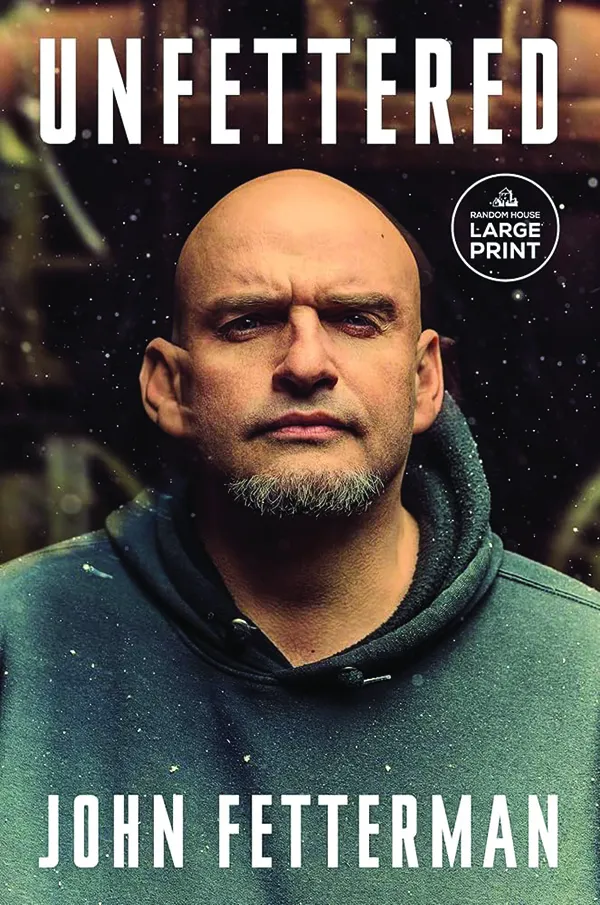
There are many reasons to write a political memoir, but none of them include a desire to tell the unvarnished truth about oneself. That said, Fetterman’s book, Unfettered, feels like it comes nearer to the mark on this point than most, if only because the book does not seem designed to make the reader think its author ought to be president.
While the book, written with the help of writer Buzz Bissinger, is intended as a full autobiography, the focus is clearly on the events of the past few years, beginning in 2022 when Fetterman became the Democratic nominee for an open Senate seat just days after suffering a debilitating stroke. It is also about the Pennsylvania that molded him — not his York County upbringing, but the early adulthood spent in Braddock, an Allegheny County town on the Monongahela River. Fetterman writes of a Pennsylvania that was used up, wrung out, and left for dead in the waves of deindustrialization of the 1970s and 1980s. As the mills closed, Braddock’s population declined from over 20,000 in 1920 to less than 10% of that number today.
Fetterman and the town of Braddock were both looking for a way to reinvent themselves, to find purpose in a world that no longer made sense to them. Fetterman ran for mayor in 2005 and won the Democratic primary by a single vote. He had an unusual look (6-foot-8’, heavily tattooed, typically scowling) and an unusual story: a transplanted white man with a graduate degree leading a poor, forgotten town with a majority-black population.
This and his left-wing politics made for catnip to journalists. The sort of liberal, upper-middle-class white progressives who would soon come to dominate left-wing politics found in the unlikely mayor a kindred spirit and political icon. Twenty years later, these same people can’t stand Fetterman. What happened?
The days when he first ran for statewide office in 2016, Fetterman explains, were a time “when supporting same-sex marriage, a fifteen-dollar minimum wage, and legal weed (all tenets of my 2016 campaign) was considered very progressive and something no traditional candidate had yet embraced.” Fetterman still believes in these things in 2026, but they’re no longer outre beliefs — they’re the Democratic Party mainstream. Indeed, you could probably find some Republicans willing to sign on to most or all of those policies.
It’s a cliche, but Fetterman didn’t leave progressivism, progressivism left him. He came to the party through unconventional means, ran against establishment candidates, and once elected lieutenant governor in 2018, did not really feel he owed any allegiance to the powers that be. In an age of declining party power and rising cults of personality, that can be a winning formula.
Successful or not, it ensured that Fetterman would clash with the establishment politicos once in office, including his fellow state Board of Pardons member, then-Attorney General Shapiro. Pennsylvania’s Board of Pardons is a conservative institution, not in the political sense but as a matter of temperament. In contrast to the pure prerogative that is the federal pardoning power, the commonwealth’s version is fully bureaucratized. The officeholders who sit on it have traditionally had little incentive to grant clemency. Every pardoned prisoner who reoffends is a horror story to hang around the board members’ necks, a nightmare for politicians aiming at higher offices.
Shapiro approached the job that way, as did most others. Fetterman did not. His advocacy for clemency in the case of Philadelphia brothers Dennis and Lee Horton, who had been in prison for murder since 1993, became personal. Fetterman calls his dispute with Shapiro “philosophical,” but the way he writes about the Hortons suggests that the philosophy is founded in emotion as well as reason. When Shapiro opposed the case for clemency, Fetterman says he became “upset because this, in my mind, was a travesty.” Shapiro was, by that time, known to be planning a run for governor. Fetterman writes that he told Shapiro he would jump into the gubernatorial race himself unless Shapiro backed down on the Hortons. Shapiro changed his mind, and the Hortons were granted clemency. Fetterman ran for Senate instead.
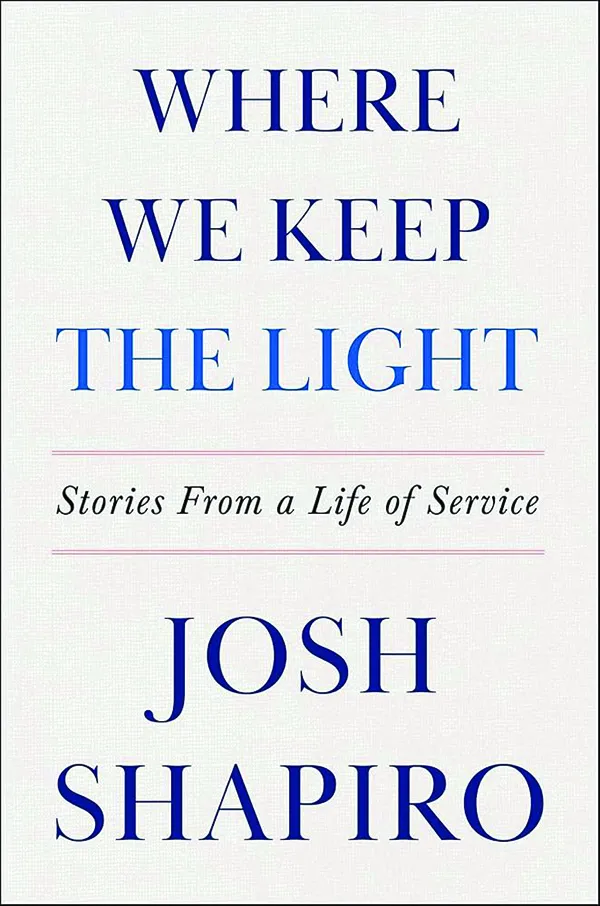
It would be interesting to hear Shapiro’s side of the story, but he never mentions the Horton brothers in his own memoir. Indeed Where We Keep the Light, released this year and written with the help of journalist Emily Jane Fox, only mentions Fetterman twice and ignores the long-running feud entirely. The book is a longer, more detailed, and more typical political memoir, one that seeks to portray its subject as reasonable, hard-working, and above all, electable.
In that vein, Shapiro is not likely to write much about long-running beefs with fellow Democrats, of which he has many. In a 2025 piece on Shapiro in the Atlantic, Tim Alberta notes that “the worst-kept secret in Pennsylvania politics is that the governor is disliked — in certain cases, loathed — by some of his fellow Democrats.” That said, Shapiro does not completely ignore this issue. His falling out with erstwhile mentor Joe Hoeffel is addressed but presented as necessary: Shapiro ran for a county commission seat, ultimately muscling out the incumbent Hoeffel. “I wanted the Democrats to have a shot, and I knew that I could get it done.”
The Shapiro that comes across in these pages is a man concerned about public service and deeply ambitious for higher office. He has never lost a race for public office, and the secret, in his telling, is hard work. Shapiro is a grinder. The same relentless drive that got a 5-foot-8’ kid to start for his high school basketball team got an outsider candidate to defeat an established GOP politician for a state house seat that had been Republican for twenty years. Abington Township, where Shapiro was raised and still lives, was trending Democratic by the time he ran for that seat in 2004, but Shapiro’s 10-point victory there was a surprise.
The relentless grind and ambition stand in stark contrast to Fetterman, who, throughout his own memoir, recalls doubt about whether he should even be in politics. Nothing about Fetterman’s ascent seems planned out; he is more like a man buffeted by the winds of fate who finds himself, against all odds, in the United States Senate. Shapiro, on the other hand, has appeared from the beginning as a young man in a hurry, a climber with his eye on the next job as soon as he’s sworn into the current one.
In seeking to achieve those goals, Shapiro has presented himself as a moderate voice in a party that is increasingly radical. That was wise twenty years ago in Montgomery County, Pennsylvania, where Republicans had dominated government since the Civil War era. He notes that as county commissioner, he implemented zero-based budgeting, an idea beloved of fiscal conservatives. “Rather than relying on previous budgets, we would go through every single expense and justify us either keeping it or cutting it as if it was the first time we were funding anything.”
Policies like this eased the county’s transition from Republican to Democratic. Shapiro and his running mate Leslie Richards were not wild-eyed liberals, and you could trust him with your money! But he and Democrats in the state legislature have declined, thus far, to apply the same rigor to the state budget.
That is part of what makes his status as “moderate” so difficult to accept. Shapiro has an extremely moderate temperament and certainly looks and sounds like a person you would associate with moderation. He avoids being counted as progressive because he takes two positions that the progressive wing of the party could never accept: support for Israel and rejection of socialism. But in what other way can Shapiro truly be called “moderate?”
His tone and policies are carefully calibrated to be at the center of the Democratic Party. Unlike Fetterman, he never mentioned same-sex marriage in his early campaigns. But in 2013, he authorized the county government to issue marriage licenses to same-sex couples in violation of state law. Shapiro presents this as a personal principle. Maybe it was. But it was also the same time when a majority of national opinion had shifted to be in favor of same-sex marriage. Is that a coincidence?
Part of what voters like about moderates in government is that they will work with the other party when their principles demand it. Shapiro talks about this a lot, but the effort ends with rhetoric. He speaks favorably of certain Republicans, but only after they are safely retired or dead. Ellen Bard, his predecessor in the legislature, and Denny O’Brien, a Republican colleague there, are singled out with the Shapiro-esque compliment that in today’s politics, they’d probably be Democrats. High praise!
But what about today’s actual Republicans? One GOP pal who is not mentioned is Mike Vereb, a former state legislator who served in the governor’s cabinet. Vereb was forced out of office in 2023 following a sexual harassment scandal for which the state government paid a six-figure settlement. How much did the governor know about it? His administration has been fighting local media records requests about the matter for the two-and-a-half years since.
Fetterman, meanwhile, has met with actual Republicans, including even President Donald Trump. He has found common ground with his Republican colleague, Sen. Dave McCormick (R-PA), and it has extended beyond rhetoric: Fetterman was in the group of eight Democrats in the Senate who voted to end his party’s filibuster of the appropriations bill in 2025. That is moderation in action, not in words.
When surveyed, voters often talk about wanting leaders who are not bound by party allegiances, people who mean what they say and say what they mean. But when it comes down to it, that is not who they end up voting for. Shapiro’s moderate center-leftism is undefeated on Election Day, and a recent survey from Quinnipiac gives him a plus-27 percentage point approval rating. The same poll shows Fetterman at plus-6, but at 40 points underwater with his own party.
It’s a strange disconnect. Fetterman is a moderate in the way voters are, and in the way they say they want, but such is the tribalism of our time that his rare defections from the Democratic Party line have rendered him untouchable to many of them. Meanwhile, Shapiro floats steadily to the left, but in the same way as his party’s mainstream, to their great delight.
These two moderates will never be moderate in the same way. Fetterman is what he is. Shapiro is whatever the median Democrat wants him to be.
Kyle Sammin is the managing editor of Broad + Liberty.
