

Ochlocracy. Now, there’s a classic $10 word common from the American founding era that should make a comeback. (But probably won’t).
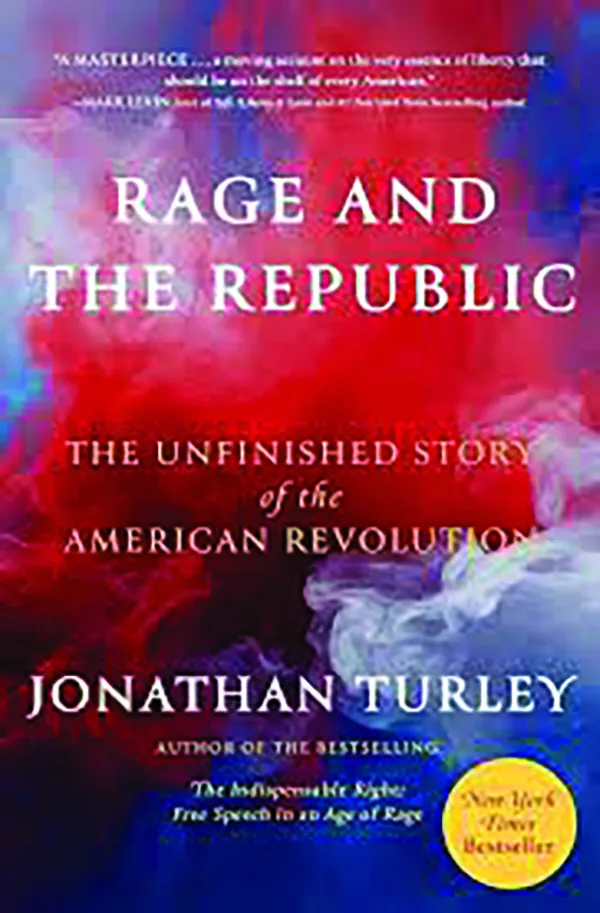
Jonathan Turley’s new book, Rage and the Republic, is fundamentally concerned with the problem of ochlocracy. Or, as most people know it: mob rule. A legal scholar and a self-described classical liberal, Turley gives his readers a rousing defense of liberty. Individual rights, protected by a counter-majoritarian U.S. Constitution and an Adam Smithian “Liberty Enhancing Economy,” is the only real practical solution to problems faced by 21st century Americans. Political concerns such as rising factionalism, a disregard for the nation’s duly passed laws, and an increasing acceptance of physical violence, all along with economic disruptions associated with artificial intelligence and robotic manufacturing, could tear apart the American experiment in self-government.
Turley makes this case by tracing a line from ancient Athens to 1770s Philadelphia, to the French Revolution, and ending with current events. In each case, Turley warns about how the tyranny of the majority can (and did) quickly trammel individual rights.
Although joined by the who’s who of Revolutionary-era American founders, Thomas Paine serves as the central organizing figure throughout. If writing about both the American and French Revolutions, Paine is an obvious choice given that he played an important role in both. Once Paine arrives in Philadelphia in the mid-1770s, he quickly gains acclaim as a brilliant writer and polemicist. His early 1776 pamphlet, Common Sense, provided the rhetorical support for independence, turning the contest with Great Britain and her North American colonies into something much more than a tax revolt.
In 1779, as the Continental Dollar entered an inflationary tailspin, Philadelphia was beset by class warfare. Price controls were instituted to deal with the rising cost of flour and firewood, but this was quickly abandoned. Members of the Associators (a radical Philly militia unit, the spirit of which lives on in those Eagles fans who throw ice at Santa) soon paraded in the city to make their presence and economic grievances known and rounded up wealthy Tories to see if they were hoarding foodstuffs. Upon coming to the home of James Wilson (who was decidedly not a Tory), someone fired, either to or from the house, starting the Fort Wilson Riot. The riot itself was quickly put down by the Philadelphia City Cavalry, but in Turley’s estimation, the incident exposed the real potential of revolutionary America to descend into mob rule. Luckily for the new country, founders such as James Madison designed a federal constitution that could harness interested factions and channel those energies into productive legislative debate while providing for the maintenance of individual rights and property.
Paine, a Jacobin of the Girondist persuasion, quickly came into odds with the Mountain, the more radical of the two factions. After seeking to have Louis XVI exiled to the United States instead of guillotined, he soon became a target of Robespierre and Saint-Just. Paine spent most of 1793 lying low, until he too was arrested and sent to prison along with other “counter-revolutionaries.” During the Thermidorian Reaction, Paine was freed. Despite this experience, he never lost his enthusiasm for the French Revolution and would write pamphlets defending the Directory until eventually returning to the U.S. In New Rochelle, he would toil in virtual obscurity before dying in 1809.
Towards the end of Rage and the Republic Turley admits that, “I love Thomas Paine. I just wish I liked him.” Paine had done as much as any other writer to motivate the populace of British North America toward independence with Common Sense and then hardened the resolve of the colonists to see it thoug with his American Crisis essays. Without Paine, the American Revolution could have looked much different.
But Paine had also travelled to France to throw in his lot with the Jacobins, and even after being freed during the Thermidoran Reaction spent his remaining days defending the murderously dictatorial Directory and the French Revolution. As Turley goes at length to show with his analyses of Paine’s influence on the French Revolution, he could get caught up in a movement that goes too far by advocating for the tyranny of the majority. Ochlocracy may have gotten the better of Paine. He was a halfway Madisonian constitutionalist.
While I share Turley’s classical liberal ethos and broad understanding of these events, I would be remiss if I didn’t point out that Turley makes numerous mistakes dealing with the ins and outs of the French Revolution. He sometimes takes Paine’s writings out of context.
In one forgivable instance, he states that Jean-Paul Marat was executed by the guillotine on the Champ-de-Mars, but this is odd because just a few pages later, Turley details Marat’s death at the hands of Charlotte Cordray. It is hard to remember how all the revolutionaries met their fate, after all, but Marat’s is especially memorable given that it took place while he was taking a bath.
In a less forgivable instance, Turley cites Paine’s April 20, 1793, letter to Jefferson, in which he describes an “Extraordinary Crisis” in France, to be about the execution of Louis XVI. The context of this quotation is about General Charles Dumouriez’s defection to the Austrians.
Turley also discusses Paine’s 1797 pamphlet, To the People of France and the French Armies, as a moment when the writer suffered a shocking and hypocritical crisis of free speech. “In April 1797,” Turley explains, “there was a crackdown by Republicans on critics, including making it a crime punishable by death to call for the restoration of the monarchy. Paine supported the measure and asked, ‘Shall the Republic be destroyed by the darksome manoeuvres of a faction, or shall it be preserved by an exceptional act?’ It was a shocking statement from a man who was charged with sedition in England for criticizing the King.”
There’s some misunderstanding here. Looking at the pamphlet in full, Paine’s quote was not against free speech per se, but rather in favor of the military coup of 18 Fructidor. (The French Revolutionaries invented new names for months of a new calendar they started at 0.) The French elections of March and April 1797 returned a Royalist supermajority to both the Council of 500 and the Council of Ancients, which were the bicameral legislatures established by the French Constitution of 1795.
Among the first things the new Royalist majority did was to repeal the law imposing the death penalty on royalist emigrants who had fled France during earlier stages of the Revolution. The Jacobins, rightly fearing that the royalists were plotting to restore the monarchy with reinforcements from abroad, launched the coup of 18 Fructidor on Sept. 4, 1797, to remove royalist control from the legislature. This coup was the “exceptional act” referred to by Paine, not an imposition of the death penalty on royalists. Granted, I’m sure that Turley and other Madisonian constitutionalists would agree that justifying a military coup against a democratically elected bicameral legislature is still pretty bad. But it’s not exactly an attack on free speech! At least Paine was consistent here.
In a work of this nature, I think it’s important to get these small things right. But given the complexity of the French Revolution and debates over American political economy, it is fully understandable that such errors can work their way into the analysis. These quibbles about proper historical interpretation aside, Rage and the Republic will be valuable reading for anyone interested in how democratic movements often degrade into ochlocracy.
Andrew Fagal is a historian at Princeton University.
