

It is rare that political pundits wax philosophical, and probably not advisable when they do. Yet in the first week of the revived American-Israeli war with Iran, most American commentators shared the exasperation of the pre-Socratic philosopher Democritus: “I would rather discover one true cause than gain the kingdom of Persia.”
The new war with Iran, dubbed Operation Epic Fury by the Trump administration, is a resumption of a recent war, the 12-day war of June 2025 that detonated Iran’s nuclear ambitions with a bang in Operation Midnight Hammer. Both wars are the beginning of the end of a much older war, the one that began on Nov. 4, 1979, when Iranian revolutionaries stormed the U.S. Embassy in Tehran and took 66 Americans hostage. And this war and the 12-day war are also outcomes of the war that began on Oct. 7, 2023, when Hamas jumped the gun and the Gaza fence and launched a war against Israel. Iran’s other proxies joined in, and Israel leveled them one by one before striking Iran’s nuclear program with American support.
Major events rarely have one true cause. Certainly not in the Middle East, where history is the present and infinite grievance makes a Sicilian with a grudge look mild and forgiving. This complexity explains some of the uncertainty surrounding the Trump administration’s motives and objectives. The administration hardly helped itself in this regard. On Feb. 28, after American and Israeli missiles had killed Ayatollah Ali Khameini, President Donald Trump, ruminating with customary expansiveness, described his war aims as preventing Iran from developing nuclear weapons, destroying its ballistic missile capability, and, almost as an afterthought, inspiring the Iranian people to revolt: “When we’re finished, take over your government.”
Much of the uncertainty is derived from bad memories. The Global War on Terror is still going on, regardless of the changes of name and theater. The long war with Iran predates it, but historians have identified the 1979-80 Islamist takeover in Iran as its real beginning. Americans’ trust in their government has declined sharply since 2001. The money-burning, bloodshedding mission creep of the GWOT has played a big part in that. It is no more than sensible to fear the worst when a war is launched without a clear exit plan.
The media accepted the invitation to replay an older script. A battalion of veteran pundits dusted the sand off its Iraq War commentary and warned of the perils of forever wars and “boots on the ground,” and the delusions of regime change, especially “regime change from the air.” The baboons of the online Right revived the specter of the neoconservatives. Tucker Carlson frowned even more chimpishly than usual as he opened a new front in his war against Israel and the Jews. Everyone had a splendid time, especially when a clip of Marco Rubio was edited so it sounded like the secretary of state was admitting that yes, Israel forced us to do it.
The reality is that the Trump administration’s one-two punch against Iran bears little resemblance to the GWOT’s march of folly into the middle of nowhere. The U.S.-led expeditionary force that invaded Iraq in 2003 differed little in method and intent from the one the British Empire sent in 1916 to put boots on the ground in what was then an Ottoman Turkish province. The “shock and awe” that blew open the road to Baghdad was the logic of Sherman’s March to the Sea, written in sand: massive force, followed by occupation. This war began as the January 2026 raid on Venezuela ended, with regime decapitation. Trump seems determined to end the assault in about four weeks.
This is a different war, fought in a different time. In 2003, America was a global hegemon with no challengers. It is now the heavyweight champion, but the contenders are limbering up. Americans, as Trump found to his electoral advantage in 2016, are tired of foreign wars. They would like to forget about the Middle East in particular. But the United States cannot afford to relent its grip. The republic votes for disengagement, but the empire cannot disengage.
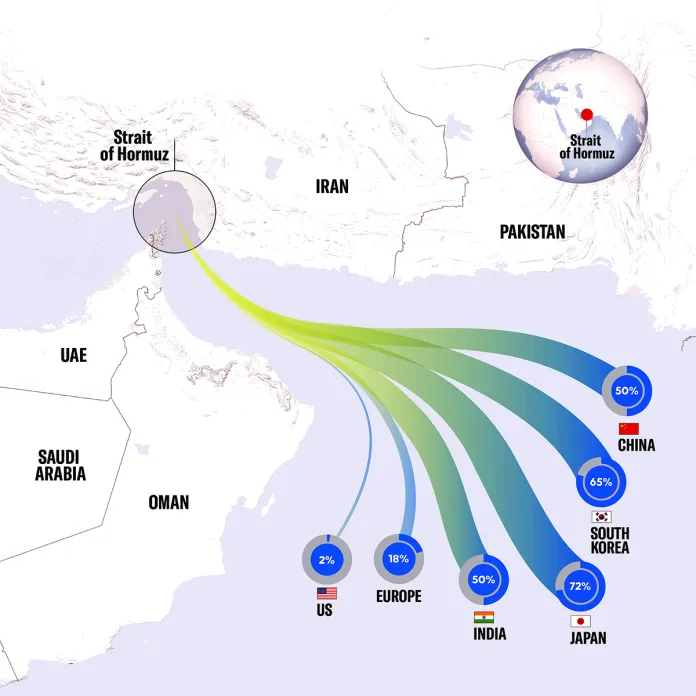
Despite decades of state-mandated environmental apocalypticism and the hyped promise of solar panels imported from China, Middle Eastern carbon energy is still critical to the global economy. Strategically, it might be more important today than it was in 2003. While America was tied down in the Middle East, China grew its economy and influence — and China runs on imported carbon energy. More than half, 55%, of Venezuela’s oil exports went to China in 2025, about 17% of China’s oil consumption. Despite America’s sanctions, nearly 90% of Iran’s exported oil went to China in 2025 at a rate of 1.4 million barrels per day.
Yet success in Iran and the wider region requires more than blocking China. The Kissingerian balance of power that the U.S. established in the Middle East in 1973 was unmade by the George W. Bush administration after 2003. Its ruins were destroyed by the Obama administration’s attempt to create a balance of power between Iranian and Israeli nuclear weapons. These self-inflicted defeats allowed Turkey and Iran to reassert their historic roles as regional arbiters. The U.S. still lacks a regional security architecture in a central theater and still relies on violent improvisation, mostly to protect its allies, Israel and the Sunni Gulf monarchies. But the ground is moving beneath everyone’s feet.
The Middle East is not the same place, and not just because of the collapse of Syria and Iraq. Iran is no longer the missing piece of the jigsaw in the Middle East. The Middle East that we knew and failed to understand is now part of West Asia — and that expanded theater is where the outcomes of the latest Iran war will matter.
East was East
In the mid-19th century, the geographers of the British Empire divided “the East” into three, in the way of “triple-decker” novels or Julius Caesar’s description of Gaul. The “Near East” was the Ottoman Empire, whose territories reached into the Balkans, North Africa, and Arabia. The “Far East” covered what Americans now call East Asia — China, Japan, Korea, and Taiwan — but it also included territories that Americans place in Southeast Asia, such as modern Indonesia. The “Middle East” was everything between the Near and Far Easts, minus British India: Persia, the Persian Gulf, the adjacent Caucasus, and Turkic-speaking inland regions of central Asia. After the opening of the Suez Canal in 1869, British interest in this Middle East meant naval bases and coaling stations that guaranteed the “India Route.”
In the 1902 article “The Persian Gulf and International Relations,” the American naval strategist Alfred Thayer Mahan used “Middle East” to describe the land and sea between Arabia and the west coast of India, with the Persian Gulf as its key waterway. As a naval strategist, Mahan focused on the coasts more than the hinterland. But when the British adopted this version of “the Middle East,” they moved its western edge westwards to include the Suez Canal. As there was no more “Near East,” because there was no more Ottoman Empire, Turkey drifted into the Middle East. But the Turkic peoples of the Soviet Union were no longer Middle Eastern. They were Soviet.
This is the Middle East we know, or knew: Arabia, plus Turkey and parts of Egypt to the west, and Iran to the east. It starts in the west at the Bosphorus, the Mediterranean coast, and the Suez Canal. It ends in the east on the border between Iran and Afghanistan in the East Iranian mountains, or perhaps a little further east in the Hindu Kush. Sometime in the 1980s, Western academics expanded it further into the Middle East and North Africa. MENA sounded less imperial. Its impression of Islamic singularity appealed to the leftward drift of the academy and the agencies of the United Nations. But it made little difference in the real world. More consequentially, the W. Bush administration used “Greater Middle East” and added, or restored, the Caucasus and the Central Asia “-stans” to the Middle East.
A quarter of the way into the 21st century, the geostrategic map is changing again. On a map from the McKinsey Global Institute, the center of global economic gravity steadily shifts westward, from Central Asia in the early 1800s to northern Europe and the North Atlantic for most of the 20th century. Since 2001, when China entered the World Trade Organization, the fulcrum of exchange has tracked rapidly back east. It was last seen in 2025, near Novosibirsk, southern Russia. It is now presumably somewhere in the Altai Mountains, where the borders of Kazakhstan, Mongolia, Russia, and China meet, and will soon be in China.
The rise of China preoccupies America’s politicians, pundits, and patriots, but it is not the only story here. Across Asia, historic trade systems that were distorted or annexed by European empires have reappeared in modern guise. A mesh of new trade and security relationships is appearing. The post-2020 Abraham Accords normalizing relations between Israel and the United Arab Emirates, Bahrain, Sudan, and Morocco are the best-known among several initiatives that both alter the balance within the old Middle East and frame it within the new West Asia. They include the India-France-UAE trilateral on defense, energy, and technology cooperation that formed in February 2023; the India-Middle East-Europe Corridor, announced in 2024 and intended to run from India to the UAE, Saudi Arabia, Israel, and Greece; and the Pakistan-Saudi Arabia defense agreement of September 2025.
On Feb. 25, three days before the war began, Indian Prime Minister Narendra Modi visited Israel. Addressing the Knesset, he offered “the greetings of 1.4 billion Indians, and a message of friendship, respect, and partnership” as “a representative of one ancient civilization addressing another.” While the Israel-India partnership is built on defense technology and current security concerns, India’s deep investments in the Gulf monarchies are welding the Middle East to a revived Indian Ocean trade system. A region that functioned as a single zone under the British Empire, then fractured in the postcolonial era, is reuniting on new terms.
“It’s not a return of history,” Mohammed Soliman told me on a Zoom call from his native Cairo. “It’s a hybrid, some of the old and some that’s very new.” Soliman, a senior fellow at the Middle East Institute, is the author of West Asia: A New American Grand Strategy for the Middle East. A realist thinker, he believes that Americans should understand West Asia as “the rise of the Gulf and the rest of Asia,” and not just as “the shadow of the question of Chinese dominance.” His book recommends that the U.S. become the “offshore balancer” of the emerging West Asia.
“The rise of the Gulf is an exceptional chapter of history,” Soliman told me. “There’s not really a historical precedent for it.” The Gulf states are “the nerve center that’s integrating West Asia” and integrating West Asia with eastern Asia. Japan launched the UAE’s mission to Mars. South Korea built the UAE’s nuclear power program. The second-biggest market for Japanese cars after the U.S. is Saudi Arabia. About a quarter of the 35 million Indians living abroad are in the six Gulf Cooperation Council states, but they send 40% of India’s remittances.
Iran has missed out on this regional remaking, even though Persia was always a regional power. The U.S. has encouraged it but not formally formulated a West Asia policy or integrated it into the “pivot to Asia.” The American-Israeli war against Iran, which Iran’s response turned into an American-Israeli-Arab war, may open the way to Persia’s return to history and America’s overland pivot to Asia.
The return of Persia
“Persians are never defeated, the people tempered and brave,” the Chorus warns in Aeschylus’s The Persians. In truth, Aeschylus’s people defeated the Persians several times and were shaped by those struggles. Before Xenophon concluded Thucydides’s History of the Peloponnesian War in Hellenica, he led the Ten Thousand, Greek mercenaries in the pay of Persia, whose epic of West Asian intrigue and bloodshed that he recorded in Anabasis. As Democritus discovered, complex events rarely have one true cause.
West Asia, Soliman said, is not a single order, but a web of overlapping networks and “multiple orders that exist in the same space.” Right now, Soliman said, Turkey is the main challenger to the emerging “Indo-Abrahamic” architecture of West Asia. Turkey is building an “Indo-Islamic axis” of its own. But Soliman believes that Turkey can work within the regional system. Iran is outside it and outside all systems. “Iran didn’t do what Pakistan did with China, integration on the military side. They didn’t do what Indonesia did with China, integration on the economic side. And they didn’t come to the other side when it came to Gulf integration.”
The conundrum for the U.S. is that one of its main reasons for fostering the rise of the Gulf, the Abraham Accords, and security ties with India was that they served as counterweights to Iranian hostility and exploited the millennial distrust of Arab Sunnis for Persian Shias. Now, as the Middle East becomes West Asia, Iran becomes more important, not less. The missing piece of the jigsaw is even more central because the jigsaw is now bigger. The U.S. needs Iran to fit in, without trouble, with a system that is working around Iran. But the system, especially in its Arab components, is brittle.
The U.S. cannot counter China without Iran. The U.S. can stave off a nuclear Iran indefinitely by “mowing the lawn.” But this will burn through depleted stocks of weaponry in a military that has been at war for more than two decades.
THE FRIENDS OF JEFFREY EPSTEIN
Trump needs to declare a win before the November midterm elections. It would be the final victory over former President Barack Obama and the final rout of the Clintonites. It would lay the ghost of the over-extended, underthought interventions of the GWOT. But there is no guarantee that a time-limited campaign of destruction will flip Iran into West Asia. There is no certainty that Iran will not collapse under pressure into its Persian core, with all the Aeschylean implications. There are already rumors that Iran’s multiethnic society is fraying at the edges, with the Sunni Baloch of the east looking to Pakistan, and the Sunni Kurds of the west receiving weapons from the CIA and Israel.
West Asia remains the Middle East at its core. If the hard lessons of the last decades teach us anything, it is to ask for little and expect the worst. The least we can hope for, at least for now, is that a new regime will emerge from the rubble of the old and trade its survival and the stability of the state for dropping its nuclear program. But Iran will remain a nuclear threshold state even if the ideal American solution, a democratic pro-Western ally, comes to pass. West Asia is a new era in a new territory. As Xenophon wrote when he and his men realized they had to retreat, “Separated from Hellas by more than a thousand miles, they had not even a guide to point the way.”
Dominic Green is a Washington Examiner columnist and a fellow of the Royal Historical Society. Find him on X @drdominicgreen.
