

In the 2003 Iraq War, the opening salvo was designed to demoralize the Iraqi military with a dazzling display of America’s unmatched airpower, lighting up the night sky over Baghdad with cascading explosions that saw air defenses and communications nodes decimated.
The demonstration of overwhelming force was dubbed “shock and awe,” first by a defense analyst, then adopted by the media and the military as a bumper sticker touting America’s unmatched military prowess.
But as impressive as it was for its time, the beginning of Operation Iraqi Freedom against Iraq paled in comparison to the first day of Operation Epic Fury, in which the United States, together with Israel, delivered punishing airstrikes at an intensity not seen before in modern warfare.
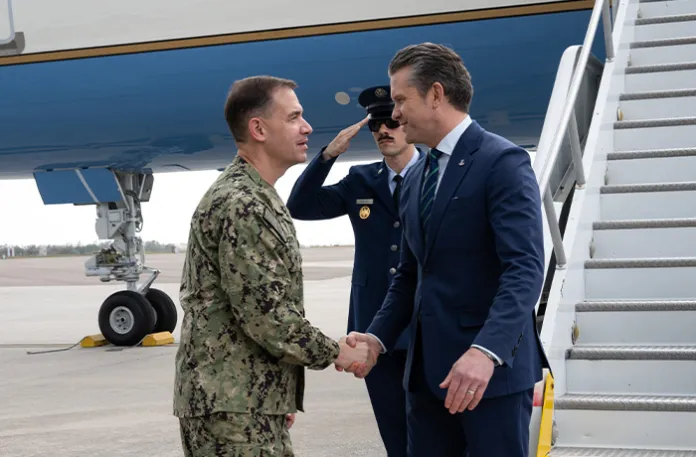
“Many of you may remember the ‘shock and awe’ strikes of 2003. The first 24 hours of this operation, we’re nearly double the scale,” Adm. Brad Cooper, head of the U.S. Central Command, said in a video three days in. “And we continue with 24/7 strikes into Iran from seabed to space and cyberspace.”
The Iran war has provided a demonstration platform for the quantum leap in technologies that has occurred over the past two decades and that have given the U.S. military — always the best trained and best equipped of any military in the world — a decisive advantage over its opponents.
“The results have been incredible. Historic, really,” War Secretary Pete Hegseth gushed at a Pentagon briefing after the first four days of bombing. “Only the United States of America could lead this, only us.”
In that first 100 hours, U.S. warplanes — including F-35 stealth fighters, B-2 stealth bombers, and older, but upgraded F-15s, F-16s, F-18s, F-22s, A-10s, and B-1 and B-52 heavy bombers — essentially neutralized Iran’s air defenses and degraded its missile launching capabilities, hitting nearly 2,000 targets with more than 2,000 munitions.
While the order of battle for Epic Fury included some of the most expensive and “exquisite” weapons in America’s arsenal — aircraft carriers, Patriot and THAAD batteries, and Tomahawk cruise missiles, the first major war of the second quarter of the 21st century also saw the introduction of cheap, but effective “attritable” drones that will play a starring role in future wars.
Among the new weapons is an American version of the Iranian Shahed drone that Russia has been using to bombard Ukraine on an almost daily basis.
“We captured it, pulled the guts out, sent it back to America, put a little ‘Made in America’ on it, brought it back here, and we’re shooting it at the Iranians.”
The U.S. also debuted LUCUS, an acronym for Low-cost Uncrewed Combat Attack System, and the long-range Precision Strike Missile, or PrSm.
But the real force multiplier for modern warfare is the exponential growth in the capabilities of artificial intelligence, in particular the AI tool Claude, a product of Anthropic, the tech company that Hegseth has banned and wants to label a security risk.
Anthropic CEO Dario Amodei is suing the Pentagon, arguing it is being unfairly punished for insisting on guardrails that would prevent its AI from being used to build autonomous killing machines or for conducting mass surveillance of Americans.
Hegseth is punishing the company because, he says, the Pentagon will not let any defense contractor dictate how the U.S. military might use its weapons.
Nevertheless, Anthropic’s Claude is embedded in the U.S. military’s Maven Smart System, built by Palantir, and which — according to a report in the Washington Post — is able to synthesize data from satellites, surveillance, and other intelligence to provide real-time targeting and target prioritization to military planners.
The result: 1,000 first week targets selected and sorted by their military value.
“Maven, powered by Claude, suggested hundreds of targets, issued precise location coordinates, and prioritized those targets according to importance,” the Washington Post said, citing sources.
“The pairing of Maven and Claude has created a tool that is speeding the pace of the campaign, reducing Iran’s ability to counterstrike and turning weeks-long battle planning into real-time operations.”
The Maven system is not included on the fact sheets published by the U.S. Central Command, but they include the disclaimer that among all the military assets listed are “special capabilities we can’t list here!”
In a video update on the 12th day of the war, Adm. Cooper, who is commander of Operation Epic Fury, credited the success of the campaign to a “combination of lethality, decision, and rapid innovation.”
“We are achieving lethal effects in entirely new ways,” Cooper said. “Our warfighters are leveraging a variety of advanced AI tools. These systems help us sift through vast amounts of data in seconds so our leaders can cut through the noise and make smarter decisions faster than the enemy can react.”
“Humans will always make final decisions on what to shoot and what not to shoot and when to shoot,” Cooper said, “But advanced AI tools can turn processes that used to take hours and sometimes even days into seconds.”
Because artificial intelligence was used to create a target list for the first day of the war in lightning speed, and because an elementary school for girls was apparently hit by a U.S. Tomahawk cruise missile on that day, many people on social media began to suspect AI, without proper human oversight, might be to blame.
But according to the New York Times, an ongoing investigation by the U.S. military has concluded the targeting mistake was a human error caused by coordinates provided by the Defense Intelligence Agency, which had not been updated to reflect that the school building was no longer part of the adjacent Iranian base.
Iran, too, is reportedly using AI in its targeting, albeit a more primitive, open-source version available from a Shanghai satellite company, MizarVision.
“MizarVision has been posting satellite photos of U.S. military activity throughout the past week to social media, including the movement of naval vessels and the location of both combat and support aircraft,” according to the website Flight Global. “A number of the facilities and assets posted by MizarVision were subsequently targeted by Iran in missile and drone strikes.”
TRUMP SAYS THERE WILL BE NO DEAL WITH IRAN OUTSIDE OF ‘UNCONDITIONAL SURRENDER’
Before the U.S. attacked, MizarVision published free AI-annotated imagery of American military positions throughout the region, including F-22s in Israel, AWACS in Saudi Arabia, and THAAD batteries in Jordan.
Between March 1 and March 2, a $500 million radar for the U.S. THAAD air defense system, based in Jordan, was hit by what appeared to be more than one Iranian drone and destroyed.
Jamie McIntyre (@jamiejmcintyre) is the Washington Examiner‘s senior writer on national security.
