

What does a Jefferson scholar do with a small clipping of Alexander Hamilton’s hair?
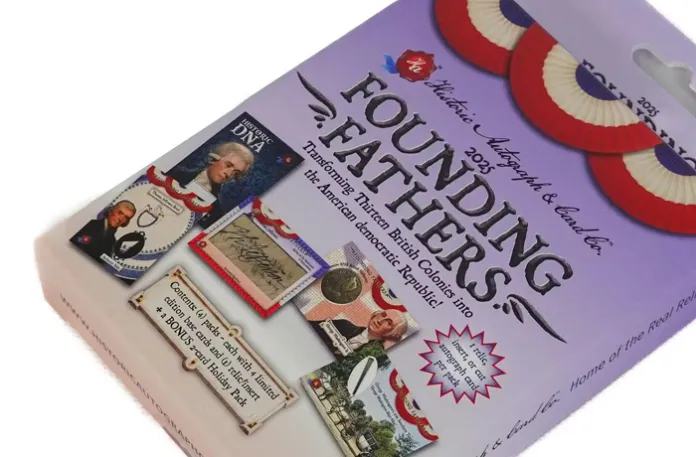
This was the question that confronted me when I cracked open a pack of the Historic Autograph & Card Co.’s 2025 Founding Fathers Box. A sucker for any type of collectible cards (a fault inherited from my father), from Magic the Gathering to football, I couldn’t resist when I saw an online ad for cards where I could “own a piece of history.” Before I knew it, I had pressed “buy it now,” and a box of cards was headed to my door.
Each pack, four-to-a-box, contains a handful of “history cards,” or, more accurately, the “commons” of the set. These depict individuals and events from the American Revolution and Founding Era, such as Benjamin Franklin, Crispus Attucks, and Abigail Adams. Each one also contains a brief history lesson on the back. For instance, the Henry Knox card reveals that he “was the first United States Secretary of War under George Washington” and that “In 1775, Knox undertook a daring expedition to transport captured artillery from Fort Ticonderoga in NY to Boston, where it was used to drive the British from the city.” Pretty standard stuff, really, and I normally wouldn’t spend my money on this. They might be good for my children as a way to teach the basics, but given the price point, it’s rather cost-prohibitive. Wikipedia is free after all.
Much more enticing to the collector in me was the fact that each pack contains “(1) guaranteed relic/insert.” Oh, a relic? What could it be?
Upon opening my first pack, I was nonplussed to discover “Authentic Dirt” from the Battle of Trenton. Dirt? Just great. I could easily drive 15 minutes and start digging to get some authentic Trenton dirt. Of course, I would probably never do that — but I could if I were so inclined! And, the dirt is nicely presented along with a bit of history about the battle. Residents of Bucks County gather each year to witness a reenactment of Washington’s 1776 Christmas Crossing of the Delaware, so there’s some nostalgic value here, especially if I ever have to move. Worth the money I paid? No way.
The second pack contained an original 1857 1-cent Benjamin Franklin postage stamp slabbed in a thin card with protective plastic. As stated on the back of the card, this stamp was “part of the first general issue of postage stamps by the USPS.” Not a stamp collector by any means, I was quite happy to discover that this stamp can go for over $100 online. Maybe I could make some money back if I ever part with my eclectic, Smaug-like horde. I know that stamp collecting, like coins and model railroads, is on the way out, so this is probably a depreciating asset. But there will always be a market for American history, right?
Much more disconcerting was the third pack, with an “Authentic Relic” from signer of the Declaration of Independence Thomas McKean. Carefully tucked between two pieces of cardstock emblazoned with McKean’s portrait is a small cutout from a period document with the words “the late” and “with two” clearly visible. Horror struck. Did I, a historian who relies upon primary sources, just contribute to the vandalism of a historic document? Yes, I absolutely did. The back of the card indicated that I could “view the original document” on the company’s website, and thankfully, it appears to be from a land patent from the early 1790s. Land patents? I can rationalize to myself that there are thousands of these on deposit at county courthouses and the Pennsylvania state archives, which duplicate the original. So, the history of this deed is probably still out there for those with the time and inclination to search.
After confirming the source for my snippet of the McKean document, I scrolled down the document list on the Historic Autograph Company’s website and saw the unmistakable handwriting of a Jefferson letter. Panic added to my initial wave of horror. Was this a one-of-a-kind Jefferson letter now lost? Delving deeper, the company has sliced up a period copy of Jefferson’s June 29, 1811, letter to John Barnes (Jefferson’s private banker, to whom he was constantly behind in payments). Luckily for the historic record, Jefferson was a consummate record keeper, and after 1804 began using a “polygraph” machine to make duplicates of all his correspondence. The copy of this letter that Jefferson kept is safely deposited at the Library of Congress, while that received by Barnes is now parcelled out in a limited edition of trading cards. But, by purchasing these cards, have I meaningfully contributed to future efforts of archival vandalism? Will other Jefferson documents receive the razor? Probably so. Such as it ever was.
Finally, the “guaranteed relic” in my last pack was a piece of “Historic DNA,” specifically an “Alexander Hamilton Authentic Hair Sample” from the John Reznikoff collection. Reznikoff, the proprietor of University Archives, which specializes in rare autographs and books, is renowned for having the largest collection of famous people’s hair. I now own what was once his: a piece (from a limited edition of 55!), a little less than an inch in length, of Hamilton’s hair. But what to do with it?
I was immediately reminded of Harvard historian Jill Lepore’s now classic essay “Historians Who Love Too Much: Reflections on Microhistory and Biography,” in which she describes coming across a locket of Noah Webster’s hair in the archives of Amherst College Library. Touching Webster’s hair made Lepore “feel closer to Webster than I had ever felt when reading even his most personal papers.” Lepore pondered whether or not such closeness to a historical subject, or even a parasocial relationship across time and space, makes one a better historian. Might this snippet of hair make me a better historian? Goodness knows I need all the help I can get. Maybe a literal fetish of Hamilton is just the thing.
THE FOUNDING FATHERS’ FAVORITE WORD FOR OUR CURRENT POLITICAL PROBLEMS
Perhaps it’s that I study Jefferson, or maybe that I recently wrote a scholarly article about Hamilton’s 1802 defense of a vessel engaged in the trans-Atlantic slave trade, or maybe it’s the plastic barrier separating me from Hamilton’s hair, but I feel no more connected to Hamilton now than I did a few weeks ago. Still, the fetish is going into the curio (every gentleman has a cabinet, of course), where I can take it out to surprise guests and make my wife ponder why she agreed to marry me.
I cannot abide by manuscript destruction, however, and I doubt I’ll be buying any more of these cards. One has to have standards, after all.
Andrew Fagal is a historian at Princeton University.
