

The ongoing, literally foundational issue of housing supply in the United States is far from being rectified. But erecting homes with novel materials and 21st-century processes is well underway. See the phenomenon of 3D-printed homes.
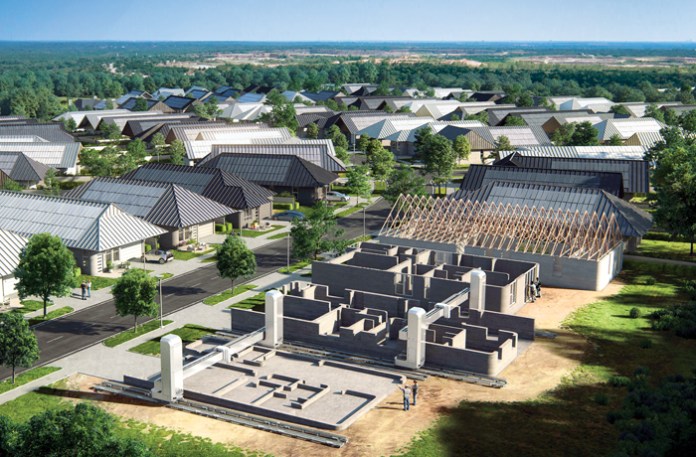
Fifteen years ago, when discussion of 3D-printed anything was broached, it was likely centered on 3D-printed guns, a flash in the alarmist media pan. More auspiciously, today, the same technology, albeit scaled, is emerging. Or rather, stacking up. Using a largely labor-free method of pouring concrete in a highly methodical, layered fashion, homes constructed using 3D-printing technology reduce build time and cost by orders of magnitude, resulting in lower home prices than those generally prevailing nearby.
“By minimizing labor costs and material waste, [3D-printed homebuilder] 4DIFY aims to provide more attainable housing options,” The California Post reported recently. The outlet focused on a home in Yuba County, about 40 miles north of Sacramento, which took just over three weeks to finish. “The first home in this experimental five-house cluster is currently on the market for $375,000, a price point intentionally set below the local average.”
Republican localities are generally friendlier to the construction of these homes, albeit for non-ideological reasons. (Unless selling homes to people who want them is ideological.) The largely GOP-led South and Mountain West are moving forward with 3D-printed homebuilding with gusto. Florida and Texas, in particular, are taking the lead. Even in California, the Yuba County project is a red team stronghold within the famously blue, er, Golden State.
States such as Colorado, Montana, and Virginia are not far behind in this regard.
The phenomenon of 3D-printed homebuilding firms being headquartered in Democratic territory — like Austin, Texas — while actually building out in Republican land is widely seen. This is due to the rare tech skills involved in the industry being found in such urban centers, more often than not, though, coupled with the lack of room to build. Or a panoply of regulatory hurdles and traditional trade union practice, to overcome.
An urban conception begets suburban, or rural, birth.
“Wolf Ranch in Georgetown, Texas, is where a group of around 100 homes has been being ‘printed’ since 2022,” reported KNUE in 2024, on the Republican-leaning town situated halfway between Dallas and Houston.
For Democrats, support for 3D-printed homebuilding often takes the form of promotion of environmentally conscious dwellings, i.e., sparing trees from the slaughter of a human thirst for lumber. Or providing efficient, relatively rapid “deployable” housing for the homeless.
“Vulnerable populations like the homeless are never among the first to access leading-edge anything,” said Alan Graham, founder and CEO of Mobile Loaves & Fishes, in 2021. “But now here in Austin, Texas, they’re among the first in line who will be living in some of the most unique homes ever built — and we think that’s a beautiful thing.”
Loaves & Fishes, along with Habitat for Humanity in places like Virginia, shows the extent to which this novel homebuilding technology has merged with the philanthropic sector. Paradoxically, the eagerness of volunteers to be hands-on in the provision of a gift of residency detracts from the labor-saving aspect of 3D-printed homes — one of their greatest features! For nonprofit groups, at least optically, the more the merrier.
Republican-dominated Florida represents a case in pragmatism. The state’s penchant for being a natural disaster magnet makes 3D-printing’s primary use of concrete and hastened project time ideal, for both building and, perhaps especially, rebuilding. Florida politicians have sung the praises of 3D printing beyond housing as well, with Sen. Rick Scott (R-FL) in 2023 boosting its potential in the defense sector.
At the other corner of the United States, Alaska’s Republican-dominated state legislature is overseeing cutting-edge housing ventures in the coldest climate the states have to offer. While later to come to fruition in Alaska than down south, and thus still earning their stripes, 3D-printed homes that can withstand the Great White North lay special claim to fortitude. If you can make it in Alaska, you can make it anywhere.
Despite these three-dimensional postcard vignettes from across the U.S., approximately two-thirds of all currently existing 3D-printed homes are found in Texas and California, the union’s twin population powerhouses.
VANCE ASKS NORTH CAROLINA TO PRAY FOR TROOPS, BUT DOESN’T DENY CAUTIONING TRUMP AGAINST IRAN WAR
Between the Left’s (albeit of the Abundance type, not the particularly “woke”) and the Right’s reasons for supporting this homebuilding trend, a roughly YIMBY consensus has emerged.
While artificial intelligence captures much of the conversational zeitgeist and is associated with urban prestige, a la San Francisco and Seattle, 3D-printed homes symbolize the progress being made in the tangible. And in both rural and futuristic, simultaneously. To speak of America’s deindustrialization, arguably true from the vantage point of someone ensconced full-time in one of the two aforementioned cities, is to miss the way that old-fashioned extraction, a bit of muscle — and printers — continue to power America.
Dain Fitzgerald (@DainFitzgerald) is a writer and “podtuber” in Diamond Springs, California, in the beautiful Gold Country of El Dorado County. His Substack is @mupetblast.
