

President Donald Trump frequently talks up artificial intelligence data centers as a cornerstone of American economic and technological strategy. But the advantages touted by the president, members of his administration, and a broader universe of Make America Great Again supporters come with significant drawbacks, per businesspeople and industry analysts.
The growth of data centers has fueled construction jobs and helped make the United States a leader in AI. However, the growth raises concerns about energy use and questions about how much the space can scale over the coming years.
DEMOCRATIC PRESIDENTIAL CONTENDERS EYE TAX CUTS TO WOO GOP VOTERS
That policy contrast is emerging as Trump, in his second term, has prioritized rapid AI data center expansion. While the Trump administration is attempting to shield consumers from rising energy costs.
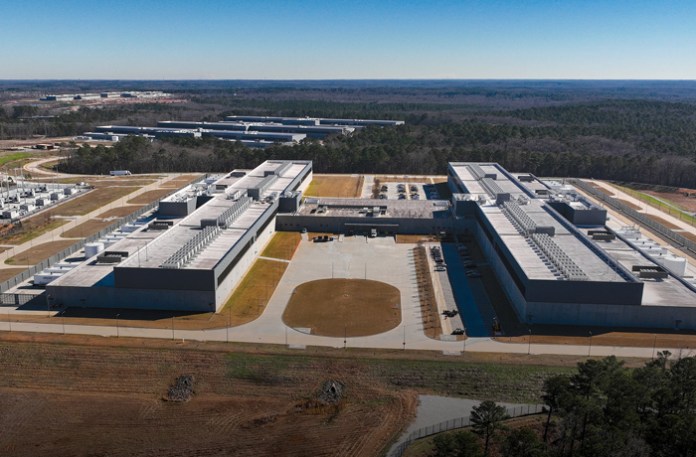
Through a “Ratepayer Protection Pledge,” major tech firms — including Amazon, Google, Meta, Microsoft, and xAI — are encouraged to fund their own power generation. This initiative, led by Energy Secretary Chris Wright, includes streamlining permits and encouraging the use of federal lands for data center construction.
Tony Woods is the founder and CEO of Midland Steel, based in Ireland, which has an exclusive licensing agreement with Nucor, where its modular rebar technology is used in U.S. data center construction. Woods said that the demand, especially in the U.S., has been enormous.
“It’s scaling at enormous levels across the globe, but particularly in the U.S.A. The U.S.A. wants to be a leader, I believe, in the AI and data world,” Woods said in an interview at a recent event between Enterprise Ireland and Amazon Web Services to discuss Irish investment in U.S. digital infrastructure.
In his estimation, Woods said there have been four revolutions in the last century or so: the steam engine, the airplane, the internet, and now AI. And he said that the requirement for enormous amounts of AI data storage goes hand in hand with this latest revolution.
Power surge
Paige Lambermont, a research fellow at the Competitive Enterprise Institute, said in an interview that power demand in the U.S. was fairly “stagnant” for about 20 years. Demand rose or fell about 1% depending on the year.
“Until like 2024, and it’s just recently started to rise,” Lambermont said.
Now, the demand is only expected to increase as data centers become increasingly ubiquitous in society. The Electric Power Research Institute projected that data centers could double their current share of power in the U.S. by 2030 and would consume between 9% and 17% of total electricity generation by then.
“We’re in the middle of a sort of paradigm-shifting change in energy demand in the U.S. that we haven’t seen for a long time,” Kathryn Kline Tyndall, an associate director with the Bipartisan Policy Center’s Energy Program, said in an interview.
But the trouble is, according to Lambermont, at the same time as all of this growth, the U.S. is set to see “significant retirements” of thermal units.
“So coal, nuclear, natural gas, the reliable power plants that keep the grid running, are supposed to go off the grid by 2030 at the same time as we’re seeing incredible rises in data center demand,” she said.
Benjamin Hertz-Shargel, global head of Grid Edge at Wood Mackenzie, said that there is a massive amount of data center projects in the pipeline. He said utilities have signed agreements for 183 gigawatts of capacity with data center companies.
“It’s equivalent to 22% of U.S. electricity demand last year in 2025, so basically, utilities are very aggressively signing up data center companies,” Hertz-Shargel said in an interview.
He added that the biggest challenge is going to be in deregulated markets, such as Texas and some mid-Atlantic states, where the utility has no responsibility over supplying the power — it essentially only manages the wires.
“So in those regions, it’s up to the state, or it’s up to the region to make sure power plants kind of show up so they can supply data centers,” Hertz-Shargel said.
One of the biggest concerns for consumers is that an increasing number of data centers could hit them financially.
Lambermont pushed back on the assertion that data centers are squarely to blame for rising electricity bills. She said that companies were unlucky last summer, as more data center projects were announced while electricity bills were rising from “pre-existing factors,” for instance, “huge transmission distribution cost upgrades.”
Hertz-Shargel said that, for the most part, data centers aren’t the main culprit pushing up electricity prices.
“I would say overall, it’s very mixed, and only in a few cases are data centers so far responsible for customers’ bills going up, mostly around the country, bills are going up because of our aging grid,” he said.
He said those costs are also being exacerbated by climate change and the need to harden the grid for extreme weather.
Still, he said, there are cases where data centers have driven up customers’ bills, particularly in parts of the mid-Atlantic.
Environmental concerns
Still, others are concerned about the unfettered growth of data centers. Amanda Levin, director of policy analysis at the Natural Resources Defense Council, an environmental advocacy group. The group advocates that data center development be done in a responsible, more regulated way.
“Data centers today are really challenging our power grid, they’re challenging utilities, they’re challenging our energy markets and putting a lot of pressure on the ways that we produce and consume electricity,” she said in an interview.
She also highlighted the regions where a lot of this breakneck growth in data centers is happening, such as the mid-Atlantic and Texas, pointing out that electricity prices have increased significantly there. Levin said that could get worse as more of these centers come online.
“This can mean more pollution, more expensive power, and potentially more difficulty meeting the needs of households, businesses, and industry, especially during extreme weather, hot summers, cold winters,” Levin said.
But there are big economic winners from this massive wave of data center construction and planned construction for the years ahead.
“I think utilities are big winners in that they are in a growth environment for the first time in a very, very long time — in many decades,” Hertz-Shargel said.
Companies developing power plants are also poised to be big winners in the boom.
Lambermont said that the growth of AI and data centers has major implications for economic growth in the coming years.
“It drives jobs, it drives innovation,” she said. “There’s a lot of money being spent to build new data centers; a lot of money being invested in the technology. The technology is driving innovations that will themselves create money and jobs.”
PETE RICKETTS INTRODUCES LEGISLATION BANNING CONGRESSIONAL STOCK TRADES
And there have even been shortages of jobs related to the growth of data centers, especially on the power plant side, according to Hertz-Shargel.
“There is tremendous growth in just the need for construction labor, and that includes also plumbing and electricians and all the trades,” he said. “There’s much less labor needed to actually operate facilities once they are running, so this is much more of a construction opportunity than a sort of longer-term jobs opportunity.”
Zach Halaschak (@zhalaschak) is the economics reporter for the Washington Examiner.
