

A few years ago, before embarking upon a particularly daunting road trip, my wife and I bought an Amazon Fire for our 6-year-old son. How would I rate the experience? The settings were a nightmare to navigate, the games were full of ads and in-game purchases, and the screen broke after a year — one star. Last Christmas, facing the same journey, we bought a Nintendo Switch. The only issue with that device has been the embarrassing number of hours I’ve sunk into playing Super Mario Bros. Wonder.
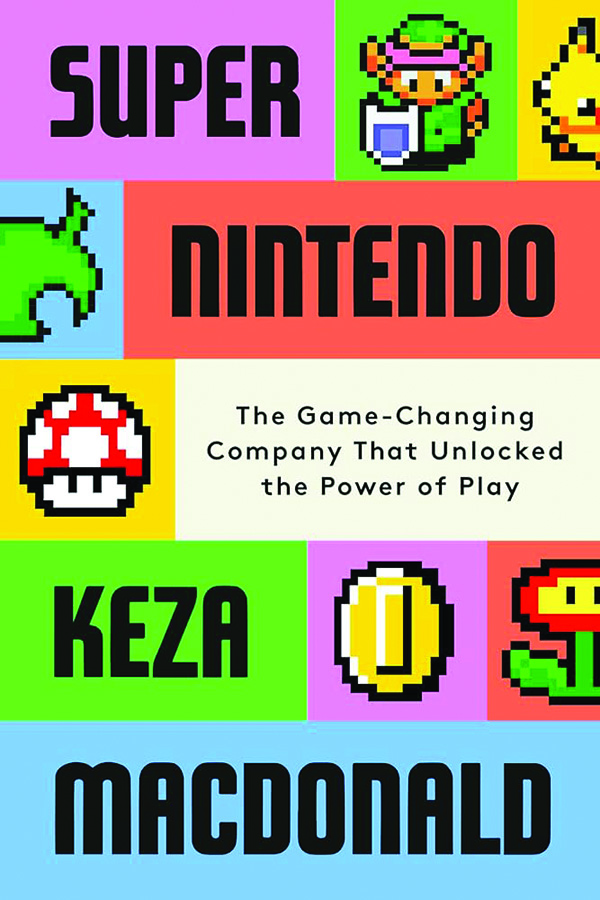
Keza MacDonald’s new history of the company that made the device, Super Nintendo: The Game Changing Company That Unlocked the Power of Play, isn’t perfect, but the Nintendo Switch pretty much is. And her book goes a long way in explaining why. The book is at its best when operating under the “great man” theory of corporate history, and Nintendo has more than a few. Consider the early chapter on Shigeru Miyamoto, who got his first big break in 1980 when Nintendo ordered 3,000 arcade cabinets for its Space Invaders rip-off Radar Scope. Only 1,000 sold, and he was tasked with creating a game compatible with the unsold machines. The result was Donkey Kong: the first game with a rudimentary plot (that monkey sure does like that princess), the first game that “wasn’t a maze, a racer, or a shooter,” and, amazingly, the first game in which a character can jump.
That character — the little mustachioed guy in red overalls — was also Miyamoto’s creation. Mario, originally called Jumpman, started as a sketch in his notebook. Ever wonder why there are so many green pipes in Super Mario Bros.? Miyamoto walked past a construction site on his way to work every day. And what about that famous mustache and those iconic red overalls? The mustache required fewer pixels to animate than a mouth, and the overalls helped clearly define Mario’s movements. How did Miyamoto manage to fit eight full levels on an eight-bit system? He presented a programmer with a sheet of paper showing five worlds, and, after the programmer agreed to the design, “revealed another three worlds on a folded-over part of the same page.” In the book, a fellow employee recounts of Miyamoto that, “if he’s told something isn’t technically possible, he will reply with ‘What would make it possible?’”
Another big name is Hiroshi Yamauchi, president of Nintendo from 1949 to 2002. You may be surprised to hear that a video game company has a history going back to 1949. It actually goes back further, as Nintendo began as a trading card company in the 1880s. Apparently, they were popular with the yakuza. If Miyamoto is the Michelangelo of video games, Yamauchi is the Steve Jobs. The number of successes Nintendo had during his half-century run is staggering, and they often came about because of Miyamoto’s idiosyncratic, unintuitive decisions. It was his idea to have Nintendo sell both video games and the consoles they run on. It was also his idea to bring those consoles out of the arcade and into the home. For his plan to work, MacDonald writes, “he wanted this new machine to be affordable, less than half the price of its competitors — but he also wanted it to outperform those competitors and be difficult for them to copy.”
Super Nintendo does a good job sketching out the corporate culture that leads to such demands. Employees tend to stay with the company a long time — think decades, not years — and the older and younger generations often work together. Unsurprisingly, there are a lot of workaholics: you get the usual stories of rising cortisol levels, people sleeping in offices, and last-minute miracle solutions. And yet, for all its innovations, the company is careful, slow to change, even conservative. In the mid-2000s, while other developers were pumping out games on an annual basis, spending millions of dollars on cutting-edge graphics, and producing fast-paced shooters for hardcore gamers, Nintendo was taking its time to develop the Wii, with its family-friendly controllers, chunky avatars, and simple, engrossing games. The results? Wii Sports is the third-best-selling video game of all time. MacDonald sums up the company’s philosophy well: “If you give game developers the time and space to follow their creative instincts, and they come up with something really good, it will sell forever.”
Unfortunately, the book’s main flaw is not minor. Super Nintendo, as the title suggests, is a hagiography. That isn’t necessarily a bad thing, but it leads to a lot of repetitive personal reflection. There’s way too much flowery language defending the importance of fun and games. For instance, in the introduction, MacDonald tells us that games “are a way for us to reconnect with an essential part of what makes us human.” Sure, sure. Remind me of that after I’ve wasted three hours grinding through Minecraft Dungeons. Reminiscing about the Legend of Zelda game Ocarina of Time, she asks, “Remember those micro-caverns hidden down holes beneath bushes, those Rupee-filled chests in strange locations?” Well, no, I don’t. The problem is that if you haven’t played the game, you aren’t interested, but if you have played the game, you know everything about it… and aren’t interested. I was nodding along as MacDonald described getting her first Super Nintendo Entertainment System one Christmas morning — it’s a story a lot of us millennials can relate to — but I was burned out on personal anecdotes long before the final chapter.
WHITE HOUSE USING WII SPORTS TO PROMOTE OPERATION EPIC FURY STRIKES ON IRAN
Perhaps there simply weren’t enough interesting details to fill 280 pages. For every cool fact (The Legend of Zelda was the first game to let you save your progress! Pokemon is the highest-grossing entertainment franchise of all time! Nintendo made constructable video game controllers out of cardboard in 2018?), there is boilerplate company history. Metroid did indeed change gaming forever when the protagonist was revealed to be a woman, but the story behind that choice is… well, someone said they needed a surprise at the end of the game, someone else said the hero should be a woman, and, in the words of creator Yoshio Sakamoto, “everyone thought that would be interesting and wanted to do it, so we decided on it right away.” Not exactly thrilling stuff.
Still, if you can hum the Super Mario Bros. theme song on cue, if you fondly remember your first round of Wii bowling, or if you’ve ever played a game designed by Shigeru Miyamoto (and you probably have: he’s sold a billion of them), you’ll enjoy this book — just probably not as much as you’d enjoy playing a level or two of Mario Wonder.
Alexander Kaplan is a writer based in Richmond, Virginia.
