

BLUFFTON, Ind. — There are no hotels in Bluffton, population 10,308. So ahead of my visit, I wrote to Kathy Gardner, proprietress of the Washington Street Inn bed & breakfast, requesting a room for two nights.
“I’m so sorry,” Kathy wrote back, “but I am in the midst of shutting down.”
I settle for an Airbnb above a shop on Market Street, and during my stay, I walk three blocks and visit Kathy, age 80, who is at work selling off the contents of the immaculately decorated inn.
It’s a magnificent place: pressed tin ceilings, carved hardwood archways, pocket doors, and a million exquisite touches that she is selling off in small batches. She particularly notes her collection of porcelain figurines made in occupied Japan, a collection she poured her heart into, but for which there is now basically no demand.
“Your generation and younger don’t even know what World War II was all about,” she gently scolds me, gesturing towards a table full of figurines. “So what we thought was an investment at the time is now junk.”
While we’re on the topic of profitability, I ask Kathy how she kept a bed and breakfast afloat in an outer suburb of Fort Wayne, where the biggest tourism draw might be the Ouabache State Park, which about 10 bison call home, three miles down the road.
“I didn’t run it in a big way,” Kathy says of the Inn, “because I didn’t care about the income.” Her voice drops a bit when she says this — as if it’s an admission, a former secret she’s just now revealing.
Kathy bought the place 20 years ago, which makes her the most senior small-businesswoman in town, by my calculations.
“Business owner.” “Entrepreneur.” These titles carry honor and convey importance, and they are very capitalistic terms. That’s why it’s something of a confession that Kathy wasn’t in it for the money. “I never spent a cent on advertising.”
The meticulous curation of decorations, the beautiful touches, the gardening, the cooking, the cleaning: It wasn’t a calculated exchange of labor for profit. No, this was a labor of love.
In that way, the Washington Street Inn is a microcosm of Bluffton, where dozens of dedicated residents give everything to keep this place going. And looking around at other small towns all around Middle America (including a few nearby), you understand the unspoken fear that all of Bluffton could one day go the way of the Inn.
The battle to keep a small town alive is fought in every corner of this country these days. The forces arrayed against Market Street are many. “When Kmart came,” Kathy recalls, “things just changed. Then Walmart came. Then Lowe’s came…. These bigger stores just forced out the local.”
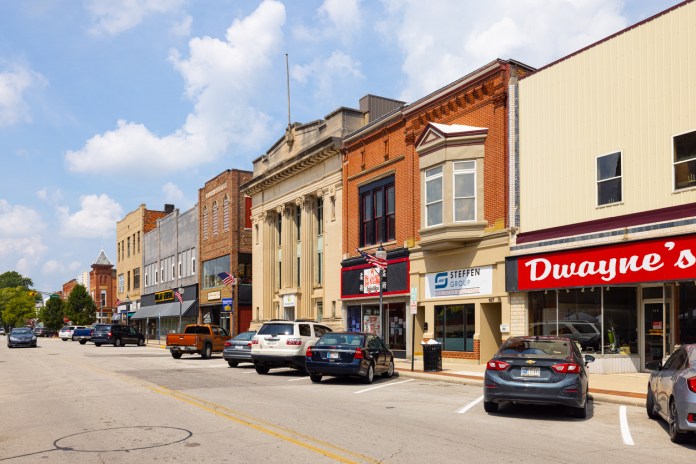
Kathy saw the vibrant “uptown” Bluffton lose most of its retail — smaller retailers that couldn’t compete on price with the big box stores. She sees today’s Market Street as a pale reflection of the past. But compared to most of small-town Middle America, Bluffton is thriving.
The town has at least three bars, and more depending on how you count. It has a Chinese restaurant and a library. Jamie’s Cafe has opened in the old diner spot, Hugh’s coffee is a block away. And there’s a surprising amount of retail, and relatively few vacant storefronts on Market Street.
Mayor Scott Mentzer uses the term “third places” to describe these businesses, thus making them more than businesses.
Everyone seems to love Hugh’s coffee shop. That’s where a group of six men meet before dawn Wednesday morning for a pre-work Bible study. I visit Hugh’s three times in my 40 hours in Bluffton, and every time I see scheduled meet-ups like the Bible study. More importantly, I see impromptu meetings: old friends seeing one another, strangers meeting and chatting.
These unplanned serendipitous encounters may seem a picayune topic for an urban planning discussion, but they are in fact valuable beyond words. Modern life is very planned and very isolated. That makes running into friends and neighbors without needing to plan it a true joy. Creating a town where this happens more and more is a true service. It’s always at the front of Mentzer’s mind.
Much of these social needs of the people and the town are provided by capitalism, but many aren’t. That’s why Wells County Foundation works with governments to subsidize businesses such as Hugh’s with special tax breaks.
That’s why Bluffton funds the library and the riverfront concert series at Kehoe Park and Parlor City Plaza. The Plaza sits on the former site of a J.C. Penney. Right across from the park is the American Salvage Company. It’s an antique store, but that title doesn’t do the shop justice. It feels like a museum, filled with antique bicycles, vintage signs, beautiful oak bureaus, and a million old, beautiful knick-knacks on which to feast your eyes.
And to some extent, it is a museum more than a store. Pam, the owner, sells basically everything online.
So why does she run this storefront? There are some minor practical reasons, but mostly, I suspect Pam wants to spend her day amid her magnificent items. Visitors, like me, get the pleasure of walking around, too. And Market Street gets one more attraction to keep people hanging around.
The Inn, the bars, the antique stores: They’re all for-profit businesses, but they’re also not entirely for-profit. The community leaders of Bluffton are the furthest things from socialists, but they see capitalism is a tool for creating economic value, which is not always the same thing as — and is less important than — fostering the good life.
The government’s heavy hand often crushes when it tries to create, but the market’s invisible hand often smothers, they argue. See what Walmart has done to Main Streets. See what free trade has done to steel towns.
Milton Friedman once wrote an article with the headline “The Social Responsibility of Business Is to Increase Its Profits.” Kathy, Pam, and others I meet in Bluffton don’t see it that way. They are capitalists, but they are also community builders. Their businesses are not mere nodes of exchange, but are or were, true third places.
SINS OF OMISSION: THE KERMIT GOSNELL DEFENSES THE PRESS DARED NOT MENTION
Kathy hosted Ladies’ bridge games, Christmas parties, and teas. Bourbon MD, the new bar downtown, hosts a speaker series. The bar brought me in to speak — they paid me and picked up my tab for the night — about how to build community. The folks I met were all conservative Republicans, but they all happily worked closely with government at the town, county, and state levels.
The conservatives here know that by giving capitalism only two cheers, rather than three, they are deviating from orthodoxy. Some talk of this as a new thing: post-liberalism. Maybe Bluffton really is a post-liberal town in the prairie. But it strikes me, in my two days here, as not something new, but something older: A conservatism about conserving.
