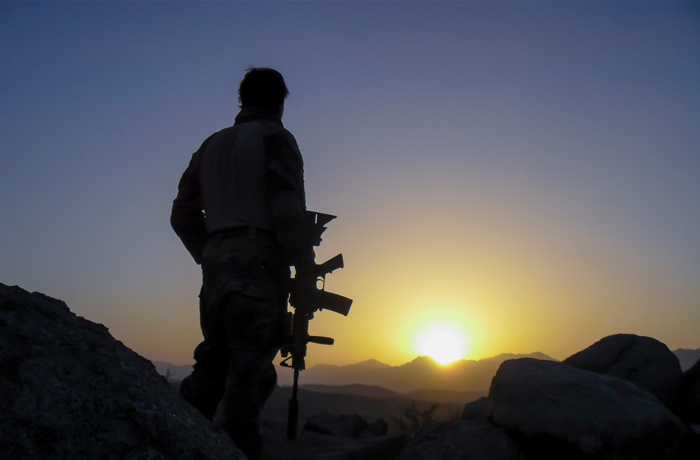
Who will go for us?

I was 20 years old when I asked my father if he thought I should enlist in the Army National Guard. My old man’s word was still law, so I was stunned to hear, “I never served, so I can’t really advise you on that. It’s a man’s decision, one that you must make yourself.”

Recently, I’ve been bothered by those who seem to wish they could make that decision for others.

I signed up for college tuition assistance. I enlisted as a combat engineer because it was a military occupational specialty that would allow me to complete basic and job training in one summer so that I could return to college on time in the fall.

By November 2003, with the Afghanistan and Iraq wars demanding many troops, a platoon of engineers from my company was on notice for deployment. I was in the backup platoon, a group of soldiers from which command could draw if one of the men in the deployment group could not ship due to medical or legal reasons. Eventually, that deployment alert was canceled.

I spoke to my squad leader: “Some of the men in the deployment platoon just started college or career jobs. Some have pregnant wives or new babies. I have no children, I’ve graduated college, and I haven’t begun full-time teaching. War would be a greater burden to them than to me. If another alert comes, I volunteer to deploy in place of one of those men.”

By that time, so many military units had endured extended deployments, and I had only participated in training. I remembered Isaiah 6:8: “Also I heard the voice of the Lord, saying, Whom shall I send, and who will go for us? Then said I, Here am I. Send me.” This I prayed, and eventually my prayers were answered, and I was shipped to the Afghanistan War. The experience nearly broke me. I wouldn’t wish it on anyone.

My friend Jerod Thompson, a former Army staff sergeant and Ranger, was on that same deployment. He recently objected to a social media post that said the president’s son, Baron Trump, should be sent to fight on the front lines in Iran. He told me, “What they’re actually saying is ‘this person needs to die’.” 

Thompson is running as the Moderate Majority Party candidate for lieutenant governor of Minnesota with gubernatorial candidate Steve Patterson.

They lament America’s partisan atmosphere, which Thompson blames for these toxic posts. “It doesn’t matter if you’re in special ops or not; you receive trauma from deploying in the United States military. It’s a deconstruction of everything you’ve ever had to think. People don’t need to experience that. And the people that have … We’re never going to say, ‘you need to go feel what it is like.’ Because it f***s you up.”

It’s hard to overstate how much I agree with Sgt. Thompson on this issue.

In addition to posts demanding that Baron Trump or Republicans or others be drafted to fight in Iran, many complain that President Donald Trump’s lack of military service makes him unqualified to order others to war. Those people somehow overlook that no president has served in a war since George H.W. Bush.

The hypocrisy is not lost on Thompson. “They complain that Trump is starting war, but Democrats [also] start wars. That’s a knee-jerk emotional reaction.”

THE MORE THINGS CHANGE 

My father said he had no right to advise me on my enlistment because he never served, but I think most of us who did sign up are, like Sgt. Thompson, never under the delusion that our military experience gives us some kind of moral authority about who should fight.

It’s most often those who never served who are the loudest about how other people should be sent to war. We should be grateful to live in a country defended by volunteers and less judgmental about those who choose not to serve.

Trent Reedy, author of several books including Enduring Freedom, served as a combat engineer in the Iowa Army National Guard from 1999 to 2005, including a tour of duty in Afghanistan.

*Some names and call signs in this story may have been changed due to operational security or privacy concerns.

Related Content
