

The amazing persistence of the legend of Chuck Norris, who died on March 19 at the age of 86, says something profound about American popular culture.
At the time of his death, Norris had long ceased being a major movie star — he had not made a high-profile theatrical feature since The Expendables 2 in 2012, and even that retro effort was an anomaly — and though he had a more lasting presence on television, it had been a long, long time since the heyday of Walker, Texas Ranger. In truth, even Norris’s peak period of stardom was awfully fleeting: less than a decade passed between his signature hits, including 1985’s Code of Silence and Invasion U.S.A., and the meta-film Sidekicks (1992), in which Norris, as himself, riffed on a stardom that seemed, even then, less reality than memory. Walker, Texas Ranger, which aired on CBS from 1993 through 2001, was definitely a big success, but, then, so were the near-contemporaneous CBS shows Touched by an Angel and Nash Bridges — and no one is thinking of building statues to Roma Downey or Don Johnson.
At the risk of sounding uncharitable, it’s questionable whether Norris could even be considered an actor, in the sense that, say, Marlon Brando or John Travolta or even former-athlete-turned-actor Jim Brown were. Will anyone be surprised if, during next year’s Academy Awards telecast, Norris’s likeness is omitted from the annual “In Memoriam” segment? Sad to say, probably not. Lone Wolf McQuade (1983) is not exactly The Godfather (1972); Braddock: Missing in Action III (1988) ain’t Pulp Fiction (1994), either. Jim Brown made better movies, like The Dirty Dozen (1967).
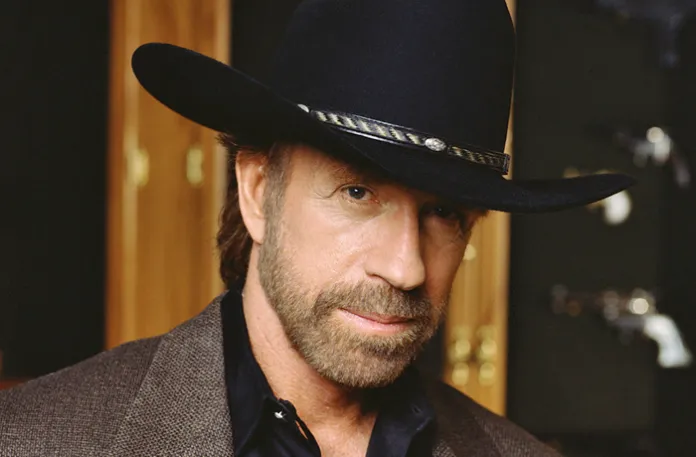
An undeniably accomplished practitioner of martial arts, Norris punched his ticket to Hollywood by using the same rationale that enabled Arnold Schwarzenegger to get cast in movie after movie: a performer’s acting inadequacies may be excused when accompanied by intense physical prowess or facility with deadly arts. When it comes to this category of performer, Norris was not as good as Schwarzenegger himself — Arnold is genuinely appealing in Bob Rafelson’s Stay Hungry (1976) and at least mildly amusing in such movies as Twins (1988) and Jingle All the Way (1996) — and substantially better than such approximately equivalent figures as Jean-Claude Van Damme and, heaven help us, Steven Seagal. In contrast to the obvious incompetence of, say, Seagal, Norris got a lot of mileage out of his slow-burning affect. His pensive countenance and ever-constant beard lent a certain intensity, if not believability, to his favored sorts of parts — you know: sheriff, ranger, prisoner of war, and karate champ.
Yet Norris’s limitations proved no impediment to his cultural dominance. His rise suggests something of both our national antipathy for credentialism — who says you need to study acting to be any good at it? — and our insistence on the endless transferability of seemingly irrelevant qualifications: just as we insist that a real-estate mogul can be president, we are persuaded that a black belt is all that is required to step in front of a motion picture camera. To the extent that Norris, even in death, continues to embody these hopeful qualities, he will remain part of the national consciousness long after bigger stars and better actors have faded. Norris exerts a pull on our imagination that does not require us to actually re-watch, uh, Delta Force 2: The Colombian Connection (1990).
Born in Ryan, Oklahoma, in 1940, Norris would likely have been as surprised as anyone by his showbiz success, but aren’t unlikely twists of fate just another feature of the American story? Like many young men who have no notion of becoming a movie star, he enlisted in the Air Force, though unlike many, he left the service with a skill set that assured a lively civilian life: while in South Korea, he initiated his study of tang soo do. His subsequent karate career in America allowed him to make contact with Bruce Lee, the actual precursor to Schwarzenegger, Van Damme, Seagal, and the like. This relationship led to one of the more legitimately, actively good movies in the Norris canon: 1972’s megahit The Way of the Dragon, a starring vehicle for Lee and an early opportunity for Norris.
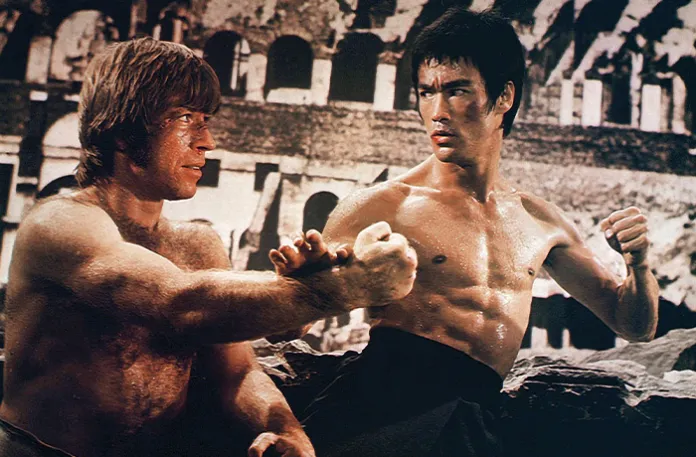
To say that Norris was the beneficiary of good timing is no exaggeration. It isn’t an insult, either. John Wayne became a star in a postwar period in which American he-men were venerated. For his part, Norris not only hitched his wagon to Lee but stuck around long enough to see karate incorporated into less scarily lethal forms of mass entertainment, such as the Karate Kid movies or Norris’s own A Force of One (1979). Then, just as that fad dimmed, Norris was available when revenge cinema needed a cooler archetype than Charles Bronson. Thus began the key series of Norris actioners, including An Eye for an Eye (1981) and Forced Vengeance (1982). There are lots of candidates for ideal Reagan-era movies — a common choice, for its clear pro-business, anti-regulatory biases, is Ghostbusters (1984) — but surely Invasion U.S.A., which features combat with Communists, and The Delta Force (1986) deserve mention for being in tune with those vigorously pro-American times. The number of movie posters in which Norris brandishes a machine gun is staggering.
Times change, but Norris gave no indication that he harbored directorial ambitions like Clint Eastwood. Sure, he accumulated some behind-the-scenes credits on his movies — he was, astonishingly, a co-writer of Missing in Action III — and his brother, Aaron Norris, was recruited to direct some of his lesser features. But Eastwood used his films to reckon with his own chiseled brutality. By contrast, Norris seemed content with who he was: a man on the march for justice. That did not mean his output remained as robust as it once had been: the bad guy from The Way of the Dragon was compelled to share screen time with a canine in 1995’s Top Dog.
Walker, Texas Ranger provided a small-screen respite from such indignities, but let’s face it: Norris’s uninflected sincerity could not last forever. Sidekicks, which is about a young lad who rather randomly worships at the altar of Chuck, was a relatively straightforward meditation on the fading Norris phenomenon, but the internet meme Chuck Norris Facts was anything but. This artifact from an earlier era of the web consisted of memes in which Norris’s greatness was touted to the nth degree. A sample “fact”: “When Chuck Norris does push-ups, he doesn’t push himself up. He pushes the earth down.” The phenomenon recalls The Onion’s Obama-era headlines about then-Vice President Joe Biden (“Shirtless Biden Washes Trans Am in White House Driveway”) in its celebration of a certain unimpressive over-the-hill machismo. Unlike Biden, who failed to see the potential political upside in leaning into the full goofiness of his personality, Norris accepted his viral status with plenty of cheer, typical of his good nature.
Chuck Norris Facts was, in fact, the form of approbation that most befitted its subject. Part of the joke of talking up Norris’s greatness is that he was not, really, especially great: a good martial artist, a decent actor, certainly a nice guy, but hardly a force of nature. That’s why the meme is funny. Nonetheless, many not completely great people and things have become part of America’s firmament: the Monkees, The Brady Bunch, McDonald’s. Why not Chuck Norris?
Peter Tonguette is the film critic for the Washington Examiner magazine.
