
In full Blume

Mark Oppenheimer is an unabashed Judy Blume fan. He admits that Blume’s language could be more vivid and her plots less predictable — Blume herself says as much about her writing — But he admires Blume’s ear for dialogue and is drawn to her honesty, warmth, and the cathartic nature of her work. He also thinks some of her critics are overreacting and should give Blume and her millions of readers a break.

That’s the trajectory of his latest book and first biography, Judy Blume: A Life. Blume, 88, is the bestselling author of 29 books, most of them written for children and teenagers, as well as several novels and nonfiction texts for adults. 

Oppenheimer had read and enjoyed Blume’s stories as a boy, even though most of them feature female protagonists. When he was in college, he heard that almost everyone in his class had read Blume’s novels. Later, when he was a father, he read her books to his children. 

Judy Blume: A Life
Mark Oppenheimer, G.P. Putnam’s Sons
480 pages, $35
Judy Blume: A Life; By Mark Oppenheimer; G.P. Putnam’s Sons; 480 pages, $35

Their admiration helped to trigger Oppenheimer’s 1997 New York Times essay asking why Judy Blume’s fiction endures. Almost 30 years later, he has expanded the essay into this biography. 

Oppenheimer explores Blume’s life chronologically in chapters that connect events she lived through to the plots of her novels. These include Blume’s adolescent anxiety about her breasts and body hair or lack of them, as well as her middle-class childhood, her friendships in elementary and high school, and her relationships with her brother, mother, and father, with whom she seemed to share a lighthearted warmth and sense of humor. 

This biography offers wide coverage of Blume’s life including her relationship with her writing instructor, Lee Wyndham; her editor, Dick Jackson, “who made my career”; her passion for reading and writing; her three marriages; two divorces; two abortions; as well as the history and culture of her era and its influence on her life and her work — which was my favorite part of the book. 

Born in Elizabeth, New Jersey, in 1938, Blume grew up comfortably in a “culturally Jewish” but not religious family. She was the daughter of Rudolph and Esther Sussman. Her father was a dentist, and her mother, a housewife. Safely ensconced in suburbia, she had time to grow a healthy imagination.

Blume began composing stories in her head as a child. Her first novel, The One in the Middle Is the Green Kangaroo, came out in 1969, after her two children started elementary school. Her final novel, In the Unlikely Event, came out in 2015. Several of her books have become films, including Forever (1978), Tiger Eyes (2012), and one of her most popular novels, Are You There, God? It’s Me, Margaret (2023).  

She and her older brother, David, weren’t particularly close. But she had several close girlfriends who called themselves the “Pre-teen Kittens,” which became the model for the Pre-teen Sensations who appear in Are You There God? It’s Me, Margaret

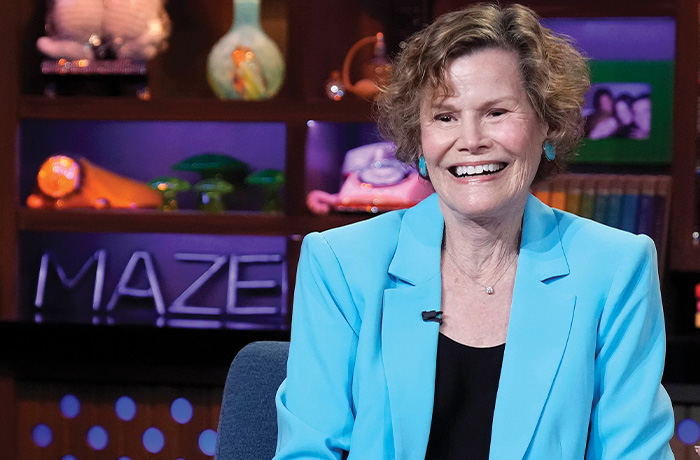
Judy Blume in 2023. (Harles Sykes/Bravo via Getty Images)

When Blume was a teenager, she read A Rage to Live by John O’Hara, thanks to a high school reading project and to a liberal-minded aunt who was a school principal. The novel centers on a married woman who has had numerous out-of-wedlock love affairs. Oppenheimer suggests that O’Hara’s novel influenced Blume’s writing about sex.

Even though Blume graduated from New York University with a Bachelor of Arts in elementary education, she only taught for a few years before becoming the housewife expected of women in her generation. Women went to college mainly to support their families in case of emergency, if the husband and father became ill or died, as did happen with Blume’s own father, who died just as she was ready to marry. One of the most pivotal and sad moments of her life, this loss found its way into her novels. 

Other pivotal moments include the fatal crash of three airplanes near her home in New Jersey; her disastrous marriage to her second husband, Tom Kitchens; her divorce from her first husband, John Blume, a busy lawyer who spent weekends playing golf away from his wife and son and daughter. All of these became fodder for the plots of her novels. 

Oppenheimer only occasionally gets into Blume’s head, and he doesn’t tend to speculate with regard to her feelings, which would have enhanced the book. But overall, he writes in a lighthearted, clear style — similar to Blume’s — making this book eminently readable.

Blume’s stories often relate to her rebellious nature. Blume was a member of the Silent Generation. But like Elvis Presley, the Rev. Martin Luther King Jr., the Beatles, and others, she resisted the conformity of the 1950s. Blume objected to the lack of realism in children’s books. Her novels deal frankly with puberty and the messy side of life. She focuses on problems with religion, friends, parents, and growing up. In doing so, she changed the face of children’s literature, which, until her time, had dealt mostly in fantasy and adventure, as children read works by P.L. Travers, C.S. Lewis, J.R.R. Tolkien, and mysteries featuring Cherry Ames, Nancy Drew, and the Hardy boys. They almost never read stories about menstruation and wet dreams.

But Blume pushed the boundaries of children’s literature, and parents challenged her novels. Librarians and bookstore owners often banned Blume’s work. She fought back, defending free speech and her belief that children should be allowed to read more realistic books concerning life experiences. 

MAGAZINE: TROUBLING STORIES 

Her books have sold more than 92 million copies and have been translated into 40 languages. The Library of Congress named Blume a “living legend.” She won close to 100 prestigious writing awards for contributions to America’s literary heritage. Time magazine named Blume one of the most influential people of 2023 and called her a crucial, honest voice for young readers.  

Yet she is one of the most repeatedly challenged U.S. authors. Her books are among the most frequently banned in school and public libraries. How does her work endure? The question is the heart of this balanced and engaging biography.  

Diane Scharper is a frequent contributor to the Washington Examiner. She teaches the memoir seminar for the Johns Hopkins University Osher Program.

Related Content