We used to have a proper video store

Published April 10, 2026 5:07am EST | Updated April 10, 2026 5:07am EST


One of the surest signs of the passing of one epoch to another is that ordinary features of the earlier era come to be regarded, in the later era, as quaint or novel. 

I was reminded of this while watching Alex Ross Perry’s recent documentary Videoheaven, which, using a trove of archival footage, film clips, and fun narration by actress Maya Hawke, engagingly explicates the origin story and larger meaning of the video rental store. For those of us even slightly over the age of 40, such establishments were about as unremarkable as car washes or haircut establishments promising service in mere minutes.

But in its length of nearly three hours, Videoheaven, which is currently streaming on the Criterion Channel, suggests that large segments of the population have become unacquainted with its subject. What does it mean that Blockbuster Video and its ilk have evidently become as distant a cultural memory as Woolworth’s or the A&P?

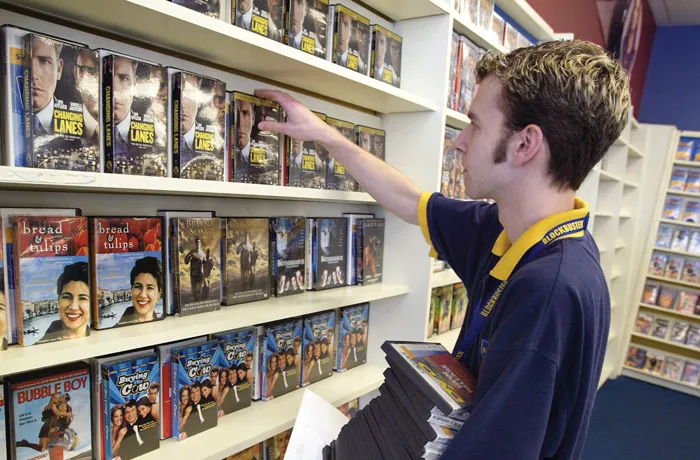
Blockbuster employee Mat Wangrow arranges DVD's on a shelf inside a Blockbuster Video store January 6, 2003 in Park Ridge, Illinois. (Tim Boyle/Getty Images)
Blockbuster employee Mat Wangrow arranges DVD’s on a shelf inside a Blockbuster Video store January 6, 2003 in Park Ridge, Illinois. (Tim Boyle/Getty Images)

To start with, the video store must be considered in continuity with a far more venerable institution: the library. Both are premised on the notion that Americans’ desire to share resources is greater than their impulse to hoard possessions. To borrow a book or rent a movie is an admission that only a finite number of copies of said book or movie exist, and that it is right and proper that they should be meted out on a first-come, first-served basis among members of a community and promptly returned to start the process all over again. There is a reason why not returning a library book invites a special sort of societal censure: The delinquent borrower is withholding a common cultural treasure of which he has no claim. The renter who delayed the prompt return of his VHS tape of Casablanca was no different from the person who kept Flannery O’Connor’s The Habit of Being out of circulation: They were claiming as their own things to which every card-carrying video store patron or library member had a right.

In the case of libraries, this arrangement always hung by a bit of a thread. Even if we have not always had Amazon, we have always had bookstores, and a reader who had concluded that he must, simply must, get and keep his hands on a particular book was always free to simply buy it — thus defeating libraries’ admirable ethic of sharing. Even so, the continued use and relevance of libraries suggests not only that some readers remain economically sensible — that they would rather borrow than buy books — but that many embrace the “share and share alike” philosophy the institution imparts.

The same was true for video stores, which, to be fair, did offer a unique form of ownership, albeit temporary. In the 1970s, when video stores commenced their takeover of the American landscape, movies were not something to be picked off a shelf, dropped into a bag, and stuffed into a VCR, as the first VHS tapes were. Instead, movies were events, not commodities: They were released on certain dates at select venues — even if those venues numbered many hundreds or thousands of theaters — with no expectation that they could be viewed at will in the home. In that sense, the development of VHS tape technology permitted the temporary acquisition of movies, but everything about the scheme was engineered to put the emphasis on “temporary”: Movies were rented, after all. Sometimes they were rented again and again, but they were always put back into circulation. 

The idea of owning a movie, of taking permanent physical possession of it, was strangely foreign to those of us who came of age during the video store era. I still remember my mother’s feelings of joy and shock when she learned that her favorite movie — Leo McCarey’s An Affair to Remember, starring Cary Grant and Deborah Kerr — was available on VHS from our local video store in the very late 1980s. She was ecstatic that she could again watch a movie she had likely not seen in its entirety since it played in theaters in 1957, but she was taken aback when the proprietor told her the cost of the tape, which, in my very foggy memory of hearing about this episode, was upwards of $80 and maybe even closer to $100. That is because, back then, many tapes were given price points that would seemingly only be attractive for video stores to buy and then rent to customers. I believe the proprietor did sell my mother a copy of An Affair to Remember, but she had an acquisitiveness about that particular title that was rare, thankfully, for my father’s pocketbook. Most of the time, my family played along with the understanding that movies belonged at the video store — itself a form of liberation, in the sense they ceased being the domain of the theaters — and were only marched home for a few days at a time.

The video store, then, was a kind of collective in the best, most capitalistic sense of the term: a place where we stood in line and took our turn for the privilege of spending time in the company of a great movie. It was not a drag to go there but a treat, like eating out on a Tuesday night, or going to a ball game on Friday. The only drudgery was setting up a membership at a new store. That’s why stores encouraged loyalty — you were either a Blockbuster family or a Hollywood Video family, in my experience. 

The largest and best video stores crowded their squatty shelves with movies. There sat row upon row of rectangular VHS covers — hallowed out and made stiff with Styrofoam — that were parked in front of the actual tapes to be brought to the front and checked out. Although new releases were represented in abundance, generally arranged on floor-to-ceiling shelving on the back wall, aspiring cinephiles such as myself knew that the glories were found in the interior shelves, which were usually broken up by genre. This is where the classics, oddities, and those new-ish releases that were no longer completely new were housed. Hunting for a title could be difficult, especially if someone sought to consume, as I often did in those days, a representative sampling of a director’s work. If I wished to see every major Woody Allen movie, I could not simply go to the nonexistent Woody Allen shelf, but do the work of picking out what the store had on hand and where it might be. Annie Hall would likely be stocked under comedy or Oscar winners, but would Hannah and Her Sisters be in comedy or drama? How about Radio Days? Would I have to go to a competitor to find the comparatively obscure Shadows and Fog

Decades before AI was considered anything but the evil computer character HAL 9000 in 2001: A Space Odyssey, video stores encouraged their patrons to function as their own search engines and become familiar with their filing system and nooks and crannies. How often was I compelled to scan a shelf several times in search of a particular rarity: Nicolas Roeg’s Walkabout or a rare Robert Altman extravaganza. Video store runs rewarded attentiveness and patience. I still remember the thrill of finding such a title, checking expectantly to assure that an actual copy sat behind its cover, and marching to the checkout to make it temporarily mine. These finds would be carted home like so much loot. The smart clerks — or the ones seeking career paths that would resemble that of Quentin Tarantino — would comment on my artier choices. 

No one who subsists on streaming services can know the pleasures of video store browsing, despite the obvious advantage streamers have over brick-and-mortar stores in terms of content available. Yet, it is well known that an abundance of choice can impede the making of a choice. To pick from among the dozen or so Ingmar Bergman movies that my Hollywood Video stocked in the late 1990s was doable. The stock was small enough to be judged and prioritized: Let’s rent The Seventh Seal and Fanny and Alexander first as a duo — an early Bergman classic, a later Bergman masterpiece — and then, to mix it up, tackle the lesser-known After the Rehearsal next time. But when the Criterion Channel makes available essentially every important Bergman production, how does one begin to even sift through the options? Especially when, if a choice is made, it can be unmade by hitting “stop”? Another advantage of the video store monopoly: A movie, once rented, demanded to be watched. Mistake or not, it should at least be put in the VCR.

THE CULTURAL DOMINANCE OF CHUCK NORRIS 

I use the term “monopoly” intentionally. Clearly, the end of video stores counts as a win for individual movie-watching freedom. Our choice of what to watch and how long we give ourselves the option of watching it has been taken from Blockbuster and given to us. But if our current state of instant availability and easy access is so great, why is there an audience for Videoheaven? Perhaps we secretly crave what the video store asked of us: effort to go there, a willingness to accept what it had in stock, and a spirit of sharing its treasures. I cannot say that I ever made a friend in a video store, but each time I rented a film I came to especially admire or love — Peter Bogdanovich’s The Last Picture Show, Jacques Demy’s The Umbrellas of Cherbourg — I returned it hoping that the next person who encountered it would react as I did. I was paying the VHS tape forward, at least until it wore out. It is too bad (and not a little ironic) that Videoheaven, which captures this whole world so well, can only be seen on streaming. 

Over the years, but especially as renting went the way of the dodo, I admit that I myself have acquired an inordinate number of movies on DVD, Blu-ray, and now 4K. I, too, have become guilty of storing up movies. But with Blockbuster and the like being so very far in the rearview mirror, maybe it is time that I open my own video store. Seven-day rental windows, anyone? 

Peter Tonguette is the film critic for the Washington Examiner magazine.
