A lost art

Published April 10, 2026 5:10am EST


Along with Rembrandt van Rijn and Frans Hals, Johannes Vermeer (1632-1675) was a major artist during the Dutch Golden Age. He painted only about 36 pictures, and he’s mentioned in just a few written documents. He had admirers but was mostly forgotten after he died. It took 200 years before French art critic Theophile Thore-Burger rediscovered Vermeer.  

In Vermeer, A Life Lost and Found, art historian Andrew Graham-Dixon tries to fathom this enigmatic master painter, known as the Sphinx of Delft. He claims that Vermeer was a pioneer of the Enlightenment, a pacifist, and a member of a secret religious movement whose tenets inspired his art. 

Blending history and religion, the book is more of a social history than a biography. It contends that Dutch art of the 17th century was not “an art of literal representation” (p. 321) and that Vermeer was a painter of ideas, not of things. So, to appreciate his art, one must realize that for him, context is everything.

Vermeer, A Life Lost and Found; By Andrew Graham-Dixon; W.W. Norton; 416 pp., $45.00

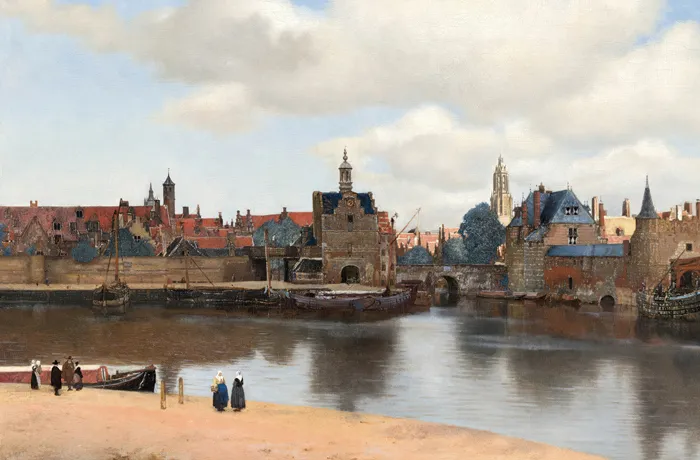
Take Vermeer’s “View of Delft,” for example. The red-tiled roofs, according to Graham-Dixon, seem to glisten after rain. Dark clouds scudding out of the picture make way for the blue sky and white clouds while the sun illuminates several buildings in the city of Delft, including a church tower and the roof of a house. 

Graham-Dixon argues that this painting is not a mere cityscape. It’s also not connected to Vermeer’s possible interest in optics, like the camera obscura (a precursor of photography). And like most of Vermeer’s paintings, it tells a story. The particular narrative in back of this picture is what makes it “radiant.”

Graham-Dixon suggests that the “View of Delft” is about a feeling of Godliness and peace that many experienced as the 17th century religious and political wars were ending. Like several paintings of the era, it may have celebrated the Peace of Westphalia in 1648. The church tower likely had religious implications for Vermeer. The painting may also be nostalgic, reflecting Vermeer’s affection for his home. 

Vermeer painted the picture in about 1654 for his primary patrons with whom he had a close relationship: Pieter van Ruijnen, his wife, Maria de Knuijt, and their daughter, Magdalena. It has been a favorite ever since. Marcel Proust called it the most beautiful picture in the world and created a character who, as he died, murmured, “little patch of yellow wall,” referring to one house in the painting.

Vermeer grew up in the poorer east side of Delft, where his father was an art dealer and a member of the artist’s Guild of Saint Luke. His parents owned the Mechelen Inn, where Vermeer lived from the age of 9, and which was near a boy’s art school.

There is no evidence that Vermeer studied art, and most historians believe he was self-taught. Graham-Dixon speculates that he did attend art school because of the excellence evident in his art from early on. There is a written record showing he joined the Guild of Saint Luke in Delft in 1653. He served two terms as its director. 

View of Delft by Johannes Vermeer, 1754. (Heritage Art/Heritage Images via Getty Images)
View of Delft by Johannes Vermeer, 1754. (Heritage Art via Getty Images)

Graham-Dixon disagrees with the view that Vermeer’s mother-in-law had Jesuit friends who shared the secrets of the camera obscura with him — partly because Vermeer was not Catholic and not favorably disposed toward that religion. 

Graham-Dixon agrees that Vermeer may have converted to Catholicism to marry his wife, Catharina Bolnes, but argues Vermeer was Catholic in name only. He suggests that Vermeer’s family, along with his parents and the van Ruijven family, were secret members of a pacifist Protestant sect: the Remonstrants, as well as a sub-group known as the Collegeants. 

Insisting on peaceful coexistence and tolerance, Remonstrants, according to Graham-Dixon, created the core values of the Enlightenment on which modern society is based. These values shaped the subjects of Vermeer’s art. The Remonstrants broke away from Calvinism and Roman Catholicism because they believed that both religions put too much emphasis on priests, rituals, rules, and formula and not enough on Jesus Christ and his teachings. They thought that Catholics were attuned to the minutiae of religion and not to the big picture.

Remonstrants distrusted institutions based on money and worldly power. They met secretly in private homes with hidden rooms set aside for worship services. Several of Vermeer’s paintings, according to Graham-Dixon, served as devotional pictures, which is perhaps why Vermeer specialized in depictions of interiors with light illuminating people.

Light streaming through the windows in his work is suggestive of a divine origin, Graham-Dixon says. “Girl Reading a Letter at an Open Window,” for example, resembles paintings depicting Mary and the Angel Gabriel. The same light is visible in “Woman in Blue Reading a Letter.” Graham-Dixon believes this woman is probably Catherina, his wife, heavy with child. 

Several other pictures are painted in this style, including “The Milkmaid” and “Woman with a Balance.” According to Graham-Dixon, who may be reading too much into these paintings, “The Milkmaid” implies a story about the importance of feeding the hungry. The “Woman with…” reminds people to practice the virtue of charity and to live a balanced life.      

Vermeer’s “Girl with a Pearl Earring” was particularly shaped by religious beliefs. The girl wearing the earring is named Magdalena, after Mary Magdalene (not her grandmother, as most historians see it), and is the daughter of his patrons. This painting, according to Graham-Dixon, has a special radiance because it depicts Mary Magdalene just as she turns and sees Christ risen from the tomb, with her face rightfully conveying a lovely otherness that’s almost inexplicable. 

IN FULL BLUME 

All of this, Graham-Dixon argues, shows that Vermeer wasn’t driven by fame or money, but by some intense religious belief. But who knows what drives an artist to create — especially one dead for about 350 years?  

Ultimately, the book is heavy with speculation — probably because very little information is known about Vermeer himself. And although Graham-Dixon’s reasoning is thought-provoking and sometimes persuasive, it is not always convincing. 

Diane Scharper is a regular contributor to the Washington Examiner. She teaches the Memoir Seminar course for the Johns Hopkins University Osher Institute.
