

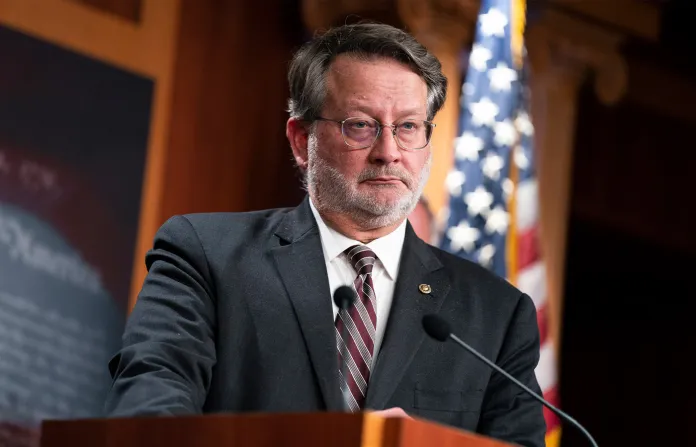
Retiring Sen. Gary Peters (D-MI) has a warning for the three Democrats fighting to replace him in Michigan’s marquee Senate race: Keep it civil.
Recommended Stories


In an interview with the Washington Examiner, Peters expressed concern that the candidates will get increasingly “chippy” with one another as the primary draws closer.
Holding Michigan in the Democratic column is crucial for the party to win a Senate majority in the Nov. 3 midterm elections. Republicans currently have a 53-47 edge, and Michigan is one of the few battlegrounds where Democrats are playing defense due to Peters’ retirement.
Ahead of the Aug. 4 primary, the race has already exposed many of the dividing lines in Democratic politics. Abdul El-Sayed, a medical school graduate who was public health director in Detroit and suburban Wayne County, is trying to steer the primary left. El-Sayed is backed by Sen. Bernie Sanders (I-VT).
He is competing against Rep. Haley Stevens (D-MI), who is seen as the establishment pick, and state Sen. Mallory McMorrow, who is courting both progressive and traditional Democrats.
The winner will face Republican nominee-in-waiting Mike Rogers, who represented a Lansing-based district in the House from 2001 to 2015 and spent his last four years there as House Intelligence Committee chairman.
Rogers narrowly lost a 2024 open-seat race to now-Sen. Elissa Slotkin (D-MI). Even as President Donald Trump won Michigan, Rogers came up just short against Slotkin, then a House member for nearly six years. Slotkin edged him out 48.64% to 48.30%, by just 19,006 votes out of nearly 5.6 million cast.
With no clear frontrunner less than three months out from the Democratic primary, Peters is advising the party’s trio of candidates not to resort to low blows to gain momentum.
“Primaries aren’t necessarily bad,” said Peters, 67, who is set to retire from the Senate after 12 years representing Michigan. “It’s an opportunity for folks to get to be known in the state, particularly if they aren’t already known statewide.”
“Our hope is that it just doesn’t get too acrimonious. And unfortunately, a lot of primaries, especially if they’re close, get a little chippy at the end,” Peters said. “I’m encouraging everyone to try to avoid that, but it’s not easy.”

Senate Republicans are watching from the sidelines as the Democratic candidates carve each other up rhetorically, hoping that the jockeying for the nomination leaves the eventual nominee bruised going into the general election.
“The Democrats have got a mess on their hands in Michigan,” Sen. Steve Daines (R-MT), who ran Senate Republicans’ campaign arm last cycle, told the Washington Examiner.
Daines, a nearly 12-year Senate veteran who is retiring after the November elections, cited Democratic infighting in the primary in handicapping the GOP’s chances.
“I realize this environment in a midterm is always more difficult than in a presidential, but I think it bodes well for our chances to pick that seat up,” said Daines, who helped Republicans win a Senate majority in 2024 after four years in the political wilderness.
Democratic tensions boil over
Democratic tensions in the Senate race are on the rise. One of the latest flashes of bitterness came on May 6, when McMorrow chided former Democratic Sen. Debbie Stabenow for supporting Stevens, who was first elected to the House in 2018. McMorrow suggested Stabenow’s endorsement of Stevens was orchestrated by Senate Minority Leader Chuck Schumer (D-NY) because he is “feeling threatened.”
Stevens, 42, has declined to say if she supports Schumer today. But the party leader’s perceived backing of her has become part of a larger, anti-establishment critique from her opponents.
At other times, the candidates have sparred over the influence of pro-Israel lobbying groups on the Senate race and El-Sayed’s embrace of controversial Twitch streamer Hasan Piker as a campaign surrogate.
So far, none of the Democrats has been able to pull ahead in polling, despite multiple debates and a steady drip of opposition research. Both Peters and his Michigan Senate colleague, Slotkin, plan to stay neutral in the race.
Hard-earned advice from a political veteran
In pleading for the younger crop of candidates — El-Sayed is 41, and McMorrow is 39 — to measure their rhetoric, Peters brings the experience of a campaign veteran. The one-time investment adviser and Navy Reserve member spent eight years as a state senator. He lost an agonizingly close race for Michigan attorney general in 2002, falling short by 5,200 votes out of more than 3 million cast, for a 0.17% margin.
Peters spent four years as Michigan Lottery commissioner before beating a Republican incumbent in 2008. He moved up to the Senate in 2014 by winning an open-seat race in an otherwise terrible year for Democrats, with Republicans gaining control of the chamber for the first time in eight years. In 2020, he won reelection by 1.7 points over now-Rep. John James (R-MI).
As the former chairman of the Democratic Senatorial Campaign Committee, Peters is well aware of how contested primaries drain candidate resources and damage the image of the eventual nominee.
That challenge is especially problematic for Senate leadership in Michigan, where the primary is not until August, relatively late in the election cycle. The timing is one reason Republicans were so eager to clear the field for Rogers to make a second straight Senate bid.
“That’s a structural problem with Michigan,” Peters said of the primary date. “I’d love to have an earlier primary in Michigan.
He added, “It’s tough for the person who emerges to be able to do what they all have to do before the general election.”
Democrats have all the electoral advantages that come with running in a midterm year with Republicans in full control of Washington. Political history is also on the Democrats’ side, as Republicans have won only a single Senate race in Michigan since 1978, and there are new headwinds for Republicans, including the war in Iran and its impact on energy costs.
With the national political environment favoring Democrats, Peters expressed cautious optimism that they could retake the Senate this fall, a task that would require them to hold blue seats such as Michigan and flip four others in GOP territory.
“I wouldn’t have been as optimistic six months ago as I am now, looking at the dynamics,” Peters said.
MIDTERM COUNTDOWN: DEMOCRATS LEAD EARLY, BUT GOP SEES A PATH THROUGH THE MAP
“I’m fairly confident there’s going to be wind in our sails,” he added. “I still don’t know how strong that wind is. Right now, I think it’s pretty good … but we still have a lot of time.”
David Sivak (@DISivak) manages the Congress and campaigns team at the Washington Examiner, while also reporting on Capitol Hill.
