

Former Labor Secretary Lori Chavez-DeRemer was forced out of her Cabinet-level post in April by a White House that had grown weary of the scandals surrounding her.
Stay informed.Stay ahead.
Join Washington Examiner for unlimited access to the news, analysis, and commentary that matter most.
Already a member? Log in
The allegations against Chavez-DeRemer included: abuse of office for her and family members’ benefit; drinking on the job; having an affair with a subordinate; taking aides to a strip club; and being forced to bar her husband, Dr. Shawn DeRemer, from the Frances Perkins Building over complaints of unwanted sexual advances on female DOL staffers. Several other members of Chavez-DeRemer’s inner circle had already been forced out by the time of her departure, including a chief of staff and a member of her security detail with whom she had an alleged affair.
The labor secretary denied any wrongdoing on April 20, the day the White House announced her exit. “The allegations against me, my family, and my team have been peddled by high-ranked deep state actors who have been coordinating with the one-sided news media and continue to undermine President Trump’s mission,” she wrote on X. “I look forward to continuing to fight the good fight from outside and always advocating for the American worker.”
Chavez-DeRemer’s dirty laundry was first aired by the New York Post in January in a story with the headline: “Labor Secretary Lori Chavez-DeRemer under investigation for ‘inappropriate’ relationship with employee.” The paper relied on leaked documents from the DOL inspector general’s investigation. (The Washington Examiner asked the DOL inspector general if the investigation continues now that Chavez-DeRemer has left her position, but did not receive a response.)
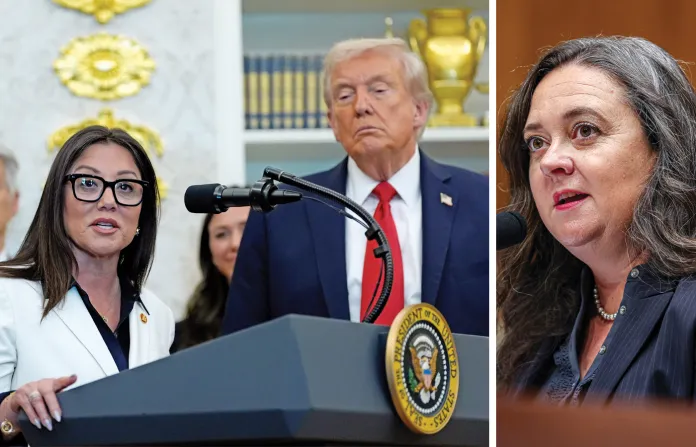
She had been confirmed by the Senate last March with significant bipartisan support, by a 67-32 vote, when many votes for other Trump Cabinet positions were cast along narrower party lines. Chavez-DeRemer picked up significant Democratic support because President Donald Trump had nominated the one-term U.S. representative from Oregon on the advice of Teamsters President Sean O’Brien.
O’Brien wanted Chavez-DeRemer to lead DOL because she was seen as a Republican sympathetic to the desires of union leadership. She had endorsed the Protecting the Right to Organize Act while running, unsuccessfully, for reelection, for instance. If passed, the PRO Act would have stacked the deck for unions and against employers in a number of ways. That was one reason why a few Republicans, including Sens. Rand Paul (R-KY) and Ted Budd (R-NC), voted against her confirmation.
Once she was sworn in, Chavez-DeRemer did not endear herself either to the DOL’s pro-union bureaucracy or to the more union-skeptical conservative political appointees. Rather, if the allegations against her are true or even mostly true, she left many things on autopilot while constantly flying around the country on the taxpayers’ dime.
Acting secretary, reporting
Chavez-DeRemer’s deputy secretary, Keith Sonderling, has been named acting labor secretary. Prior to this job, Sonderling, in his mid-40s, has been all over the federal bureaucracy, including at the Equal Employment Opportunity Commission, the Department of Commerce, and the DOL’s Wage and Hour Division. There has been some speculation that Trump will give him the nod for the main job.
Deputy secretary is also a Senate-confirmed position. Sonderling was approved on a roughly party-line vote of 53-46. With past as prologue, so long as Senate Democrats don’t filibuster his nomination, he would likely have enough votes in this Congress to take the “acting” out of his title.
But all kinds of things could happen to derail that. If Trump consults O’Brien again, it’s unlikely the Teamsters president would want Sonderling for the job, for instance. There’s also the cautionary tale of Julie Su, Chavez-DeRemer’s predecessor in the Biden administration.
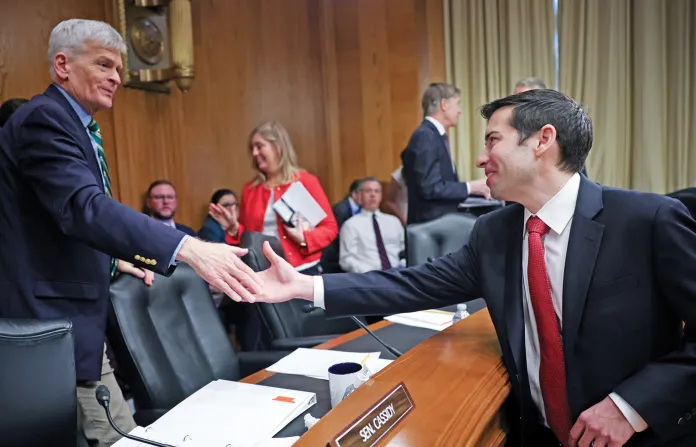
As President Joe Biden’s first DOL secretary, former Boston Mayor Marty Walsh was confirmed with similar bipartisan numbers to Chavez-DeRemer’s, 68-29. Su was seen as much more of an activist and was dogged by charges that she had allowed billions of dollars worth of fraud in COVID-19 funds while labor secretary of California. She barely squeaked by into the deputy slot, with a 50-47 vote.
When Walsh moved on to represent the NHL’s hockey players as the head of their union, Biden attempted to elevate Su to the top job. But because he couldn’t find the votes for it, she remained acting head of the agency until Trump returned to the White House. Su was then appointed as “Deputy Mayor for Economic Justice” by New York City Mayor Zohran Mamdani upon the latter’s victory last year.
New boss, met
At about the same time that things began to go badly for Chavez-DeRemer in January, Crystal S. Carey was sworn in as general counsel of the National Labor Relations Board.
Her title is confusing because, while Carey is indeed a lawyer, that is beside the point.
Carey is not serving as the independent executive agency’s head lawyer. Rather, she is the new boss of another federal labor agency that has roiled employment law for the last decade or so. Some of her early moves have earned praise from unexpected quarters.
“The new boss is not the same as the old boss,” wrote Cary Burke, a partner in the mostly plaintiff-side employment law firm Lee Meier Burke, on social media. Burke called Carey a “lunch-pailer who’s ready to get down to business” to deal with a case backlog that is “just crushing everyone.”
Burke said that the new general counsel’s general approach “makes all the sense in the world.” He added that “if I’m honest, I’m also annoyed that it took Congress more than six months to confirm her appointment.”
Carey was confirmed by the Senate in December 2025 as part of a deal to clear up a massive nominations logjam and sworn in mid-January. The confirmation of two NLRB board members alongside her finally brought to the body to a quorum, which is legally necessary for many agency functions.
Breaking the cycle
All general counsels for the NLRB, which oversees unionization elections and polices union-related labor law, begin their tenure with a memo laying out their priorities for the agency’s workers. The message of Carey’s January memo to 1,500-plus employees spread across 26 regional offices was simply: “Let’s get to work.”
“This memorandum will not follow the format of previous initial GC memos,” Carey announced in her opening line, and there was a reason for that. “For too long we have been stuck in a cycle where justice to all parties is delayed,” she reckoned, by what amounted to partisan axe grinding.
Now, the agency has a massive backlog of cases to grind through. The number was reportedly over 16,000 cases, though only a fraction of those will require action by the board itself.
This introduction was a sharp contrast to her predecessor in the Biden administration, Jennifer Abruzzo. The Biden NLRB general counsel’s opening memo, Burke pointed out, “identified nearly 20 separate fact patterns” for the local offices to send to D.C.’s Division of Advice for further scrutiny. That move only gummed up the works.
Abruzzo had many obsessions, including intense scrutiny of all company manuals for workers, a hatred of mandatory company all-hands meetings to discuss unionization, and a desire to push college athletes toward unionization. In her parting statement, she confidently predicted, “There’s no putting that genie back in the bottle.”
Carey, who, like Sonderling, is also in her mid-40s, has a history with the agency. While attending law school at Penn State, she interned at the Baltimore regional office. She then served as a field attorney and rose through the ranks to senior staff counsel assigned to past Republican Board Chairman Philip A. Miscimarra.
She left the agency for a private practice in 2018, and this move drew opposition from organized labor to her nomination. O’Brien said that his duty on nominations was to call balls and strikes, and that Carey was “a strike that must be called.” As a partner at Morgan Lewis, Carey had “spent her entire professional career backing Big Business to the detriment of working people,” he warned. (With Carey confirmed and his nominee Chavez-DeRemer forced out, he’s currently batting 0-for-2.)
The NLRB is the agency that kicked off a long struggle in U.S. labor law in 2015 by muddying the so-called joint-employer standard. Workers may toil for a services firm that subcontracts for a client firm, on the client firm’s campus.
For example, many hospital cafeterias are run and staffed in this way, which only makes sense as hospitals are not known for any special competency in supervising line cooks. The law had been clear that those employees could be declared jointly employed by both parties for the purposes of unionization and wage laws, but only if the job site firm exercised control that was substantial, direct, and immediate.
An NLRB packed with Obama nominees scrapped that clear standard. It added both indirect control and reserved control, which in plain English means control that the job site firm might have exercised but didn’t, as criteria that might be considered in declaring joint employment. This led to several lawsuits from business groups.
Standards whipsawed back and forth with successive administrations, and one would be hard pressed to find a single step along the way that wasn’t met with yet more litigation. Even O’Brien, who is part of the larger team pushing for a more expansive rule, admitted in a 2025 Senate hearing that workers regard it as “regulatory ping pong” at this point.
Carey’s approach to an issue that sucked up so much agency attention is almost Solomonic in its creativity. Under her, the NLRB removed the judicially stayed Biden joint-employer rule, treating it not as a matter of rulemaking but as a matter of housekeeping.
That will still mean some litigation over the final rule from the first Trump administration, which reinstated the old standard. Her hope appears to be that any remaining litigation might settle out, and the agency can move on to other things.
THE LITTLE LABOR NEGOTIATION THAT COULD
In the meantime, the new NLRB boss is using the backlog to reform the agency’s processes quietly, using bureaucratic triage to refocus the agency on its core mission.
One representative memo from Carey counseled agents to resolve cases “through settlement rather than litigation whenever feasible”; to go light on firm rules that, while technically incorrect, had caused no actual harm to workers; and to hold off on formal agency demands for evidence until agents see “a prima facie case” in front of their own noses.
Jeremy Lott (@jeremylottdiary) is the author of several books, most recently The Three Feral Pigs and the Vegan Wolf.
