

America is facing a reading catastrophe. Nearly five years after pandemic closures, only 31% of fourth graders can read proficiently, achievement gaps are widening, and student performance continues to slide. Yet instead of treating literacy as an emergency, many of the nation’s most powerful teachers unions remain consumed by political activism — organizing protests, advancing ideological causes, and turning classrooms into vehicles for social advocacy while millions of children struggle to read at grade level.
Stay informed.Stay ahead.
Join Washington Examiner for unlimited access to the news, analysis, and commentary that matter most.
Already a member? Log in
According to an analysis of state standardized tests taken by more than 20 million K–8 students, reading scores in most grades are unchanged from spring 2021. And in some cases, they have fallen further.
The data is stark: Fourth- and eighth-graders are now reading two points below their 2022 levels, extending an already steep 3-point drop since 2019. The lowest-performing students now score roughly 100 points below the highest-performing students, a gap that has been growing for a decade.
Surprisingly, the data also show that the learning crisis did not originate with COVID-19, but started around 2013. The pandemic didn’t create this disaster — it accelerated one already well underway.
“The pandemic was the mudslide that followed seven years of erosion in student achievement,” said Professor Tom Kane, faculty director of the Center for Education Policy Research at Harvard University.
So what are the nation’s teachers unions doing about it? Fighting the wrong fights, it seems.
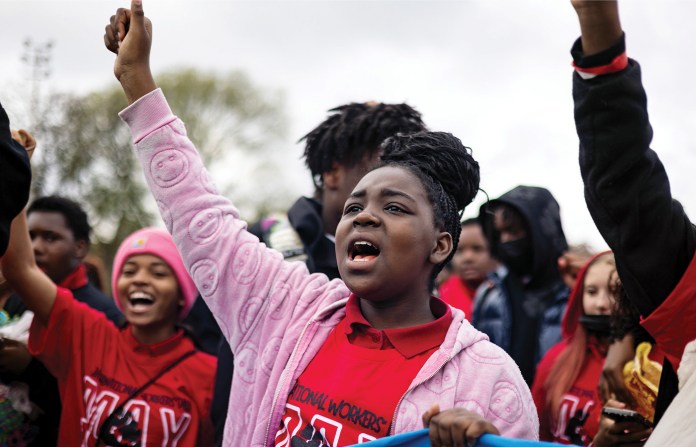
On May 1, the Chicago Teachers Union fought to close Chicago Public Schools for May Day, with the explicit goal of bringing students out to protest against the Trump administration, Immigration and Customs Enforcement, and what organizers called “fascism.” The schools stayed open, but thousands of students and teachers attended the protests anyway, on the taxpayers’ dime, while union members advanced their one-sided political agendas and students missed a day of learning. This is in a city where academic scores lag behind the already abysmal national average.
At the national level, while spending upwards of $40 million on political advocacy, one of the biggest unions, the American Federation of Teachers, is set to consider a resolution this November that would give activist teachers explicit cover to present contested geopolitical opinions as established fact. The proposal, offered by the AFT local representing Brown University graduate students and deceptively titled “Defending Critical Speech and Scholarship,” would condone teaching about what it calls “the US/Israeli genocide and scholasticide in Gaza” — an inflammatory charge that is actively disputed by legal scholars, historians, and governments worldwide. The resolution would allow teachers to present that framing to children as young as 5, as settled truth, with no obligation to offer alternative perspectives.
And while obsessing over irrelevant political fights, some of them are actively opposing legislation meant to implement “science of reading,” a data-backed strategy that is proven to improve literacy. This is a system-wide pattern that cannot be ignored.
Recall the president of the United Teachers of Los Angeles, an AFT affiliate, who famously dismissed concerns about pandemic learning loss by saying: “It’s OK that our babies may not have learned all their times tables … They know the difference between a riot and a protest. They know the words insurrection and coup.”
It was a revealing statement, and not in the way its author intended. Students might know the word “coup,” as the union president boasted, but they probably can’t spell it.
There are longstanding legal norms embedded in district policies and state education codes across the country that require controversial issues to be presented with multiple perspectives in K–12 classrooms. These policies exist for good reason: The courts have long held that K–12 teacher speech is not unfettered and that there is no “academic freedom” to use a public school classroom as a political platform. Under these rules, a teacher cannot tell students that the U.S. and Israel are committing genocide any more than a teacher can tell students that abortion is morally wrong. The classroom is not a pulpit, and the rule applies to all sides.
The unions appear to have forgotten this. Or perhaps they never cared.
The problem runs deeper than union politics. It starts in the institutions that train teachers in the first place.
A major 2023 report by the National Council on Teacher Quality, which reviewed nearly 700 teacher preparation programs, found that only 25% adequately cover all five core components of science-based reading instruction: phonemic awareness, phonics, fluency, vocabulary, and comprehension. Even more alarming: Another 25% of programs fail to cover even a single component adequately.
Meanwhile, teachers’ colleges and ongoing teacher training programs remain hyper-focused on activist frameworks that prioritize creating social justice warriors over producing proficient readers. This means teachers are often not equipped to teach reading because their training programs did not prepare them to do so. The unions have done little to demand better from those programs, and plenty to deflect attention from the results.
This cover-up should be one of the biggest scandals in America. Rather than reckon with the consequences of inadequate instruction, the K–12 system increasingly masks failure with inflated grades.
According to a 2023 ACT analysis of more than 4 million high school seniors, average adjusted math GPAs rose from 3.02 to 3.32 between 2010 and 2022, even as ACT scores fell to their lowest point in a decade and 12th-grade reading scores on the National Assessment of Educational Progress dropped. Graduation rates, similarly, have climbed steadily, from 80%in 2012 to 87% by 2022, even as the share of graduates reading or doing math at grade level has declined. Students are “failing up,” that is, being passed along with credentials that don’t reflect what they know.
By the time they reach college, the illusion collapses. A stunning internal report from the University of California, San Diego, last fall found that 1 in 8 incoming freshmen placed below high-school level in math. Elite universities, confronted with the underprepared students their admissions offices now enroll, have responded not by demanding more but by quietly inflating their own grades, from community colleges all the way up to Harvard. The cracks in K–12 are showing up in higher education’s transcripts, and soon, they’ll show up in the workforce.
What’s being lost in all of this is not just reading scores, though those losses are severe and measurable. What’s being lost is the foundational promise of American public education: that schools exist to equip children with the knowledge and skills to think for themselves, not to recruit them into adult political causes. Activists know and bank on the fact that children in public schools are a captive audience. Students and parents alike are unable to choose their teachers or opt out of the lesson. They are young and impressionable, and they deserve better than to be treated as raw material for ideological formation.
A new coalition, the Coalition of Organizations for Responsible Education, has mobilized more than 40 organizations nationwide and collected nearly 2,000 signatures on an open letter calling on educators to keep personal political biases out of the classroom. The group One Nation of Educators is likewise advocating for change within the unions. These efforts reflect a growing demand for accountability, one that the unions would do well to take seriously.
REVERSING THE READING RECESSION
The students falling furthest behind are disproportionately low-income and from minority communities — the very children public education was supposed to serve as an equalizer. These are the same marginalized students the unions claim they are fighting for. It’s painstakingly clear: Union activism for unrelated political causes doesn’t close achievement gaps. Instead, it widens them by consuming the time, attention, and institutional energy that should be directed toward instruction. Forget ICE — where are the protests for better reading scores?
There is nothing conservative or progressive about wanting children to learn to read. The adults running America’s schools keep insisting they are shaping the future, but if children still can’t read, the future they’re shaping looks increasingly illiterate.
Sharon Ceresnie Sorkin is director of community engagement at the North American Values Institute.
