

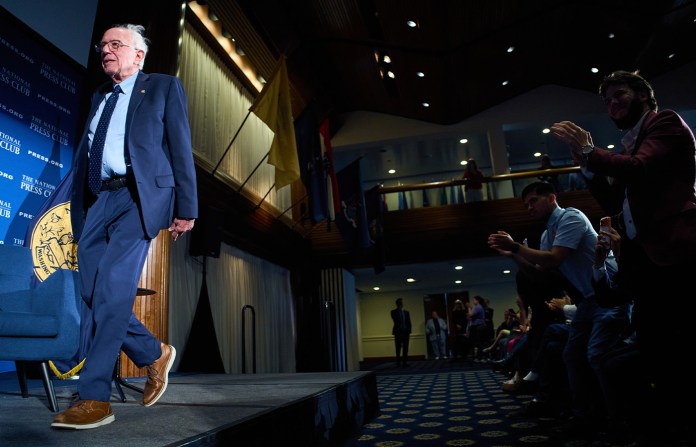
Sen. Bernie Sanders (I-VT) is winding down his long political career. “I suspect that’s not going to happen,” he told journalist Robert Costa when asked about a third bid for the Democratic presidential nomination during an event at the National Press Club.
Recommended Stories


Sanders had all but ruled out running for reelection to the Senate seat he’s held since 2007 when his current term expires, saying shortly after he won again in 2024 that this would likely be his last go-round. (He has been more equivocal on that front, however: Last January, he filed paperwork with the Federal Elections Commission to run again in 2030, just weeks after being sworn in for his fourth term.)
But the 84-year-old socialist clearly knows that his age is a limitation at this point. “Because they want youthful vigor in the White House! That’s what they want. We’re tired of these 30- and 40-year-old people,” he quipped to the laughing audience when asked about his 2028 plans. “What we really need are 80-year-olds running the country.”
Sanders’s ideology aside, it would be remarkable for the country to elect its third consecutive octogenarian president after never having previously voted for a commander-in-chief of that age. “I know I look like I’m 30; I am not. And that’s that,” he said.
The longtime Vermont lawmaker said something similar when he seemingly ruled out another Senate term. “I’m 83 now. I’ll be 89 when I get out of here,” Sanders told Politico at the time when asked if he was running his last campaign. “You can do the figuring. I don’t know, but I would assume, probably, yes.” Then-President Joe Biden was forced to end his campaign for a second term earlier that year after a faltering debate performance intensified fears he had gotten too old for the job. Sanders is more than a year older than Biden.
If Sanders has run for office for the last time, he may be going out on top. He has never been more influential within the Democratic Party, despite never seeking office on the party’s line until he ran for its presidential nomination for the first time in 2016. (Sanders has caucused with Democrats his entire congressional career, dating back to his first House term in 1991.)
Candidates endorsed by Sanders keep winning Democratic primaries. This includes Graham Platner in Maine, who drove establishment-backed Gov. Janet Mills (D-ME) out of the race months ago and won the nomination to challenge Sen. Susan Collins (R-ME) with 72.4% despite a slew of negative headlines in the days leading up to the primary.
“Congratulations to Graham Platner on his landslide victory in Maine,” Sanders wrote in a celebratory social media post after the election was called for his candidate. “Together, we will defeat Oligarchy and create an economy that works for all, not just the few.”
Sanders stood by Platner when a sexting scandal prompted Mills to remind Maine voters she was still on the ballot, even if she had stopped actively campaigning.
“We got a housing crisis. People can’t afford healthcare; they can’t afford groceries; they can’t afford to fill up their gas tanks. And I think it’s important for us to focus on the issues facing working families a little bit more than Graham Platner’s marriage,” he told reporters on Capitol Hill.
“I wish their marriage the very best. But right now, I think we should be focusing on the crises facing the working class and electing people of the guts to stand up to the oligarchs who control our country,” Sanders added.
Platner may be the most prominent Sanders pick, but he isn’t the only successful one. In California, Randy Villegas advanced to a runoff ahead of the candidate preferred by the Democratic Congressional Campaign Committee. He will face vulnerable Rep. David Valadao (R-CA) on the Nov. 3 ballot. Villegas joined another Sanders-backed Democratic House candidate in making it to the general election: Bob Brooks in Pennsylvania, Brian Poindexter in Ohio, Sam Forstag in Montana, and Adam Hamawy in New Jersey. Plus Rep. Analilia Mejia (D-NJ), who won an April special election.
“Progressives are on the march,” Sanders declared on June 3. He issued a statement rattling off his allies’ recent primary victories, concluding, “candidates willing to stand up for working people are taking on the establishment and WINNING.”
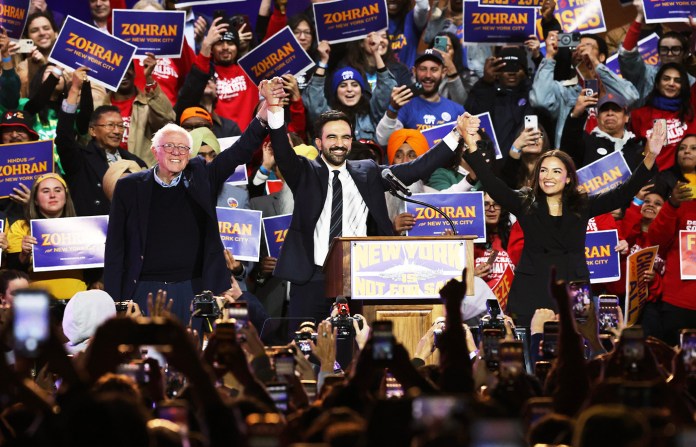
New York City Mayor Zohran Mamdani is another Sanders ally in high places. Last year, he took on former Gov. Andrew Cuomo in the Democratic primary and won. The young socialist upstart then beat Cuomo again in the general election. Sanders swore in Mamdani as mayor at the beginning of the year.
“You showed the world the most important lesson that can be learned today — and that is that when working people stand together, when we don’t let them divide us up, there is nothing we cannot accomplish,” Sanders told Mamdani in a speech delivered beforehand at the event outside New York City Hall.
For his part, Mamdani has hailed Sanders as “the single most influential political figure in my life.”
The Uganda-born Mamdani isn’t constitutionally eligible to run for president and therefore can’t succeed Sanders at that level. But Rep. Alexandria Ocasio-Cortez (D-NY) can. The 36-year-old was one of the first socialist Sanders acolytes to topple a Democratic establishment figure when she defeated 10-term incumbent Rep. Joe Crowley, then the chairman of the House Democratic Caucus, in a 2018 primary.
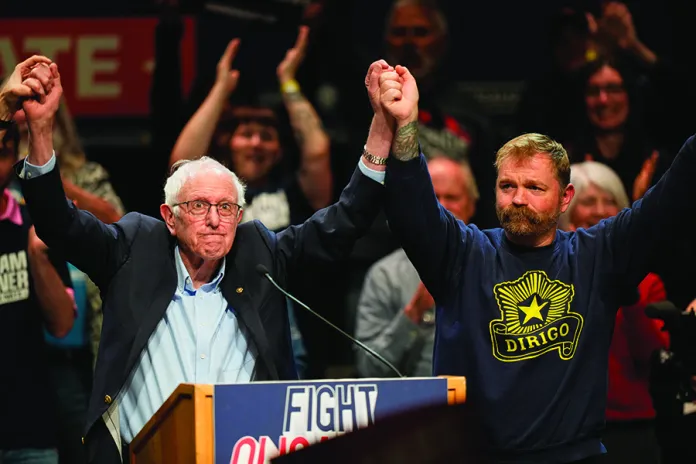
Sanders and Ocasio-Cortez have joined forces on their “Fighting Oligarchy” tour, drawing tens of thousands at rallies across the country.
“We believe in a government of the people, by the people and for the people,” Sanders said at one such event in a heavily Republican California congressional district. “Not a government of the billionaires, by the billionaires and for the billionaires.”
“Every single one of us, I think, is a beneficiary of the work that he has accomplished,” Ocasio-Cortez later said of Sanders.
After decades of running for office as an independent or the nominee of obscure left-wing political parties, Sanders is reshaping the Democratic Party in his image. That’s why, despite his advanced age, some are clamoring for him to run for president or the Senate again — perhaps both.
The 2028 Democratic primaries are likely to be crowded. His most fervent admirers believe Sanders could cobble together enough support to win in a multi-candidate field. That might have happened in 2020, but relatively centrist Democrats quickly consolidated behind Biden when it looked like they could be saddled with a socialist presidential nominee. Former New York Mayor Michael Bloomberg, Sen. Amy Klobuchar (D-MN), and Pete Buttigieg, then only the former mayor of South Bend, Indiana, all dropped out and endorsed Biden at a convenient time rather than split the non-socialist vote. Black Democrats rallied to save Biden’s precarious candidacy in the crucial South Carolina primary. (Sanders, who represents one of the country’s whitest states, has traditionally struggled to win black support.)
Sanders supporters feel the Democratic establishment more overtly put its thumb on the scale against their candidate to benefit Hillary Clinton in 2016. They believe Sanders could have gotten enough working-class votes to stop Donald Trump in either election, especially in the Rust Belt states that delivered him the presidency in both 2016 and 2024.
There is no consensus on who would replace Sanders as the leader of this movement or as its representative in the 2028 Democratic presidential primaries. In addition to Ocasio-Cortez, who might also have her eyes on Senate Minority Leader Chuck Schumer’s (D-NY) seat when it’s up that same year, there is Rep. Ro Khanna (D-CA). Khanna has been traversing the country in preparation for a national candidacy, and like Sanders, was a top surrogate for Platner in Maine.
Democrats are currently facing a Tea Party-like moment, a revolt against the party’s leaders and elders (except Sanders himself). Unlike the small-government Tea Party, however, this intraparty insurgency is being driven by socialists and diehard progressives who believe passionately in the government’s power to solve problems.
“We will prove that there is no problem too large for government to solve, and no concern too small for it to care about,” Mamdani said as he became mayor of America’s largest city.
FROM A MAMDANI GURU TO A CARD-CARRYING SOCIALIST, HERE’S WHO’S HELPING PLATNER
The Sanders wing of the party has seemingly won the argument over why Democrats lost in 2024: Former Vice President Kamala Harris abandoned progressive economics and lost the working class to Trump. (The conclusion could have just as easily been that Harris was the victim of the rampant inflation sparked by even a half-hearted attempt at economic progressivism under Biden’s watch.) Republicans attacked Harris more for cultural wokeness than for activist government during the 2024 campaign.
If this is Sanders’s final political act, it is a long goodbye. A man who once was a single-digit also-ran as a perennial candidate is now a senior citizen entering the most consequential phase of his career. Whether that redounds to the benefit of the Democratic Party — or the country — remains to be seen.
W. James Antle III (@jimantle) is executive editor of the Washington Examiner magazine.
