

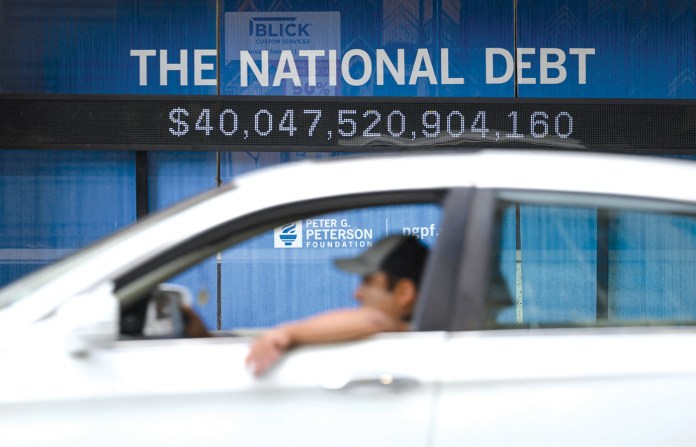
The ticking time bomb that is the national debt just crossed the $40 trillion mark and could spark a fiscal crisis that could throw the economy into disarray, spiking unemployment and exploding inflation.
Republicans and some centrist Democrats have long sounded the alarm about growing debt and deficits. The debt first crossed the $1 trillion mark in 1981, but lawmakers of both parties have done little to reduce debt and deficits since the temporary run of balanced budgets from fiscal 1998 through 2001.
Recommended Stories


THE DEFICIT, EXPLAINED: WHAT IT IS, WHY IT’S GROWING, AND HOW TO FIX IT
Now, some are warning that the burden of that debt could spark a spiraling crisis that would affect everyone.
Former Rep. Carolyn Bourdeaux, who is now the executive director of the Concord Coalition, which focuses on balancing the budget, told the Washington Examiner that there is a “failure of imagination” among most analysts where they simply can’t imagine a scenario in which Congress “absolutely fails to act in the teeth of a crisis, or the bond market fails to respond to a potential crisis.”
Bourdeaux, a Georgia Democrat who represented an Atlanta-area district from 2021 to 2023, noted the potential for a death spiral of sorts when it comes to debt and interest rates — something that could result in massively deleterious effects for the economy and consumers.
“If we have to issue more debt or print money, that will then cause the interest rates to go up further, which then causes us to have to print money or issue debt to cover those interest payments,” she said. “We get into a spiral of both inflation and rising interest rates. So stagflation, which has the potential to be a disaster for the economy.”
Stagflation is seen as one of the worst economic scenarios that could play out. Stagflation, a portmanteau of stagnation and inflation, is when prices are rising while economic growth and the labor market are languishing.
Bourdeaux said one could look to other countries that have experienced crises in the past.
“The causes that led to the crisis are different, but it is possible that the experience would be the same in countries like Argentina, or Greece, or Turkey, where they experienced inflation not at 3% a year, but at 100% a year or higher,” the former congresswoman warned.
Inflation clocking in at 100% might seem unimaginable to consumers and would disproportionately hurt salaried workers — those largely dependent on investment income would be better able to weather such a crisis, Bourdeaux said.
For instance, if someone is earning $100,000 before, with 100% inflation, that same person would need to have their salary doubled to $200,000 just to keep up their status quo.
“The people who struggle to weather it are those who have to renegotiate their salary, renegotiate their pay on a regular basis,” she said. “It’s much stickier and much more difficult to keep up. Anything held in cash will be degraded.”
Desmond Lachman, a senior fellow at the American Enterprise Institute, told the Washington Examiner that there have recently been some warning signs about the situation that have gone along with that $40 trillion milestone. For instance, the 30-year Treasury rate recently spiked to the highest level since 2001.
“So markets are beginning to say, you know, what’s going on? That these guys can’t finance themselves — this is just a whole big Ponzi scheme,” he said. “So you’ve got a lot of signs that there’s already trouble brewing.”
And the situation is even more complicated in that there is no clear timeline for when a crisis might occur.
“One of the scariest things about worst-case scenarios is it’s impossible to say how close we are to a crisis,” David Ditch, a policy analyst at the Cato Institute, told the Washington Examiner.
Ditch said he doesn’t consider a worst-case crisis an immediate threat, like in the next year or so, but the odds go up over time.
War-gaming fiscal disaster
What exactly a fiscal crisis might look like, and the severity of such a crisis, is not possible to predict. The Committee for a Responsible Federal Budget released a paper analyzing various crisis scenarios, including a financial crisis, an inflation crisis, an austerity crisis, a currency crisis, a default crisis, and a gradual crisis.
Of crucial note, the CRFB said several of these crises could happen simultaneously, which would be even more disastrous for consumers.
In the case of a financial crisis, the group warns that high and growing debt could degrade investor confidence in the country’s fiscal outlook and cause interest rates to spike, which could then “set off a panic,” further exacerbating the crisis and hurting financial markets.
“This could lead to a series of cascading failures at financial institutions, which could have ripple effects across the economy — making it difficult for individuals and businesses to make payments or receive loans and sparking a wave of defaults, rising unemployment, business failures, and foreclosures,” the paper reads.
The CRFB said in the “most extreme case” of trying to avoid a financial crisis or default without addressing the underlying debt, the Federal Reserve or government could monetize the debt, essentially printing money to finance the debt. That could lead to spiraling inflation.
An inflation crisis could result in businesses shuttering and unemployment rising. Such high inflation, as has been seen in other countries, could also have escalating noneconomic side effects.
“These types of crises typically go hand in hand with enormous social and political unrest,” Bourdeaux said.
Stagflation could become a reality, featuring high unemployment and explosive inflation.
For a long time, economists did not think stagflation was possible because they believed that higher inflation could be traded off for lower unemployment. The notion of high inflation being married to low unemployment and vice versa was turned on its head in the 1970s when both high inflation and stagnating growth occurred simultaneously, causing pain for consumers.
Ditch said it is very challenging to predict what the consequences of all of this might be and what a worst-case scenario might look like, but he pointed out that consumers are already experiencing higher borrowing costs, and in a crisis, those could shoot higher.
That would mean credit card balances going up, mortgage costs shooting up, and making homebuying more challenging.
“It’s going to be a lot harder to borrow money to start a new business, harder to borrow to expand a business, and if you make it harder for businesses to get the capital they need, that’s going to mean fewer job openings,” Ditch said.
Ditch also warned about the possibility of spiraling inflation. Inflation hit a recent multidecade high of nearly 9% in June 2022 and is still the No. 1 concern for voters four years later.
“What people perceive as a cost-of-living problem right now could spiral into a cost-of-living crisis that we experienced to a certain extent in 2021, but on a more prolonged basis back in the 1970s,” he added.
The Congressional Budget Office, Congress’s nonpartisan scorekeeper, has been warning about the severe consequences of not addressing the growing national debt for years.
In February, the CBO projected that federal debt held by the public would reach 101% of GDP this year. By 2030, debt will exceed 108% of GDP, surpassing the all-time high during World War II. The CBO said debt is projected to be 175% of GDP by 2056.
In its report, the CBO warned of “far-reaching implications” if debt continues to grow faster than the country’s GDP. It said one of the consequences could be another financial crisis.
“The risk of a fiscal crisis — that is, a situation in which investors lose confidence in the value of the U.S. government’s debt — would increase,” the report reads. “Such a crisis would cause interest rates to rise abruptly and other economic and financial disruptions to occur.”
And to stave off a crisis, experts say the government and Congress would have to get serious about trying to balance the budget.
The situation is tricky for lawmakers because if they were to make tough decisions, such as raising taxes or dramatically cutting spending on popular programs to balance the budget, they could face the threat of having that used against them by a political opponent and being voted out of office.
‘SLOGGING ALONG’: PROSPECTS FOR THE HOUSING MARKET IN THE YEAR AHEAD
“Anybody serious in Washington knows that this is going to require both expenditure cuts and revenue increases, and you can see the problem there,” Bourdeaux said. “Nobody wants to put any of those kinds of ideas on the table … even though everybody behind the scenes, behind closed doors, understands that this is necessary.
“So what we need is to convey to people how very serious a problem this can become, very quickly, if we don’t address it.”
Zach Halaschak (@zhalaschak) is the economics reporter for the Washington Examiner.
