

One of the harsh realities that sports have thrust into the public eye is the rise of intergenerational rivalry. The same medical advances that permit aging boomers to hold onto public offices, academic sinecures, and big houses for longer than ever allow older athletes to dominate to an extent that would have been unthinkable mere decades ago. When a pro turned 30 in the early 2000s, it usually signaled the beginning of the end. Yet, from 39-year-old Lionel Messi’s run to the World Cup finals to Tom Brady winning a Super Bowl at 43, early retirement is no longer a given in professional sports. Perhaps the most astonishing thing about LeBron James’s storied basketball career is that he has stayed in the NBA long enough to share the court with his son.
Recommended Stories


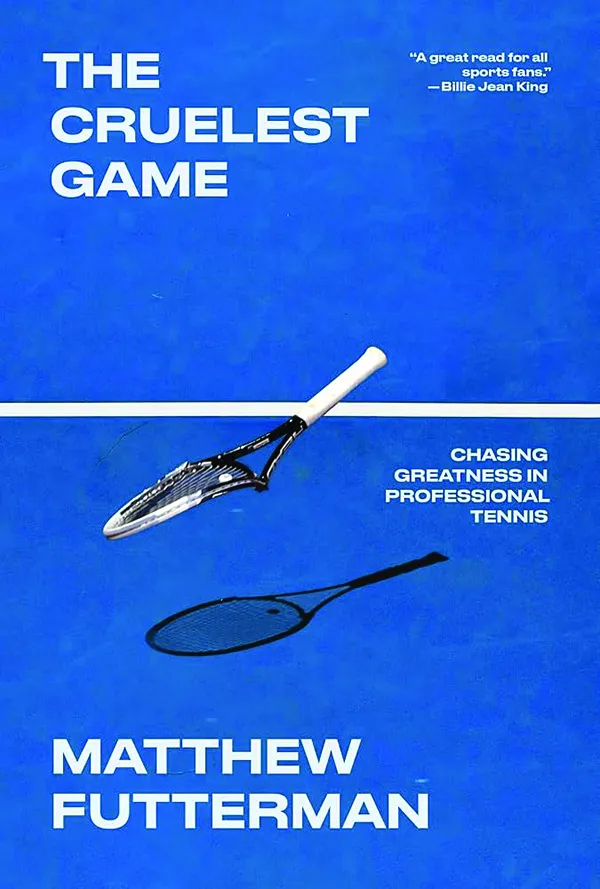
Soccer, basketball, and football are each more popular, but for pure drama and theatricality, it’s hard to beat tennis. Shorn of helmets, pads, and teammates, players enter every match for a winner-take-all duel with a single opponent. It is, to borrow the title of sportswriter Matthew Futterman’s new book, the cruelest game.
Tennis is also a showcase for the dominance of aging athletes. For years, the triumvirate of Roger Federer, Rafael Nadal, and latecomer Novak Djokovic had a stranglehold on the sport. When Federer and Nadal retired, Djokovic continued to hold back younger rivals, becoming arguably the greatest tennis player of all time in the process. Even today, the 39-year-old Serb is ranked No. 5 in the world. The four players ahead of him are each in their 20s.
Futterman calls the secrets of Djokovic’s success “the codes.” This catch-all term goes beyond talent, skill, or dedication, which are necessary but not sufficient for players who aspire to championship-level tennis. “The codes” also encompass the special quality that allows players such as Djokovic to remain inhumanely calm during high-leverage moments. Earlier generations would have called this sang froid, or grace under pressure. Whatever term you prefer, it’s rarer even than top-level athletic talent.
Lots of phenoms never quite figure out “the codes,” or flame out early under pressure. This happens to some tennis legends at what should be the apex of their careers. Bjorn Borg famously left the sport after losing the U.S. Open Finals at the tender age of 25. Since his abrupt retirement, many top players have followed in his footsteps.
Others thrive in the limelight for years, even decades. How someone like Djokovic stays calm is difficult to describe and even more difficult to teach, which is why a cottage industry has sprung up to groom the next generation of tennis superstars. The top-ranked pros, followed by Futterman, rapidly cycle through coaches, trainers, and sports psychologists. Even for the best in the world, the secret formula for competitive success remains elusive.
Certain “codes” are easier to grasp. The idea of elite athletes partying until dawn seems more distant today than Andre Agassi’s mullet. In 2026, every great tennis player follows an exacting diet and personalized training routine. Andy Murray became a devotee of hot yoga, while Naomi Osaka found a ballerina to improve her footwork and leaping ability. For his part, Djokovic follows a grueling regime of stretching, workouts, and dieting that extends to avoiding even a sip of celebratory champagne after winning the Australian Open.
The relentless drive to quantify health and performance is one aspect of “the codes” that even the layperson can understand, which is why these techniques have filtered into our everyday lives. Today, soccer moms count their steps, fitness influencers count their macros, and amateur tennis players record their matches and try to model their serves on Djokovic.
If you’re looking for lyrical paeans to form and technique in the manner of David Foster Wallace’s celebrated tennis essays, The Cruelest Game will likely disappoint. Futterman’s casual, insider-y tone owes more to ESPN reporters or perhaps Bill Simmons, the columnist-turned-podcaster who pioneered an informal, fan-first approach to sports commentary. The Cruelest Game is littered with conversational asides and dated pop culture references. Federer, Nadal, Djokovic, and Serena Williams are, naturally, “the Jedis.” Coaches, trainers, tennis gurus, and hangers-on turn big tournaments into “Star Wars bars.” Every German the reader meets is described as “Teutonic.” Carlos Alcaraz studies his draw at the French Open like Benedict Cumberbatch studying Nazi codes in the movie The Imitation Game (2014).
This relaxed approach may draw readers in, but it’s a strange fit for a sport that still has a certain aristocratic veneer. And some of the sports cliches that infiltrate The Cruelest Game are truly wince-inducing. Djokovic treats his body “like a temple.” “Father Time,” Futterman writes, “always wins in the end.” There are rookie sideline reporters who would think twice about that last one.
Futterman’s quest for “the codes” also leads him through a parade of trainers and coaches, most of whom are discarded almost as soon as they are introduced. His perspective as an insider is put to better use when he draws Agassi into a conversation about how greater hitting power has changed the geometry of a tennis court, or why the higher earnings of an NBA journeyman, compared to a top-100 tennis pro, explain the dearth of top-end talent on the American scene.
Even in the age of the geriatric superstar, younger challengers won’t be denied forever. By the end of The Cruelest Game, Djokovic is facing tennis mortality in the form of Alcaraz and Jannik Sinner, two young phenoms who have started beating him on the biggest stages.
THE FIVE DAYS THAT MADE US BELIEVE IN SPORTS AGAIN
In any sport, there is something about the aging lion who refuses to go quietly that always inspires nostalgia and affection. Djokovic, in his prime, was a fiery competitor who never engendered the same reverence as Federer or Nadal, but as he fights off Father Time — who is, by the way, undefeated — he finds spectators and fans warming up to him. The end is near, but one can’t help but root for Djokovic to keep holding on for as long as possible.
In the end, even the all-time greats can’t escape the scoreboard. In the boardroom or on the Senate floor, however, politicking, personal loyalty, and institutional inertia conspire to keep leaders in place well past their sell-by date. Despite Djokovic’s heroic efforts to stay at the top of his game, the grizzled Serb was foredoomed to lose out to younger, more athletic contenders. Alas, the same cannot be said for our corporate or political overlords.
Will Collins is a lecturer at Eotvos Lorand University in Budapest, Hungary.
