

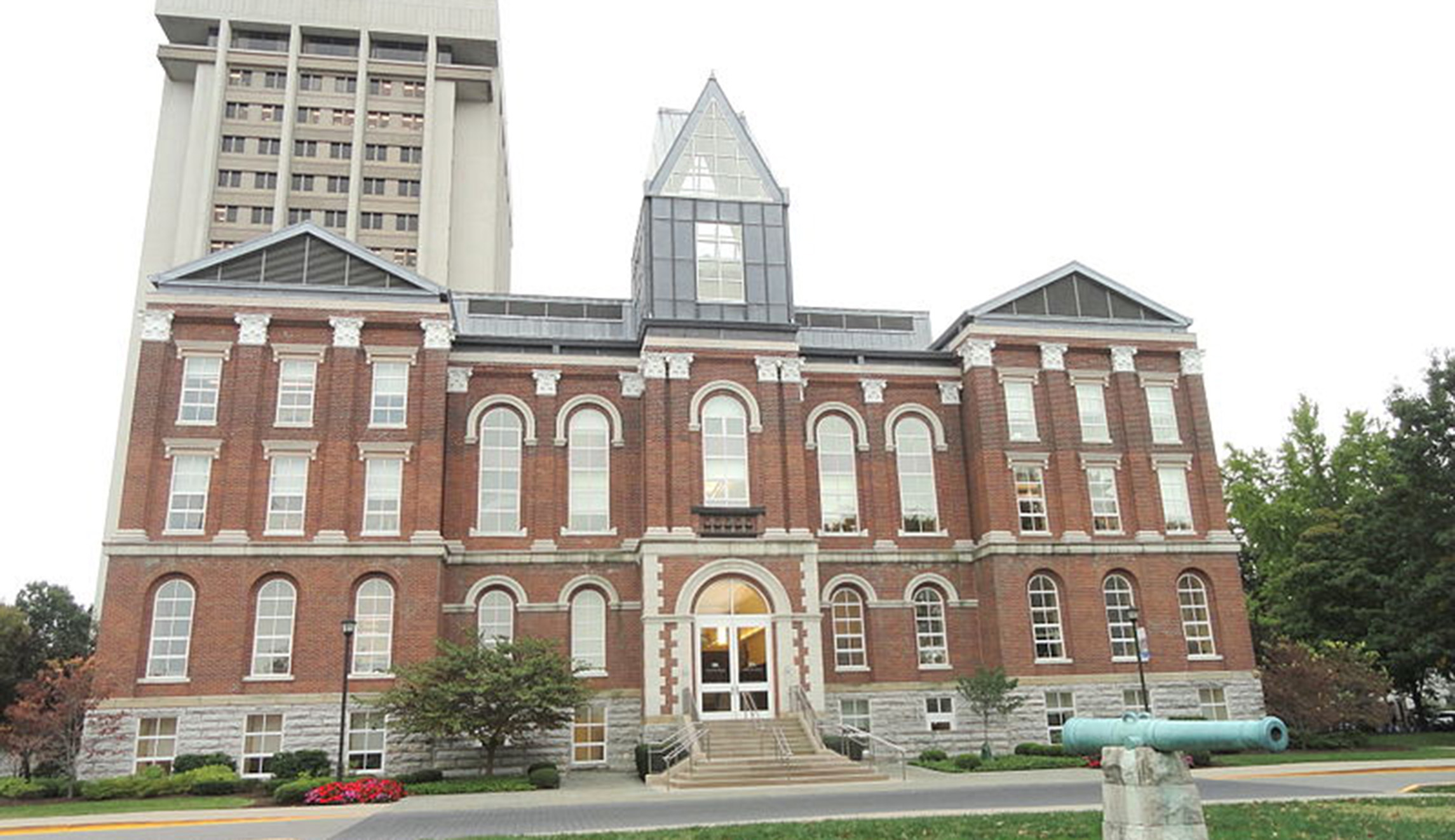
As of May 2018, the University of Kentucky in Lexington, Ky. has a yellow speech rating from the Foundation for Individual Rights in Education, a nonprofit that rates college campuses on their free speech protections and commitment to civil liberties.
Under FIRE’s rating system, a “yellow light speech code ranking” indicates that the university has “at least one ambiguous policy that too easily encourages administrative abuse and arbitrary application.”
Recommended Stories



FIRE’s initial critique of the University of Kentucky’s protest and demonstration policies concerned their small “open discussion area” between Limestone St. and the Alumni Gymnasium, which student groups were allowed to occupy for up to two hours. This area essentially constituted a free speech zone. In several federal lawsuits, free speech zones have been found unconstitutional; although the campus administration often implements them with good intentions, they constitute a restriction of students’ First Amendment rights on the rest of the campus.
Fortunately, the most recent version of Kentucky’s speech code removed the “open discussion area” and theoretically grants students broader freedom of expression throughout the entire campus. Yet major problems still exist in the new code, passed in 2017.
Although the text claims that the university “does not impose restrictions” on speech outdoors on campus unless the restrictions are “reasonable, are justified without reference to the content of the regulated speech, are narrowly tailored to serve a significant governmental interest, and leave open ample alternative channels for communication of the information,” the rules directly following this statement could easily be interpreted to enforce unreasonable and unnecessary restrictions on campus speech.
For instance, students have to make a reservation in an Associate Provost-approved area to exercise their First Amendment rights before 7 a.m. or after 7 p.m. As long as students are not being disruptively loud, it’s hard to imagine a good reason why they should be prevented from expressing themselves without a reservation early in the morning or in the evening.
Reservation requirements for outdoor spaces seem reasonable on their face, but they tend to be unnecessary. If a public university is actually protecting students’ free speech rights comprehensively, students should have plenty of options for where they can get their message out on campus. And if there is a dispute between organizations over a space, it seems logical that they should try resolving it on their own like adults first before calling for administrative interference.
The University of Kentucky’s location restrictions are also ambiguous and have the potential to be very rigid. Speech is restricted “between buildings” and cannot occur on “streets, parking lots, grassy areas adjacent to or near parking lots, or on sidewalks.” If you’ve ever been on a college campus, you’ll notice that the areas restricted by this rule probably describe most of the campus. At Kentucky in particular, this code could be interpreted to mean that the entire area south of Cooper Dr., a sizeable slice of campus, is unavailable.
“I think the regulation [Administrative Regulation 9:1] speaks for itself and reinforces in writing our commitment to free speech throughout the campus,” University of Kentucky representative Jay Blanton told the Washington Examiner in an email. “Our policies underscore that commitment. How we’ve implemented them underscores our commitment to free speech.”
“Unfortunately, this is just another example of bureaucrats who fundamentally misunderstand the U.S. Constitution, Alexander Staudt, Young Americans for Liberty’s Director of Free Speech told the Washington Examiner. “It’s disheartening to hear that UK believes that the university can legislate above and beyond the First Amendment.”
Rachel Altman is a sophomore at Tulane University studying political economy and marketing. She is a Washington, D.C. native and recruits for Young Americans for Liberty.
