Restoring America

Conservative values, National renewal

Menu

Venezuela needs a presidential election in 2027

Published September 12, 2026 6:00am ET


Venezuela needs elections: regional, municipal, parliamentary, and, above all, presidential. After 27 years of authoritarianism, kleptocracy, and institutional destruction, the country must rebuild almost from scratch. But sequencing matters — one election cannot be postponed, substituted, or sacrificed for the others. The transition ends only when the Chavista system ends, and power is transferred democratically. Electing new governors, mayors, or even a new National Assembly means little while the central question stays unresolved: Who governs Venezuela, and with what legitimacy?

Jan. 3 changed our history. That was the day Nicolás Maduro‘s dictatorship fell, the visible face of a Chavista system that has ruled for 27 years: a criminal enterprise built by Hugo Chavez, carried forward by Maduro, and today led by Delcy Rodriguez, three names for the same regime. The Trump administration helped make that day happen. But removing Maduro did not dismantle the system that produced him. Stabilization was necessary, but managing an emergency is not the same as building a legitimate government. A provisional arrangement can help a country cross a bridge, not become its destination. Only Venezuelans, through the ballot box, can confer it.
The danger of changing everything so nothing changes

Regional, municipal, and parliamentary elections are necessary too, but their importance must not be confused with the priority. Authoritarian systems often use subnational elections as pressure-release valves, surrendering peripheral spaces while keeping the executive, security forces, and state institutions. Venezuela knows this mechanism well. Starting from the bottom without resolving national power risks liberalization without real democratization.

The problem is the system itself, which, over 27 years, destroyed institutions, hollowed out the state, and driven millions abroad. It must be reset, and that cannot happen while the same Chavista establishment remains in control of national power.

A society that needs a date

Venezuela today is a pressure cooker: public services deteriorating, political prisoners jailed, families separated by migration. The double earthquake of June 24 exposed what Venezuelans already knew: the extraordinary weakness of an abandoned state whose repressive machinery was preserved.

Machado Rodriguez
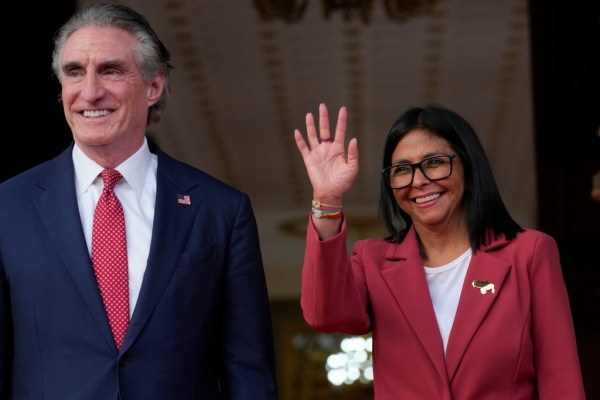
Opposition leader Maria Corina Machado and acting Venezuelan President Delcy Rodriguez. (AP)

An AtlasIntel poll taken right after the earthquake found 45.7% said elections had become more urgent, 32.6% prioritized reconstruction, and 21.6% saw no change. Reconstruction and democratization are not competing priorities — hospitals, jobs, and wages ultimately depend on functioning institutions and the rule of law.

That light at the end of the tunnel must be a date for a presidential election. A date alone does not guarantee democracy — an electoral council, freedoms, and competitive conditions are still needed — but it establishes a verifiable horizon.

Venezuela is not divided into two equal halves

Fear around the transition rests on the image of a country evenly split, and the assumption that the regime’s fall would leave a vacuum. That is not Venezuela today.

Between 2023 and 2024, the country built its most important civic movement in recent history, producing on July 28, 2024, under extraordinarily adverse conditions, a demonstration of civic organization that changed its political history. Polling shows an enormous asymmetry: Maria Corina Machado has 72% favorable and only 14% unfavorable; Edmundo Gonzalez Urrutia, 61% favorable.

Delcy Rodriguez has 71% unfavorable; Maduro and Diosdado Cabello, 79% unfavorable; Jorge Rodríguez unfavorable, 76%. This is not two equivalent Venezuelas facing off — it is an overwhelming majority against a small power structure whose coercion far exceeds its support. That is why sequencing matters: Regional elections would fragment that majority into 23 separate contests, while a presidential election reunites the country around one decision.

Democracy is also in America’s interest

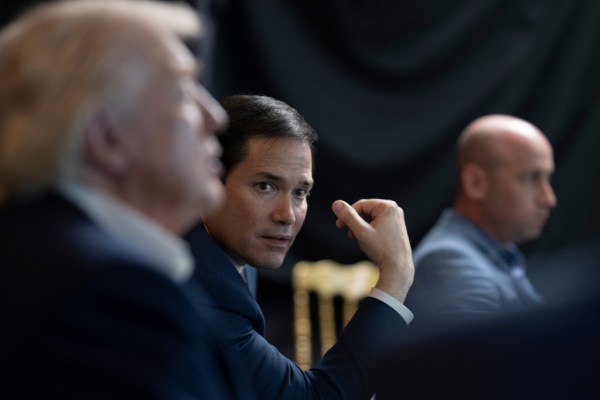
A presidential election would be a major strategic win for the United States and the clearest foreign-policy victory available to the Trump administration in the hemisphere. Trump and Marco Rubio opened the door on Jan. 3, but its significance depends on what follows: Stabilization can be an instrument, but democracy must be the outcome.

A democratic Venezuela would replace an autocracy aligned for decades with Cuba, Russia, Iran, and China with a government freely elected by a society deeply connected to the United States. This is not only a hemispheric question: Every authoritarian regime that survives in the Americas is a foothold for the same powers challenging the free world from Eastern Europe to the Indo-Pacific.

A democratic Venezuela would deny Beijing, Moscow, and Tehran one of their last reliable partners here, signaling that authoritarianism does not get the last word, even in its own backyard. Venezuela is not Afghanistan or Vietnam — it is a society that has already defeated authoritarianism at the ballot box and wants the right to choose its future.

Latin America’s and investors’ interest

A democratic Venezuela would also transform Latin America’s migration equation. For years, millions fled a country marked by persecution and hunger rather than opportunity, and Colombia, Peru, Chile, Brazil, Argentina, and Ecuador absorbed much of that cost. The lasting solution is rebuilding a country worth returning to.

The same logic applies to investors. Venezuela has oil, gas, hydropower, minerals, and a skilled diaspora, but assets alone do not make an investment opportunity. Long-term capital requires trust, independent courts, and legal certainty. Any agreement — oil, energy, or of any other kind — can only be robust, strong, and lasting if signed with a democratically elected government, with a legal and legitimate signature. A transition can attract limited deals; only a democracy can attract the world.

A presidential election in 2027

We must begin speaking clearly about 2027. Venezuela needs a new National Electoral Council, a credible calendar, competitive conditions, and the institutions a genuinely free election requires. That process must have an unmistakable destination: a presidential election in 2027.

Ideally, Venezuela should hold general elections — if not, simultaneous presidential and parliamentary elections are reasonable. But the presidential election cannot be sacrificed. Governors, mayors, and legislators can be elected without ending the regime. Only a new president, freely elected and accompanied by an effective transfer of power, would mean its end.

Nearly everyone gains: Venezuelans would recover their sovereignty; the United States would complete what began on Jan. 3; Latin America could ease one of its largest migration crises; investors could enter a market governed by rules; and millions abroad would again have a country to return to.

Venezuelans already did what seemed impossible on July 28, 2024. We organized, we united, and even under authoritarian rule, we showed where the majority stood. Now we need to finish the job. A transition without a destination becomes a provisional government without an end, and a long enough provisional arrangement can become a new status quo. We need a date. We need a presidential election. And we need it in 2027.

Jan. 3 opened a historic door. Now Venezuela must walk through it.