

It was around 2018 that I recall “woke” fully wiggling its way into our political dialogue, rapidly supplanting the erstwhile “social justice warrior” as the default pejorative for far-left progressives and their Marxist antics.
Unlike socialism, “woke” has never possessed a single doctrinal definition. Say what you want about the tenets of communism, dude, but at least it’s an ethos. “Woke” is an umbrella term encompassing much of contemporary progressive ideology, generally rooted in intersectionality: the belief that a litany of grievances and identity categories are interconnected through the shared pangs of oppression.
Stay informed.Stay ahead.
Join Washington Examiner for unlimited access to the news, analysis, and commentary that matter most.
Already a member? Log in
During the 2010s, this worldview manifested in the advancement of transgender ideology to the point of denying any meaningful distinction between a biological woman and a transgender woman. It then shifted much of its attention toward denouncing law enforcement as wanton racists during the Black Lives Matter movement. In recent years, the same activist class has become beguiled by Palestinian nationalism as its latest moral crusade, buying up keffiyehs like they’re Hot Topic’s spring collection.
The causes may appear disparate, but they share a common political grammar. Society is divided into oppressors and the oppressed. Identity confers moral authority. Institutions must be reorganized around rectifying group disparities. It updates Marx’s effort to unite the ostensibly oppressed by economic class, substituting identity as an even more powerful source of perceived grievance.
For a time, “woke” served as an effective shorthand for this ideological tendency. In recent years, however, some prominent conservatives have begun using it for everything — the duct tape of political jargon.
The word has gradually become a reactionary reflex among some on the Right who have appointed themselves cultural gatekeepers. Films and television series featuring women, non-white actors, gay characters, or any other demographic associated with progressive politics are scanned for ideological impurities and summarily dismissed as woke.
A clumsy casting decision is “woke.” A female protagonist or gay character? “Woke.” A movie that fails to flatter conservative politics is “woke.” The term has been stretched so broadly that it increasingly communicates little beyond the speaker’s displeasure.
This is a self-defeating and myopic approach to cultural criticism. It also threatens to maroon the political Right outside the cultural mainstream, resigned to cheering explicitly right-wing fare such as “Citizen Vigilante” — which was perfectly entertaining, though blunt and unmistakably ideological — while treating every major studio production as enemy propaganda.
Influencing culture requires engaging with it, and engagement warrants considerably more thought than labeling anything outside one’s preferred aesthetic vision as woke drivel.
The online Right’s response to Christopher Nolan’s “The Odyssey” crystallizes the problem.
Nolan’s films have long displayed a distinctly conservative artistic temperament. “The Dark Knight” was practically a love letter to George W. Bush and the moral burdens of the war on terrorism. “The Dark Knight Rises” transformed the rhetoric of Occupy Wall Street into mob tribunals, revolutionary violence, and the summary execution of Gotham’s bourgeoisie. “Interstellar” celebrated American ingenuity, individual heroism, paternal duty, and humanity’s refusal to accept managed decline. Even “Oppenheimer” portrayed many of its communists as fashionable intellectual posers dabbling in ideas whose consequences they scarcely understood.
His latest work, “The Odyssey,” is a traditionalist and intensely masculine war epic about marriage, family, sacrifice, and the yearning for home. Nolan has reached back to one of the foundational texts of Western civilization and spent hundreds of millions of dollars bringing it to a mass audience. Sales across all editions of Homer’s epic had risen 76% from a year earlier — how many self-professed conservative influencers can claim to have inspired such a renaissance in reading the classics?
Yet some conservatives have condemned Nolan, a valuable cultural ally, over the casting of Elliot Page as Sinon and Lupita Nyong’o as Helen of Troy.
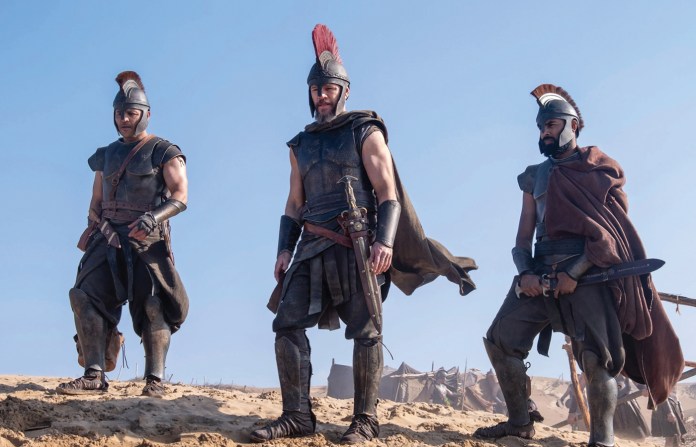
Questions about casting are perfectly legitimate. A director’s decisions can be distracting, historically incongruous, aesthetically unsuccessful, or simply irritating. The relevant distinction lies in whether those choices serve an artistic vision or subordinate the material to an ideological agenda.
Woke politicking enters the picture when a work’s moral architecture is governed by identity politics, when a source is dismantled to indict Western civilization, and when representation becomes more important than character and storytelling.
Page’s performance as Sinon was more than serviceable. Nolan presents Sinon as the Greek soldier left behind on the beach to persuade the Trojans that the wooden horse was an offering — a role well suited to Page’s slight frame.
As for Helen of Troy, a convincing argument can be made that Nolan intended to present her storied beauty as something otherworldly. Lupita Nyong’o’s night-dark complexion, razor-sharp cheekbones, and striking facial symmetry suit that vision. In all three of her scenes, she immediately stands out. Viewers may disagree with the choice, but it emerges from a coherent interpretation of Homer’s epic. It is no more inherently “woke” than Glenn Gould’s rhythmically eccentric interpretations of Beethoven’s piano sonatas.
Ultimately, the charge of wokeness must be judged through the film itself. Despite Nolan’s creative liberties and deviations, his interpretation remains faithful to the core ideals of Homer’s epic: marriage, family, sacrifice, masculine duty, and the yearning for home. That reveals considerably more about the film’s ideology than the racial or sexual identity of its cast.
Netflix’s “Bridgerton,” which I have generally enjoyed despite its racially ambiguous depiction of Regency England, offers a more complicated boundary case. Its diverse casting has always been part of the series’ heightened, theatrical aesthetic. The show presents Regency England as a lavish romantic fantasy, and its historical liberties help create that distinctive world.
The inclusionary impulse has become more conspicuous as the series has progressed. Recent episodes have introduced a deaf character who communicates through sign language and an amputee maid missing part of one arm. Taking inclusion to such comic and absurd extremes is eye-roll-inducing. Yet “Bridgerton” continues to extol marriage and family — traditional values that, I would argue, outweigh its bouts of performative inclusivity.
Is inclusion inherently woke? Follow that reasoning far enough, and conservatives will find themselves satisfied only by Ayn Rand adaptations, biblical epics, and films whose casting decisions have been approved by a tribunal of engagement-chasing podcasters.
The irony is that this approach begins to resemble the progressive criticism it opposes. The Left inspects a cast list and celebrates its demographic composition. This wing of the Right inspects the same cast list and recoils. Both reduce art to representation. Both treat an actor’s identity as politically dispositive.
The Right spent years objecting to the Left’s corruption of language. “Fascist” came to mean anyone politically to the right of Trotsky. “Violence” came to include disagreeable speech. “Genocide” became available for any military action that activists opposed. Conservatives correctly understood that expanding a word beyond its proper boundaries eventually empties it of meaning.
“Woke” is now undergoing the same degradation.
CHRISTOPHER NOLAN HAD THE MUSES ON HIS SIDE
The pernicious ideology remains real, which is precisely why the term should be preserved. Otherwise, right-wing critics will have created critical race theory in reverse: a cultural worldview in which every actor is first a racial or sexual identity, every casting decision is an act of politics, and every work of art is judged according to which demographic boxes it checks.
That is an exceedingly woke way to oppose wokeness.
Harry Khachatrian (@Harry1T6) is a film critic for the Washington Examiner. He is a software engineer, holds a master’s degree from the University of Toronto, and writes about wine at BetweenBottles.com.