


Variety magazine has published what it confidently calls “The 100 Best Comedy Movies of All Time,” asserting that “laughing may matter even more in modern times.” These lists are always subjective — I’ll get to the more egregious omissions shortly — but they can also serve as accidental cultural autopsies. Comedy, more than any other genre, tells you how a society thinks, what it tolerates, and what it’s willing to laugh at. And on that score, Variety’s list is remarkably revealing.
A look at the release years shows a dramatic bulge between 1980 and 2009, a 30-year stretch that accounts for over half the canon. It is the golden age of cinematic comedy, the era that produced everything from Airplane! (1980) to Groundhog Day (1993) to Anchorman: The Legend of Ron Burgundy (2004). And then, abruptly, the well runs dry.
Recommended Stories


BELTWAY CONFIDENTIAL: FIVE CLASSIC THANKSGIVING MOVIES AND SHOWS THAT CELEBRATE FAMILY
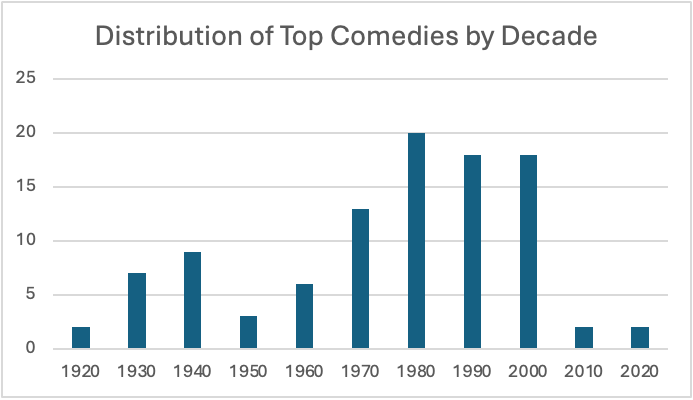
If comedy is a cultural barometer, its vital signs flatlined sometime around 2010. Correlation is not causation, but the timing is suspicious. Around 2013, progressive ideology began grafting itself onto every corner of pop culture, resulting in such perverse silliness as Disney slapping trigger warnings onto Peter Pan (1953). Add the rise of Marvel/IP monoculture — the Marvel Cinematic Universe began its hostile takeover in 2008 with Iron Man (2008) — the death of mid-budget studio films, and the migration of comedic talent to prestige television, and you have a remarkably tidy explanation for comedy’s collapse.
In a climate of hair-trigger indignation, the genre withers. How is an audience trained to hyperventilate at the slightest hint of emotional discomfort supposed to stomach Billy Wilder’s 1959 Some Like It Hot, Variety’s own (and justifiable) No. 2 pick? The film centers on two jazz musicians who cross-dress and infiltrate an all-women’s band, hiding from the Chicago mob. Today, Tony Curtis and Jack Lemmon would introduce themselves with their “preferred pronouns” and then answer inquiries about how they identify. Wilder, mercifully, lived in a saner era.
Variety’s preamble asks: “Does anyone think that during the Middle Ages, ordinary citizens spent as much time laughing at the popular culture of the day as they have during the past 110 years?” Its own list inadvertently answers the question: People today are not laughing. The 2010s contribute a paltry four films to the entire ranking. The 2020s, now half over, contribute two, and neither — Poor Things (2023) and Everything Everywhere All at Once (2022) — is a traditional comedy. Yes, they are funny in places; so is 1990’s Goodfellas (“Funny how? How am I funny?”), but that hardly makes it a comedy.
Even more damning is the fact that none of the top 25 comedies were released in the last 15 years. Bridesmaids (2011) squeaks in at No. 24, filmed just before the woke hive mind hollowed out Hollywood’s comic sensibilities.
But strange inclusions abound even within the earlier decades. Variety crowns the original The Naked Gun: From the Files of Police Squad! (1988) as the greatest comedy ever made. It’s a fine film, but not even Leslie Nielsen’s best. That distinction belongs to Airplane!, which Variety inexplicably buries at No. 62. Edgar Wright’s horror-spoof Shaun of the Dead (2004) appears at No. 75, but the magazine somehow ignores his superior buddy-cop masterpiece Hot Fuzz (2007).
The omissions grow more severe with the masters. John Hughes, the chronicler of middle-class Americana, whose films are woven into the fabric of our adolescence, receives only a passing nod under House Party (1990), where his “youthful energy” is invoked in a throwaway comparison. Meanwhile, The Breakfast Club (1985), Ferris Bueller’s Day Off (1986), and Planes, Trains and Automobiles (1987), three stone-cold classics, are relegated to oblivion. Hughes deserves better than a footnote.
Then there are the modern entries whose absence is indefensible. Undoubtedly, in efforts to salvage some legitimacy for the past 15 years of otherwise fallow grounds for humor, Variety’s list includes the (albeit unorthodox) aforementioned 2020s entries. But to make room, it omits two of the most influential and quoted bromance comedies of the millennium: The 40-Year-Old Virgin (2005) and The Hangover (2009), two hallmark entries that shifted the trajectory of the comedy from being driven by gags and traditional jokes to being defined by outlandish characters doing outlandish things. Alan’s (Zach Galifianakis) mere presence exudes comedy in the same way that Mick Jagger personifies charisma. This would mark the last great era of comedy before its trajectory shifts into a coffin, 6 feet under.
Tropic Thunder (2008) is also nowhere to be found; in a similar vein to Tom Green’s 2001 Freddy Got Fingered, it seems, in hindsight, a cosmic accident that the film was made in the first place. At least we can always look back at that Robert Downey Jr. scene: “What do you mean, you people?”
REVIEW: AZIZ ANSARI RETURNS WITH SOCIALIST COMEDY ‘GOOD FORTUNE’
And the final, indefensible oversight is Armando Iannucci’s The Death of Stalin (2017), the sharpest, darkest, and funniest political comedy of the past 15 years — a brilliant distillation of the absurd brutality that defined life behind the Iron Curtain. That it is absent from a list purporting to represent “all time” is mystifying.
If lists like this are to serve any purpose, it is to provide a newcomer to Western culture with a coherent road map of what we once laughed at and why. Variety fails that task, omitting classics with the cultural weight of Madama Butterfly or Beethoven’s Piano Concerto No. 5, Emperor. But it does inadvertently achieve something else: it pinpoints (albeit unintentionally) the moment our culture declared comedy too offensive to survive.
Harry Khachatrian (@Harry1T6) is a film critic for the Washington Examiner’s Beltway Confidential blog. He is a software engineer, holds a master’s degree from the University of Toronto, and writes about wine at BetweenBottles.com.