

Soccer fans around the world pushed back this month after FIFA unveiled 2026 World Cup prices that would set ticket holders back thousands of dollars.
Shock turned into outrage as fans accused the organization of betrayal. Tickets for matches that should have cost less than $100 shot up past $4,000, leaving fans and host cities in the United States, Mexico, and Canada fuming. For the final in New Jersey, for example, tickets for mediocre seats will cost more than $6,300 a pop, much higher than even the most expensive seats for the last World Cup in Qatar, which cost about $1,600.
U.S. fans, eager to have a front-row seat at one of the world’s most prestigious sporting events, have complained they are being priced out because they can’t afford the high ticket prices. The reality stands in contrast to the message President Donald Trump has been pushing about the health of the U.S. economy and overall affordability.
In a Dec. 17, 2025, speech that focused heavily on the topic, Trump claimed to be making progress. But he has blamed the problem on his White House predecessor, former president Joe Biden, and illegal immigrants, claiming he “inherited a mess.”
The president has struggled over the past several months to convince the public there isn’t an affordability crisis in the country, going so far as to call it a “hoax.” But the inability to purchase soccer tickets for a tournament taking place in the U.S. is yet another example of the economic realities facing the country.
FIFA attempted to hand him a lifeline. In a rare climbdown by the international soccer body, FIFA President Gianni Infantino announced that some $60 tickets would be made available for every game at the tournament, with batches going to the national federations whose teams are playing. It would then be up to those federations to decide how to distribute them. But some say the $60 tickets account for only a tiny sliver of the overall tickets, and that prices and resale values often quadruple, making them unaffordable for the masses.
The number of $60 tickets for each game is likely to be from 400 to 740 per team, in what FIFA is now calling a “Supporter Entry Tier” price category. FIFA is using 16 host cities, including 11 NFL stadiums in the U.S., plus two in Canada and three in Mexico.
While FIFA has taken a step toward defusing the anger over its ticket prices by lowering the cost of some, it has not resolved the core complaint.
“Fans are reacting less to the existence of one low price tier and more to the feeling that the average path to attendance is becoming unaffordable,” Irina Tsukerman, a geopolitical analyst and president at Scarab Rising, Inc., told the Washington Examiner. “If the cheapest seats are scarce, restricted to limited matches, or buried behind presales and packages, the headline number reads like a public relations patch rather than a meaningful change. In that sense, FIFA has eased the optics more than it has eased the experience.”
She added that a significant part of the FIFA backlash centers on predictability and trust.
‘The people’s game’
“Football has long sold itself as the people’s game, and the World Cup has been treated as a once-in-a-lifetime event that ordinary fans can still reach with planning and sacrifice,” she said. “When ticket pricing feels opaque, dynamic, or tilted toward corporate buyers, fans start to think they are being priced out by design. FIFA’s messaging about affordability clashes with a market reality where many fans worry that the ‘real’ tickets are the ones they cannot touch.”
Keith Pagello, founder of TicketData.com, which tracks real-time resale pricing across major ticket marketplaces, told the Washington Examiner that FIFA’s $60 ticket offer feels performative.
“FIFA can point at $60 tickets, but resale data shows that for the vast majority of fans, the realistic cost to attend meaningful World Cup matches will be far higher,” he said. “Based on what we are seeing in the resale market, FIFA has not done enough to ease affordability concerns. While low-priced tickets technically exist, they make up a very small share of inventory and are often limited to a handful of very low-demand matches or early release windows. For nearly all group stage games and knockout rounds, prices are already signaling a much higher barrier to entry than the sport’s long-standing affordability narrative suggests.”
Pagello said the backlash is less about “whether cheap tickets exist at all and more about whether fans can realistically access them.”
“Without greater transparency around low price inventory, expanded price-capped sections, market pricing will continue to define public perception regardless of FIFA’s messaging,” he added.
One defense FIFA has floated for its high ticket prices is that they reflect the North American market. The organization said it tailors all of its tickets to whatever market it is playing in.
Tsukerman called it an incomplete defense.
“North American sports pricing is known for premium seating, aggressive fees, and a heavy reliance on hospitality and resale. If FIFA adopts those norms, it imports the same frustrations,” she said. “Fans then perceive that FIFA is borrowing the highest revenue features of the market while still trading on the World Cup’s global cultural meaning, which is not supposed to be just another entertainment product.”
Another defense of FIFA’s high prices was its not-for-profit designation. The organization said it reinvests 90% of its revenue into global soccer development and needs to capture value from the massive demand, especially with open resale markets.
“People generally accept that FIFA reinvests revenue into football development, but they still question what portion of revenue depends on squeezing fans,” Tsukerman said. “A nonprofit can still behave in ways that feel extractive, especially when executive pay, event costs, and sponsorship structures appear far removed from the everyday supporter. The issue is not whether FIFA spends money somewhere beneficial. The issue is whether the event’s social contract with fans is being preserved.”
Jeff Le, a soccer enthusiast and managing principal at 100 Mile Strategies, told the Washington Examiner that the backlash, not only in ticket prices but also in expensive hotel rates across North America, could do real damage to the World Cup.
“While FIFA has put plans to reduce some select ticket prices to $60, the growing concerns over affordability, inflation, and difficult travel, including visa applications, to the United States could make a significant dent on the success of the competition,” he said. “The tourism industry, in particular, has highlighted major economic impacts should travel restrictions prevent fans of teams from entering the country.”
Le said that Trump’s “close embrace of FIFA” also makes World Cup success a political priority.
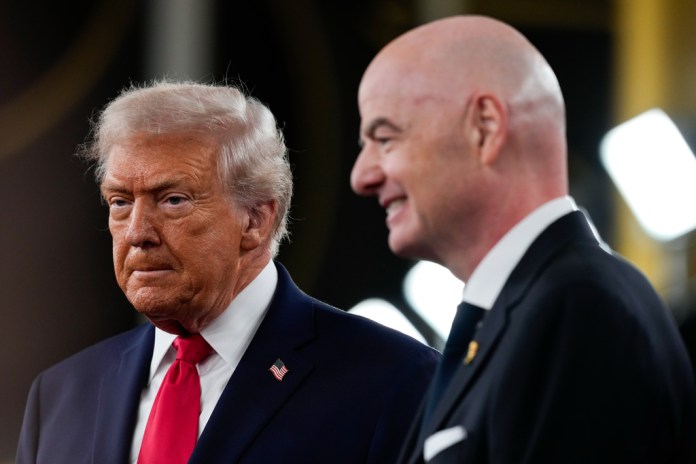
“Earlier this year, the President raised public safety concerns in key American host cities, raising the specter of moving the matches to a different location,” he said. “However, with so many different sites to protect and coordination with multiple cities and law enforcement across the other co-hosts – Canada and Mexico – the administration created a FIFA World Cup Task Force to help support the American organization and coordination.”
TRUMP FINALLY GETS HIS PEACE PRIZE AS FIFA HANDS HIM INAUGURAL AWARD AT WORLD CUP DRAW
Le added that there are still significant concerns around physical and cybersecurity with increased activity from “hactivists and American adversaries, such as Iran, Russia, China, and North Korea.”
“Cyber concerns could impact both North America’s critical infrastructure as well as make World Cup attendees vulnerable to hospitality scams and other cybercrime,” he added. “Elevated prices would be dwarfed by potential disruptions and digital attacks during the tournament and would represent a major setback for the administration heading into the midterm elections.”
