

Consciously or not, we draw our favorite sports narratives from the world of Greek mythology. Michael Jordan is Hercules, who ruthlessly vanquished every foe ever to confront him. LeBron James, by contrast, assumes the mantle of Achilles, an unparalleled warrior who can single-handedly turn the tide against overwhelming odds but is just as often a tragic figure brought low by forces beyond his control: crummy teammates, an unsmoothed salary cap, Boston.
It’s no accident that the Greco-Roman tradition lends itself well to athletic storytelling. From Homer to Virgil, we encounter tales of peerless beings with unrivaled skill — demigods and champions whose exploits the poets would sing about for generations to come. Often, what we want out of our sports heroes is precisely this: individual excellence.
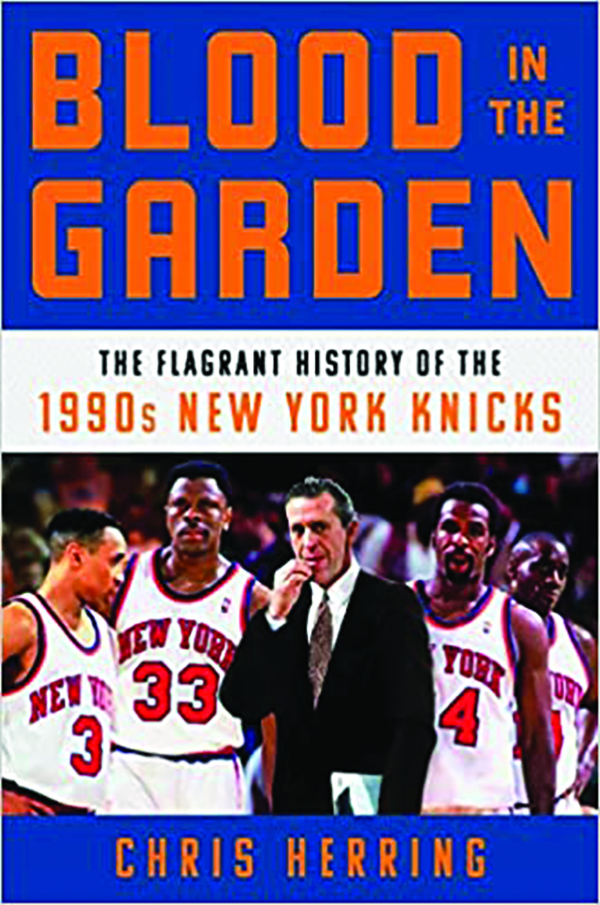
But in his masterly chronicle, Blood in the Garden: The Flagrant History Of The 1990s New York Knicks, veteran sports writer Chris Herring tells a fundamentally different sort of story. His protagonists never win anything. They perpetually break their fans’ hearts. On a recent podcast, Herring joked that one of the most common questions he received while writing the book was, “Do you have a different ending for the book than what actually happened?”
In short, it’s a story of failure. And in that respect, it draws, consciously or not, upon the other great storytelling tradition at the foundation of the West: the Bible.
Unlike Greco-Roman myth, the Bible doesn’t feature a pantheon of demigods. It’s disinterested in conquerors, and suspicious of individual heroes. Certain figures stand out, to be sure, but not for any special abilities they possess that fundamentally distinguish them from mere mortals. To the extent that the Bible has a main character, it’s not an individual at all. It’s a family, a collective — the children of Israel. The Bible, moreover, records its protagonists’ severe shortcomings just as much as their achievements. While the Greeks yearned for immortality, celebrating the victories they thought could earn it, Hebraic literature accepted its subjects’ human frailty, encouraging excellence even in the face of inevitable failure.
From this vantage point, the ’90s Knicks represent the quintessential biblical sports story. Reeling from a disastrous stretch the decade before, the Knickerbockers under president Dave Checketts began their rebuild not by drafting a superstar but by hiring a coach. Though Pat Riley insisted the team do everything it could to keep then-disgruntled star Patrick Ewing, he certainly had no intention of running the Ewing Show. Riley’s focus wasn’t on an individual at all but upon forging his players into a family. As Herring recounts, a crucial moment early in Riley’s tenure came during a particularly bad stretch of basketball in 1992: his first season in New York. Riley gathered his floundering team into the ballroom of an Oakland hotel and had them sit in pre-assigned groups at four different tables. Riley addressed the peculiar seating arrangement by noting that these were the groups the players split themselves up into anyway. “We’re a bunch of cliques rather than a team,” he explained. The players didn’t have to become best friends, he continued, but they did need to interact together as one unit. Knicks guard Gerald Wilkins would remember that speech as “one of the turning points of our season.”
And much as the biblical family comprised workaday human beings rather than a collection of demigods, the ’90s Knicks shone much more at the collective than the individual level. From the moment Riley arrived until the departure of his protege coach Jeff Van Gundy at the beginning of the 2002 season, no more than four Knicks aside from Ewing would ever reach the All-Star Game. Only Allan Houston was selected more than once — he made it twice. One of their most iconic players, John Starks, came into the league undrafted. He only secured a chance with the Knicks because of an injury during his tryout that prevented the Knicks from being able to cut him right away. Another standout during this era, Anthony Mason, had actually given up on an NBA career prior to his Knicks tenure. Just minutes before the Knicks surprised him with an offer, in fact, he had already signed a contract to play in Israel.
Unsurprisingly, then, Blood in the Garden ends up as one of the most poignant reflections in recent memory on that defining element of our humanity: failure. Leonard Cohen’s memorable phrase could just as easily describe this book as it could the Bible: “a manual for living with defeat.” And Herring’s tome certainly has more than its share of disappointment. In the aftermath of an excruciating loss during a crucial Game 5 against Jordan’s Bulls in 1993, probably squandering those Knicks teams’ best chance at winning a title, Doc Rivers remembered, “It felt like the sudden death of a family member who was perfectly healthy. … I’m not saying that losing a game is as bad as someone dropping dead. But I’m accurately describing the feeling.” Or there’s the image of a listless, despondent Starks needing to be literally pulled out of the locker room showers in the wake of his historically disastrous showing in the decisive final game of the 1994 NBA Finals against the Houston Rockets. We even find instances of the Knicks being undone by their own sins, such as the bench-clearing brawl that resulted in suspensions to four of New York’s best players during the pivotal final two games of the 1997 Eastern Conference semifinals against the Miami Heat.
But it’s precisely in defeat that we stumble upon hints of resilience. As players wandered outside in a daze after that loss to the Heat, they found Van Gundy already there, squatting on the curb behind the team bus. Bent over a series of pebbles he’d collected off the ground, he was determinedly diagramming offensive schemes, already preparing for next season. Similarly, Knicks fans also learned to celebrate incomplete successes. Sure, New York would end up losing to the Bulls in the 1993 playoffs, but what true Knicks fan could forget the joy of watching an incandescent Starks throw down a thunderous dunk over Jordan himself in Game 2? Perfection is the province of the divine, after all, so on this side of eternity, we humans must learn to celebrate such moments, even when our full redemption has yet to be consummated.
The ’90s Knicks never came home as champions. But their story is all the more gripping, relatable, and instructive for that — and just as heroic. It takes courage, to be sure, to face the Nemean lion or to stand alone before the walls of Troy. But does it take any less to trudge up the mountain and gaze upon Israel, fully accepting that you’ll never reach it? The Knicks never reached the promised land. But that doesn’t mean the fight to get there isn’t worth it or that we can’t find extraordinary meaning along the way.
And besides, who knows what next year will bring?
Rabbi Dr. Ari Lamm is the chief executive of Bnai Zion, founder of The Joshua Network, and host of Good Faith Effort.
