

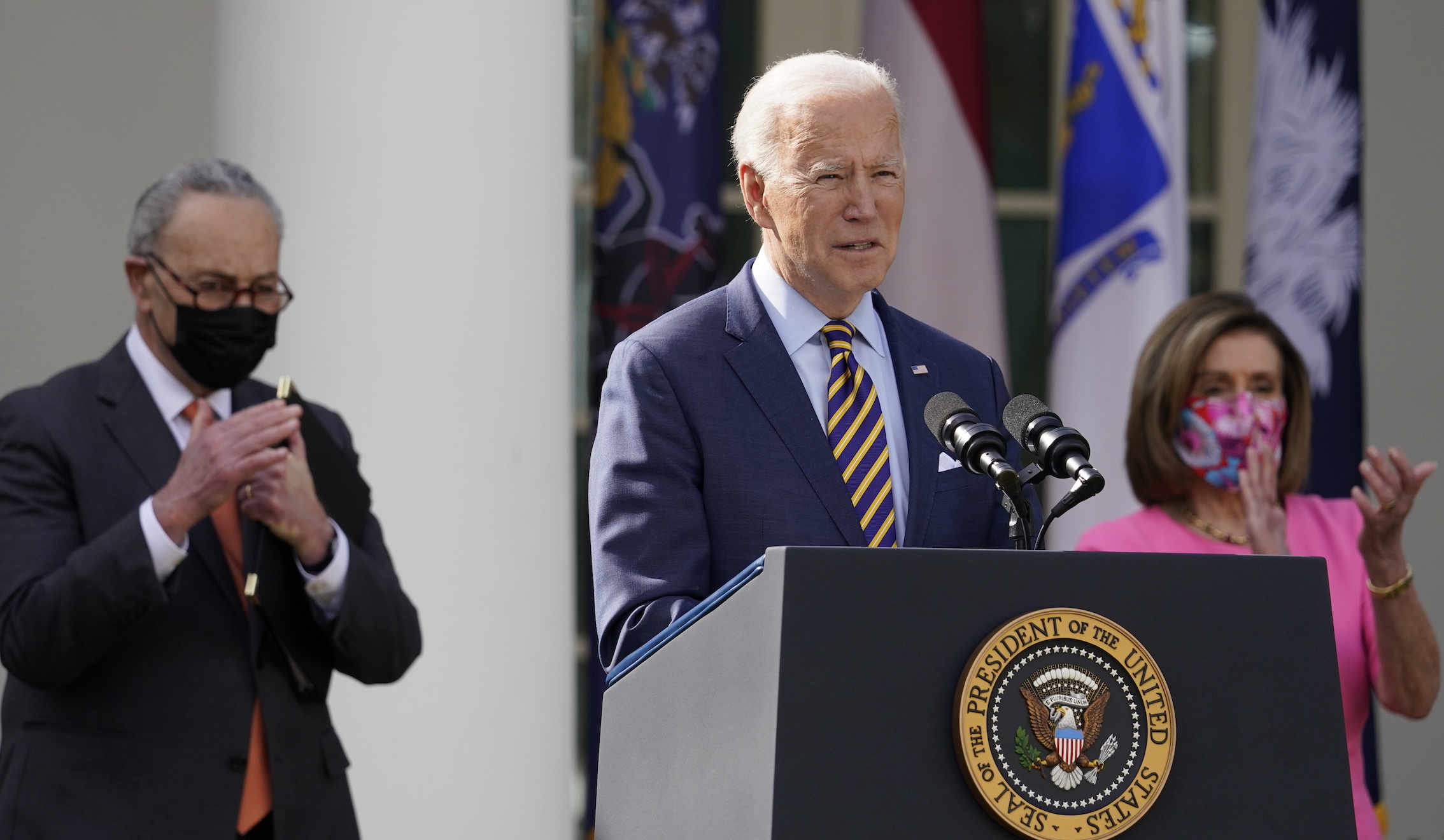
It won’t be easy for congressional Democrats to pass President Joe Biden’s massive infrastructure and tax increase proposal, especially with the 2022 midterm elections threatening to give back control of both chambers to the GOP.
Political strategists were already predicting House Republicans would win back the majority in 2022 when Biden announced a $2 trillion infrastructure proposal that would be funded by tax increases.
Recommended Stories


“Democrats are raising taxes on the middle class during a pandemic, and it will cost them their House majority,” National Republican Congressional Committee Spokeswoman Torunn Sinclair told the Washington Examiner.
Biden’s plan calls for raising the corporate tax rate from 21% to 28%, hiking taxes on overseas profits.
He’s also expected to announce a proposal to raise the tax rate on those earning more than $400,000, as well as a proposal that would raise the capital gains tax and broaden who must pay federal estate taxes.
Democrats plan to tout Biden’s proposal as a bill to provide middle-class jobs, stave off climate change, and rebuild crumbling roads, bridges, and waterways.
Biden’s tax increases, Democrats argue, would target the wealthy and corporations to pay “their fair share,” according to White House press secretary Jen Psaki.
But tax increases are historically lethal politically and have crushed the reelection prospects of both parties in the past.
“The two issues that could hurt Democrats the most in 2022 would be a big tax increase and the border crisis,” nonpartisan political analyst Ron Faucheux told the Washington Examiner. “Either could be damaging, and both could be devastating.”
Speaker Nancy Pelosi, a California Democrat, hopes to move the infrastructure and tax increase legislation through the House swiftly, perhaps as early as July or at least by September.
The speedy timeline would shield Democrats from having to vote on a tax increase closer to the midterm elections, when vulnerable centrists from red states will be struggling to hold on to their seats.
Republicans can retake the House by winning just a handful of Democratic-held seats.
The NRCC is already targeting those who will be vulnerable in 2022 and tagging them with a tax increase, including Rep. Kim Schrier, a Washington Democrat who won reelection in 2020 by only 3 points.
“When Kim Schrier was asked to respond to critics who say Democrats shouldn’t raise taxes to pay for their expensive infrastructure plan, she deflected and called the bill ‘an investment,’” the NRCC declared in a new press release. “Why can’t Schrier give taxpayers a straight answer?”
The looming election could make it difficult for Democrats to pass the bill with a narrow majority in both the House and Senate, where the chamber is evenly divided but Democrats hold the gavel thanks to the tiebreaking vote of Vice President Kamala Harris.
Centrists may balk at the tax increases, while more liberal lawmakers will likely push for more spending and provision aimed at eliminating fossil fuels. Writing legislation that can win a unanimous vote in the Senate and nearly all Democratic votes in the House may take longer, dragging the process closer to November 2022.
Republicans are already criticizing the bill as a liberal, green energy wish list that will no doubt make some swing-district Democrats hesitate.
“This plan is not about rebuilding America’s backbone,” said Senate Minority Leader Mitch McConnell, a Kentucky Republican. “Less than 6% of this massive proposal goes to roads and bridges. It would spend more money just on electric cars than on America’s roads, bridges, ports, airports, and waterways combined.”
Democrats could benefit politically by the timeline, elections analyst Nathan Gonzales told the Washington Examiner.
The election is 20 months away and is likely to be influenced by other factors that will be in play much closer to November 2022.
“What is the state of the economy in the fall of 2022?” said Gonzales, who is editor and publisher of the nonpartisan Inside Elections. “And that applies to how we recover from the pandemic, to this particular bill, and things that will come up over the next year or so.”
Gonzales said it is impossible to determine the popularity of the infrastructure and tax increase bill on the electorate until it becomes law and the voters can see the results for themselves how it affects their lives.
“I know Republicans are confident that Democratic ideas are toxic, but we just don’t know,” Gonzales said. “We know how Republicans are going to react, but we don’t know how independents and more moderate voters will see it.”
Democratic leaders Wednesday threw their support behind Biden’s plan.
Pelosi said it would create millions of good-paying union jobs and rebuild America’s infrastructure but in “a transformative way.”
It would be a once-in-a-century investment, Pelosi added.
“And it will be centered squarely on justice,” Pelosi said. “With a ‘Made in America’ tax plan that ensures that big corporations pay their fair share and with a laser-focus on creating opportunities for communities of color and rural areas too often left behind.”
