

There were more Republican states than Democratic states in 2015 for the first time since Gallup started tracking the statistic in 2008.
When Barack Obama was elected president in 2008, 35 states were either solid or leaning Democratic, and there were just five Republican states.
But the new Gallup survey said there were 20 solid or leaning GOP states, and just 14 Democratic states. The remaining 16 states are in the middle.
Between 2014 and 2015, 13 states flipped, and 11 of those shifted toward the GOP. The Democrats lost three states, moving from Democratic-leaning to neutral: Maine, Pennsylvania and Michigan. Republicans gained five states — New Hampshire, West Virginia, Missouri, South Carolina and Texas — all moving from neutral to leaning or solidly red.
Alaska and Oklahoma shifted from leaning Republican to being solidly Republican, and Delaware went from being solidly Democratic to leaning Democratic.
The two states that moved in a more Democratic direction were Nebraska and New Mexico, though Nebraska still remains a leaning Republican state. New Mexico went from leaning Democratic to a solid blue state.
Among the solid Republican states, four are in the South (Arkansas, Tennessee, Alabama and South Carolina), four are in the Mountain West (Utah, Idaho, Montana and Wyoming), three are in the Midwest (North Dakota, South Dakota and Kansas), and the other is Alaska. Wyoming is the most red state, as 31.8 percent of respondents over the course of the last year identify as Republican or leaning Republican. The eight states leaning Republican are Nebraska, Missouri, Arkansas, Texas, Indiana, Mississippi, West Virginia and New Hampshire.
The solid Democratic states in 2015 were largely coastal (California, New York, Delaware, Maryland, New Jersey, Massachusetts, Rhode Island, Connecticut, New Jersey), with a few middle-of-the-nation outliers (Illinois, New Mexico and Vermont).
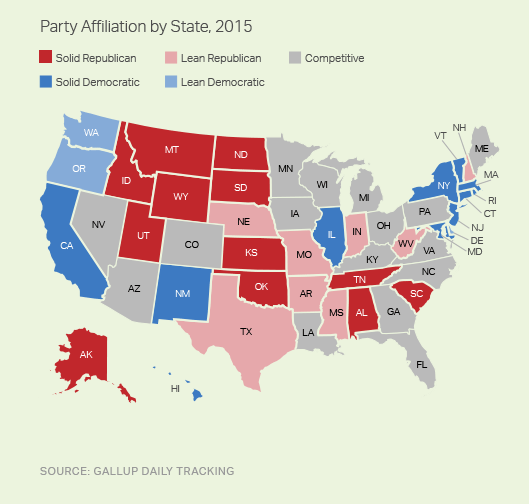
Note: Solid states are those in which one party has at least a 10-percentage-point advantage over the other in party affiliation. Leaning states are those in which one party has more than a five-point but less than a 10-point advantage in party affiliation. Competitive states are those in which the parties are within five points of each other in party affiliation.
Gallup drew results for the analysis from telephone interviews conducted throughout 2015, surveying nearly 178,000 U.S. adults nationwide with an overall margin of error of plus or minus one percentage point.
