

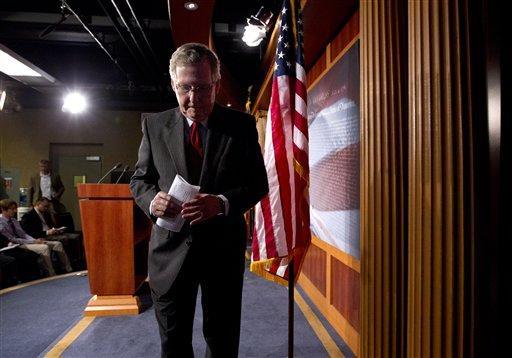
Last year, Washington was consumed by two knock-down, drag-out fights over federal spending levels. A repeat performance, however, is now unlikely, thanks to quiet move last Thursday by Senate Minority Leader Mitch McConnell, R-Ky., who agreed not to fight for a lower spending cap. The move has an understandable political rationale in an election year, but we hope it does not presage further GOP capitulation.
In 2010, Republicans regained control of the House of Representatives and picked up six U.S. Senate seats, in large part by pledging to rein in government spending. Despite promises to cut spending by $100 billion in their first year, the newly-elected Republican House cut a deal last April with President Obama and Senate Democrats to reduce spending by $38 billion (although by some estimates, the true number was closer to $350 million). Then came last summer’s tense showdown over the nation’s debt limit. The deal that eventually emerged set discretionary spending levels for the 2013 fiscal year at $1.047 trillion.
Recommended Stories


Last month, the House voted for a budget resolution authored by Rep. Paul Ryan, R-Wis., that would bring discretionary spending down to $1.028 trillion and make sure that the defense budget does not become the main or only victim. Yet last week, by an overwhelming 27 to 2 vote that was joined by McConnell, the Senate Appropriations Committee broke with House Republicans to endorse the higher spending level.
McConnell’s move was no big surprise. In a February interview with The Washington Examiner, he said it’s unrealistic to think that the Democratic Senate and Obama could be forced into accepting deeper spending cuts. He didn’t want to give the White House the gift of another high-profile showdown with Republicans during an election year, which would only deflect attention from Obama’s weak record.
Fine, but we fear a repeat of what happened the last time Republicans backed down from their promises to scale back government. After Republicans swept to control of the House and Senate in 1994 on a similar vow to reduce the size and scope of government, a standoff with President Clinton forced a government shutdown. Clinton won re-election, and the Washington conventional wisdom blamed the GOP for becoming too extreme. By the late 1990s, the Republican majority had completely lost its taste for spending cuts and smaller government.
At that time, Republicans used Clinton’s presence in the White House as a convenient excuse for their timidity. But when President Bush was elected in 2000, the emptiness of GOP rhetoric was exposed. Spending shot up 46 percent between 2001 and 2007 (when Democrats regained Congress). Republicans augmented the federal role in education through “No Child Left Behind” and in health care through the Medicare prescription drug entitlement.
We understand what McConnell is trying to do by avoiding this fight. But we hope his decision is not a sneak preview of what to expect from Republicans should they regain control of the Senate and win the presidency this November.
