Donald Trump’s tariffs hurt his favorite companies

Published May 30, 2026 5:00am ET


David Ricardo’s theory of comparative advantage is counterintuitive, and a lot of people struggle with it. Most of us can see why free trade works in the interest of competitive countries. How, though, can it be in the interest of less efficient places? Why wouldn’t all the jobs go to the more productive trading partner?

For years, I struggled to convince skeptics of the theory, which relies on a bit of math. Then I stumbled upon a short sketch by the comedian Dave Chappelle. Satirizing President Donald Trump’s obsession with bringing Chinese jobs to the United States, Chappelle asks, “For what, n****r? So iPhones can be $9000? Leave that job in China where it belongs, none of us wanna work that hard!” Warming to his theme, he gives as pithy summary of the case for free trade as you will hear: “I wanna wear Nikes, I don’t wanna make them s***s!”
Sneakers are, indeed, a textbook example of Ricardian comparative advantage in action. Making footwear is badly paid work and, in consequence, Americans no longer do it. The stitching jobs went, first to China, then to Vietnam, and now, increasingly, to Indonesia.

They were, as usually happens, replaced by better-paid jobs in the same sector. American shoe companies employ lots of people in design, accounting, software, marketing, logistics, procurement — pretty much everything, in fact, except the actual piecing together of the leather, rubber, and canvas. On any normal reckoning, the U.S. has traded up, exporting low-value jobs that were largely performed by unskilled immigrants and replacing them with more and better-paid jobs higher up the production chain.

Trump has never accepted this argument, and his tariffs were a tax on companies that had become more productive through globalization. His tariffs did not “reshore jobs.” It is no more practical to stitch sneakers in the U.S. today than it was two years ago. All that happened was that American shoe companies had to pay for the privilege of bringing in the material they needed.

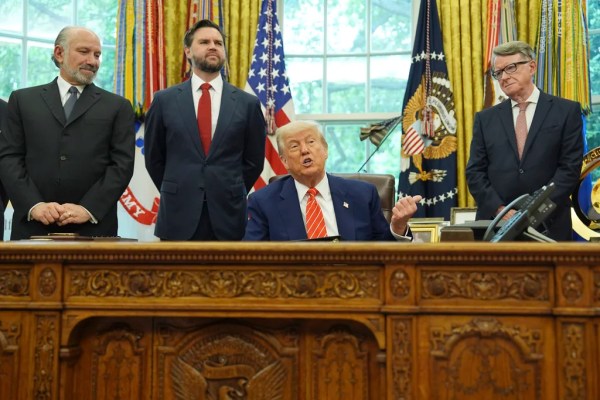
Consider, for it seems an apt example, the unofficial MAGA shoe brand, Florsheim. Trump reportedly gives its shoes to his advisers. Ambitious Republicans, including Vice President JD Vance, Secretary of State Marco Rubio, and most of the Cabinet, make a point of wearing them in his presence.

Last week, the CEO of the company that makes those shoes, Thomas Florsheim Jr, revealed that the tariffs had cost his firm $21 million in direct duties. No company can absorb such a hit — before we even consider the secondary costs of disrupted supply chains — and not lay off staff. Thus, without adding a single job in shoe manufacture, the tariffs destroyed a number of the jobs involved in bringing those elegant leather Oxfords to Trump’s feet and those of his ministers. Trump’s promises turned out to be — for once, the British idiom seems precisely apt — a load of old cobblers.

Now, zoom out and consider every other U.S. company affected, as the makers of Florsheim shoes have been. For the “Liberation Day” tariffs applied as much to inputs and raw materials as to retail goods. There cannot be a single sector that has not suffered. Toward the end of last year, when I met a steel lobbyist in Pennsylvania, I joked that I might finally have come across someone who backed the Liberation Day racket. “You have not,” she replied, without a hint of levity. “Our companies need the imported pig iron.”

Inevitably, the Supreme Court struck the tariffs down, though it was a nearer-run thing than it should have been, and I was disappointed to see the extent to which even Justice Clarence Thomas, formerly a hero of mine, was prepared to defend obvious presidential overreach. “False, fleeting, perjur’d Clarence,” as the poet says. Now, companies like Florsheim are getting their money back.

THE WHITE GEORGE FLOYD

That last point bears repeating. The people getting their money back are American companies. Not a single foreign government is asking for reimbursement. You know why? Because the tariffs were paid by Americans. Sure, some big companies, including Amazon and General Motors, are reported to be weighing up whether to ask for a rebate. No doubt they picked up on the president’s Corleone-style statement that “If they don’t do that, I’ll remember them.”

Yet, incredibly, despite all this, the administration is looking for ways to return to the failed tariff policy that caused all the chaos in the first place. And, even more incredibly, those Republicans who know how much damage tariffs caused are, with only a handful of exceptions, too scared to dissent in public. They would rather inflict needless chaos on American firms than speak their minds. And they wonder why people distrust politicians.