

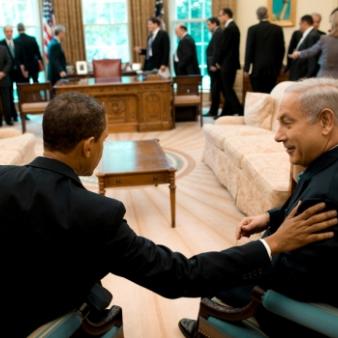
A simmering dispute between the United States and Israel heated up this week as leaders of both countries traded sharp statements. On the surface, and according to most media accounts, the disagreement stems from Israel’s dissatisfaction that the United States has not articulated a red line that it will not allow Iran’s nuclear program to cross. But the Obama administration has articulated a red line. In fact, the U.S.–Israel spat is fundamentally about Israel’s dissatisfaction with where that line is drawn and its lack of confidence that the line can and will be enforced.
This week, Israeli prime minister Benjamin Netanyahu drew attention declaring that those “who refuse to put red lines before Iran don’t have a moral right to place a red light before Israel.” He was responding to Secretary of State Hillary Clinton’s statement from the day before regarding Iran: “We’re not setting deadlines.” Not surprisingly, this dispute has been interpreted as being about American willingness, or lack thereof, to establish a red line – a line beyond which Iran’s nuclear program will not be allowed to advance. But this is both a misreading of Clinton’s comment – deadlines are not red lines – and of Israeli concerns. At the heart of this dispute are actually esoteric questions at the intersection of foreign policy, intelligence gathering, military planning and nuclear engineering: what does Iran need to do in order to acquire nuclear weapons? What specific actions can prevent Iran from acquiring them? When will it be too late to prevent Iran from taking that last step? How much can we know about what Iran is actually doing?
Stay informed.Stay ahead.
Join Washington Examiner for unlimited access to the news, analysis, and commentary that matter most.
Already a member? Log in
