

Taiwan condemned the Russian invasion of Ukraine and declared it would join U.S.-led sanctions against Russia, even as China, which has long desired to conquer Taiwan, sent mixed signals about its Kremlin ally and its own intentions.
Taiwan, an independent and self-governed democratic island off the coast of China, receives U.S. defense support but has not been formally recognized by Washington since the 1970s, and Beijing has long sought to fold Taiwan under its control. The island nation’s condemnation of Russian President Vladimir Putin’s invasion of Ukraine is notable as Chinese leader Xi Jinping has lent tacit support to Russia’s invasion.
Recommended Stories


China has not directly condemned the Kremlin’s assault on its neighbor and has often echoed Putin’s language on Ukraine and his critiques of NATO.
Taiwanese President Tsai Ing-wen said Friday that Taiwan would assist with sanctions against Russia and criticized Putin for his invasion of Ukraine.
“We strongly condemn Russia’s invasion of Ukraine, which violates Ukrainian sovereignty and has eroded peace and stability in the region and around the world,” Tsai said. “Taiwan is also joining international economic sanctions against Russia.”
The Treasury Department levied financial sanctions on Thursday following Putin’s invasion but did not issue sanctions against the massive Russian energy sector. The United States and the European Union announced sanctions against Putin himself Friday.
Taiwan’s leader sought to distinguish the invasion of Ukraine from the tensions between China and Taiwan.
“I want to emphasize that the situation in Ukraine is fundamentally different from the one in the Taiwan Strait,” Tsai said. “The Taiwan Strait provides a natural barrier and Taiwan has its own unique geostrategic importance. Our military is committed to defending our homeland.”
Tsai said Taiwan was also working to “prevent external forces and their collaborators from using the situation in Ukraine to manufacture and spread disinformation in an attempt undermine morale among the Taiwanese people.”
RUSSIAN BANK AT CENTER OF DEBUNKED COLLUSION CLAIMS SANCTIONED AFTER PUTIN INVASION
Xi reportedly spoke with Putin on Friday, with China avoiding a direct condemnation of Russia’s moves.
“The situation in eastern Ukraine has undergone rapid changes, drawing great attention from the international community. China’s position would be based on the right and wrong in relation to the Ukraine issue itself,” Xi told Putin on Friday, according to Chinese state television. “China supports Russia and Ukraine in resolving the issue through negotiation.”
Xi also reportedly told Putin that “China is consistent in the fundamental position on respecting the sovereignty and territorial integrity of all countries.” But the Chinese leader also noted it’s “necessary to abandon the Cold War mentality, attach importance to and respect the legitimate security concerns of all countries, and form a balanced, effective, and sustainable European security mechanism through negotiations.”
Russia vetoed a U.N. Security Council resolution Friday condemning its Ukraine invasion. China abstained.
Taiwan’s Economy Minister Wang Mei-hua indicated the country would “harshly scrutinize” its exports to Russia. Taiwan Semiconductor Manufacturing Company, the world’s most valuable producer of semiconductors, told Reuters it was “fully committed to complying with the new export control rules announced.”
Taiwan’s Ministry of Foreign Affairs said Friday that “Taiwan will continue to coordinate closely with the United States and other like-minded countries to adopt appropriate measures in order to free Ukraine from the horrors of war.”
Chinese Foreign Ministry spokesperson Wang Wenbin said Friday that “we recognize that the Ukraine issue has a complex and special historical context and understand Russia’s legitimate concerns on security issues.”
The CCP spokesman also made it clear China wouldn’t join in sanctions against Russia.
“Sanctions are never effective means to solve any problem … I must also stress that we consistently oppose all illegal unilateral sanctions,” Wenbin said. “China and Russia conduct normal trade cooperation.”
It was reported by the New York Times on Friday that senior Biden administration officials held multiple meetings with Chinese leaders in the lead-up to Russia’s invasion of Ukraine, with the United States showing intelligence demonstrating the increase of Russian troops and asking Beijing to tell the Kremlin to back off on its invasion. The outlet reported Chinese officials pushed back, said China would not block Russia’s efforts, and sided with the Kremlin.
Chinese Foreign Minister Wang Yi echoed Russian arguments at the Munich Security Conference earlier this month, asking, “If NATO keeps expanding eastward, is it conducive to maintaining peace and stability in Europe?”
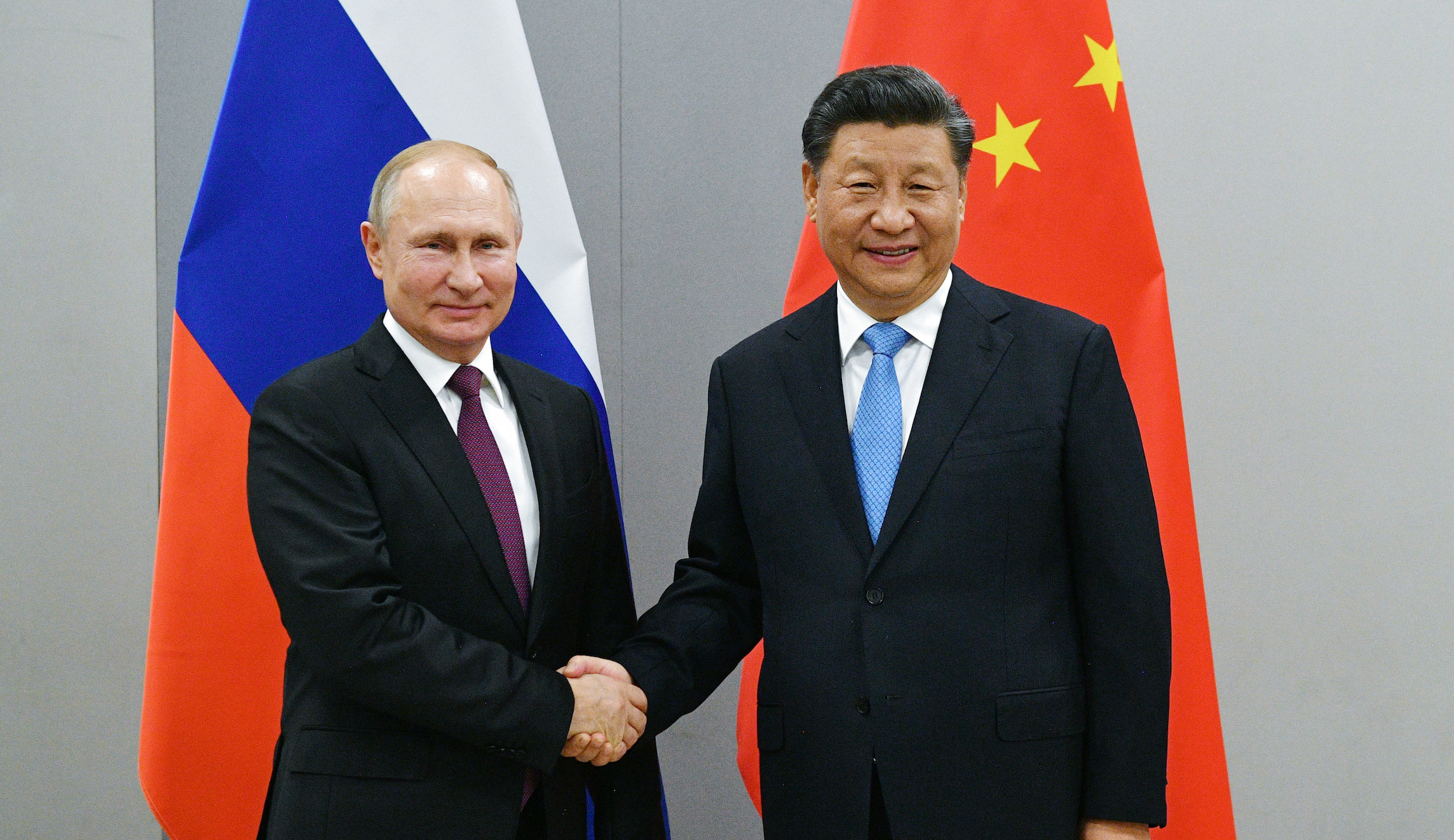
Putin and Xi met in early February in Beijing at the start of the Winter Olympics, and China and Russia issued a more than 5,000-word joint statement, claiming their partnership has “no limits” and that “Russia and China stand against attempts by external forces to undermine security and stability in their common adjacent regions.” The China-Russia statement also said that “the Russian side… opposes any forms of independence of Taiwan.”
The Taiwanese Ministry of Foreign Affairs said it “strongly condemns this false and derogatory statement regarding the sovereignty of the Republic of China (Taiwan)” and emphasized that “the PRC government has never ruled Taiwan.”
Chinese Foreign Ministry spokesperson Hua Chunying blamed the U.S. for tensions between Russia and Ukraine on Wednesday, saying, “Lately the U.S. has been sending weapons to Ukraine, heightening tensions, creating panic and even hyping up the possibility of warfare.”
Putin’s main invasion began that evening.
“It is unwise of certain people of the Taiwan authorities to latch on to and exploit the Ukraine issue to their advantage,” Hua said. “Taiwan for sure is not Ukraine.”
CLICK HERE TO READ MORE FROM THE WASHINGTON EXAMINER
The U.S. policy on Washington’s response if China moved to attack Taiwan is known as “strategic ambiguity.” Biden had seemed to declare a shift in the U.S. defense posture toward Taiwan during an October town hall, saying the U.S. has “a commitment” to come to Taiwan’s defense if China attacked.
The president’s response prompted a rapid clarification by the White House, with one spokesperson telling the Washington Examiner Biden “was not announcing any change in our policy” and that “we will continue to support Taiwan’s self-defense.”
A similar declaration by Biden and clarification by the White House happened in August, shortly after the Taliban took over Kabul in Afghanistan.
