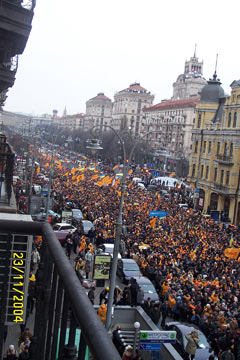
[img caption=”Yushchenko supporters form a march several miles long running through the center of Kiev and down the main thoroughfares of Khreshchatyk and Red Army Street. (11/23/04)” float=”right” width=”240″ height=”360″ render=”<%photoRenderType%>”]8853[/img]Kiev
THE POLITICAL CRISIS in Ukraine has produced crowds that now number over a million people here in the streets of the capital (Kiev’s total population is only 2.6 million) and demonstrations in the thousands by the Ukrainian Diaspora in Canada and Britain. European statesmen such as the former Czech president Vaclav Havel, who once led his own revolution in the street against an authoritarian regime, are calling for the rest of the world to support the democratic opposition. This growing popular movement was sparked by the announcement of the final vote tally from the November 21 presidential run-off election, in which the Ukrainian Central Electoral Commission claimed pro-western opposition leader Viktor Yushchenko had been defeated by Prime Minister Viktor Yanukovich, who is closely allied with Vladimir Putin’s Russian government and is looking now to assume the presidency of this former Soviet Republic.
The demonstrations are all in support of Yushchenko, who has denounced the results as fraudulent. His well-organized followers–who were expecting the Yanukovich government to attempt rampant ballot box-stuffing chicanery–immediately swung into action. The tent city, barricades, and massive stage that they have set up Kiev’s central Independence Square is now one of the largest public revolts against a government in power since Chinese students occupied Beijing’s Tiananmen Square in 1989.