

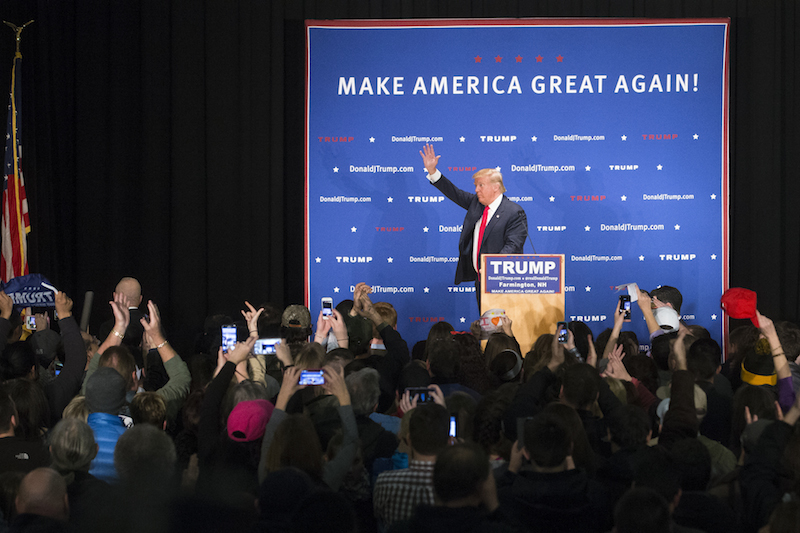
Donald Trump is expanding his lead in New Hampshire against his Republican rivals, and boosted his support by 5 percent over the last two months, according to the latest [email protected]): http:/www.suffolk.edu/documents/SUPRC/1_28_2016_marginals.pdf”>Suffolk University poll released Thursday.
The poll said Trump won 27 percent of likely voters in the Granite State, compared to the 22 percent he got in mid-November. That puts him well ahead of Texas Sen. Ted Cruz and Ohio Gov. John Kasich who each got 12 percent.
Recommended Stories


Cruz and Kasich jumped 3 points over the last two months, and took over the rights to second and third place from Sen. Marco Rubio and Ben Carson.
In the latest poll, former Florida Gov. Jeb Bush won 11 percent, Florida Sen. Marco Rubio won 10 percent and the rest of the candidates are in single digits. And with less than two weeks until the Feb. 9 primary, 12 percent are still undecided.
“More than a quarter of New Hampshire’s GOP voters are loyal to Donald Trump,” David Paleologos, director of the Suffolk University Political Research Center in Boston, said in a statement accompanying the poll’s release. “That 27 percent isn’t a skyscraper, but it towers over the four candidates vying for second place. However, a surprise win from a second-tier candidate in Iowa could create the momentum needed to break into the twenty percent range in New Hampshire. If there are no surprises in Iowa, the undecided voters will be divided, and Trump will prevail.”
Four in 10 of those surveyed said Trump has the best chance to defeat the Democratic nominee.
In a three-way hypothetical general election matchup between Trump, Democratic front-runner Hillary Clinton and possible independent candidate former New York Mayor Michael Bloomberg, 63 percent of Republicans said they would back Trump. Ten percent said they would vote for Clinton, while another 10 percent said the same of Bloomberg — though 14 percent said they were undecided. If Vermont Sen. Bernie Sanders were to be the Democratic nominee instead of Clinton, 57 percent said they would vote for Trump, 18 percent for Sanders and 9 percent for Bloomberg, with 13 percent undecided.
The telephone survey of 500 likely New Hampshire Republican primary voters was conducted Jan. 25-27 and carries margin of error of plus or minus 4.4 percentage points.
